
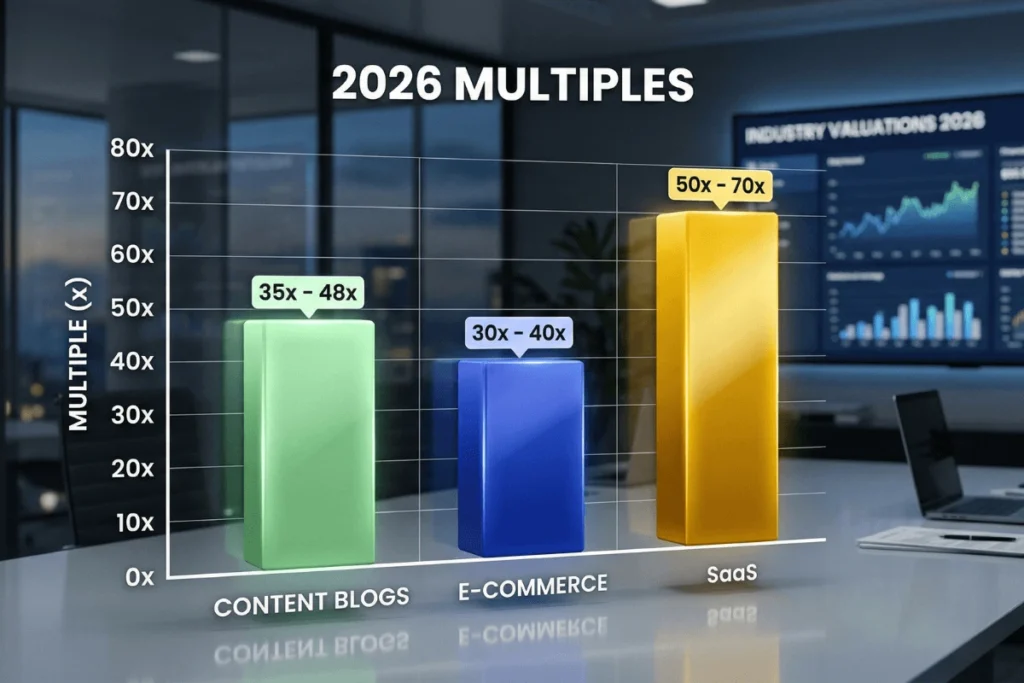
In 2026, a standard content blog typically sells for 35x to 45x its average monthly profit. However, if your site possesses three specific “hidden” value drivers, you can realistically demand a 50x multiple or higher. Understanding how website profit multiples in 2026 work is the difference between leaving $10,000 on the table and exiting with a life-changing payout.
What Exactly is a Website Revenue Multiple?
If you are new to the world of digital asset flipping, the term “multiple” might sound like high-level Wall Street jargon. In reality, it is a very simple mathematical shortcut used to determine a website’s total value.
When evaluating your exit strategy, understanding the standard website profit multiples in 2026 ensures you don’t undervalue your hard work.
A website profit multiple is the number of months of profit a buyer is willing to pay upfront to own your business. In 2026, we have moved past the “wild west” of valuation. Buyers are more sophisticated, looking for stability over raw traffic numbers.
Understanding your website worth is the first step toward a successful exit in the digital marketplace.
The 2026 Valuation Formula:
$$Total Value = (Average Monthly Net Profit \times The Multiple) + Inventory/Assets$$
For example, if your blog earns $1,000 per month in net profit and a buyer offers you a 40x multiple, the sale price is $40,000.
Standard Website Profit Multiples in 2026: A Niche Breakdown
Not all websites are created equal. A SaaS company with recurring subscriptions is naturally worth more than a seasonal affiliate blog because its income is more predictable.
When comparing different asset classes, website profit multiples in 2026 for content-heavy sites remain highly competitive due to their low overhead.
1. Content Blogs & Niche Sites (35x – 48x)
Google’s 2026 algorithm prioritizes E-E-A-T (Experience, Expertise, Authoritativeness, and Trustworthiness). If your blog has survived the AI-content wave, you are now in a “premium” bracket.
- The 2026 Trend: Buyers are paying more for “Zero-Click Search” proof sites—those that get traffic from newsletters and social media, not just Google.
2. Standard SaaS Multiples 2026 (50x – 70x)
In the SaaS world, multiples are often calculated on annual revenue, but for smaller flips, we use monthly profit.
- Key Metric: Churn Rate. If your monthly churn is under 3%, you can easily hit a 70x multiple. Buyers in 2026 see SaaS as the “Gold Standard” of digital assets because of the recurring nature of the income.
3. E-commerce & Shopify Stores (30x – 40x)
How to calculate e-commerce site worth: Unlike blogs, e-commerce valuations must account for Inventory Value. Usually, the formula is $(Profit \times Multiple) + Cost of Inventory$. In 2026, “Agentic Commerce” (AI shopping assistants) has made structured product data more valuable than brand storytelling.
SDE vs. EBITDA: The Million-Dollar Distinction
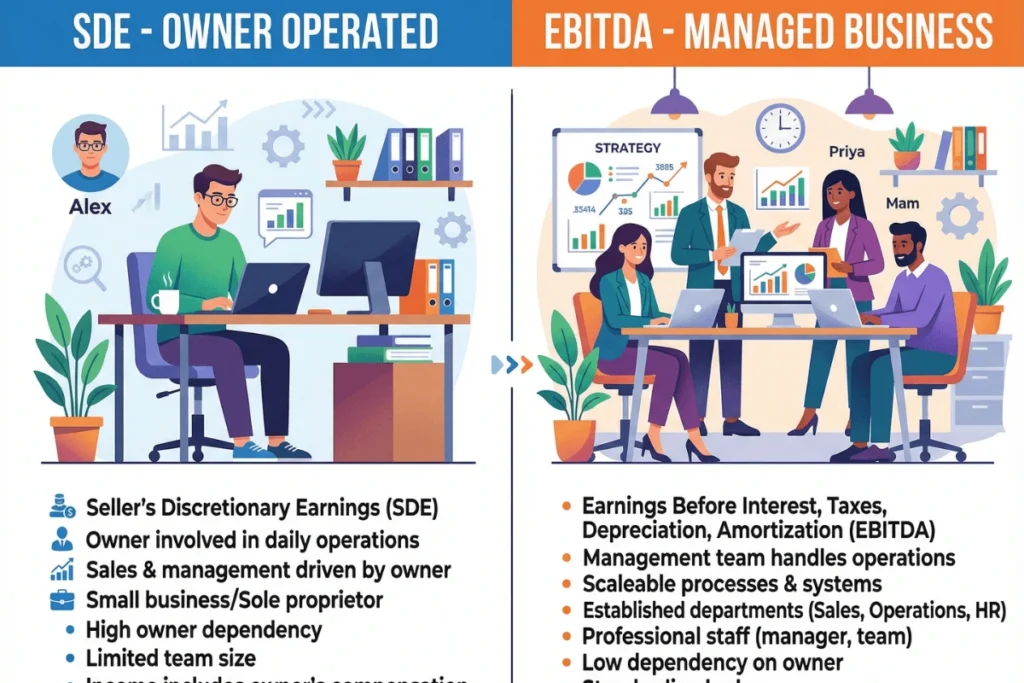
One of the biggest “Seller’s Secrets” is knowing which accounting method to use when calculating website profit multiples in 2026, most small owners prefer the SDE method. Using the wrong one can make your site look less valuable than it actually is.
Understanding these accounting differences is vital because they directly impact how website profit multiples in 2026 are applied during a professional appraisal.
- SDE (Seller’s Discretionary Earnings): Best for small, owner-operated sites (earning under $2M/year). It includes your net profit plus your salary and personal perks. Most 35x-45x multiples apply to SDE.
- EBITDA: Used for larger businesses with a full team. Since the business doesn’t rely on you, institutional buyers (Private Equity) will often pay a higher “annual” multiple (e.g., 5x–8x yearly profit).
The 3 “Sellers Secrets” to Hitting a 50x Multiple

Achieving high website profit multiples in 2026 is no longer just about traffic volume.
To jump from an average 35x to a premium 50x tier, you must prove your site is a Business, not just a Website.
Secret #1: Diversified Traffic (The AI-Proof Shield)
In 2026, Google’s “AI Overviews” can steal up to 60% of informational clicks. Buyers are terrified of “Single Point of Failure” risk. To get a 50x multiple, you need to show:
Investors are willing to pay a premium for website profit multiples in 2026 when a site proves it can generate revenue independently of search engine updates.
- Email List Revenue: 20%+ of your income should come from your subscribers.
- Direct Traffic: People who search for your brand name specifically.
- Social Proof: Strong engagement on platforms like LinkedIn or Pinterest.
Secret #2: Clean Financials & “Add-Backs”
During Due Diligence, buyers will look at your “Profit & Loss” statement for the last 3 years. A “Seller’s Secret” is knowing about Add-Backs. If you bought a $2,000 laptop through the business this year, that is a “one-time expense.” You can “add it back” to your profit to show the buyer the real earning potential of the site.
Secret #3: Standard Operating Procedures (SOPs)
A buyer wants to know: “If I buy this tomorrow, how many hours a week will I work?” If your answer is “40 hours,” your multiple will be 30x.
If your answer is “2 hours, because my team follows these SOPs,” your multiple will be 50x.
Document everything: how you find keywords, how you format images, and how you update plugins.
How to Increase Website Valuation Multiple Before Selling
If you want to maximize your exit, focus on these ‘Value Drivers’ to push your website profit multiples in 2026 toward that elusive 50x mark
If you plan to sell in the next 6-12 months, follow this “Exit Prep” checklist:
- Reduce Concentration Risk: If one affiliate product makes up 80% of your income, find a second one.
- Optimize Page Speed: In 2026, a 1-second delay can drop conversions by 26%. High conversion rates lead to higher multiples.
- Audit Your Backlinks: Use a tool to remove any “toxic” links. Buyers in 2026 use AI-auditing tools to scan your link profile for spam.
- Ownership Verification: Ensure your domain, trademarks, and custom code are owned by your LLC, not you personally.
Common Pitfalls in 2026 Website Appraisals
Failing to account for seasonality is a major mistake that can artificially deflate your website profit multiples in 2026 during a mid-year sale.
- The “Hockey Stick” Trap: Buyers hate seeing a sudden spike in traffic right before a sale. They want to see consistent, sustainable growth.
- Key-Person Risk: If the “voice” of the blog is your personal name and face, it’s harder to sell. Start transitioning the content to a “Brand Voice” at least 6 months before selling.
- Ignoring Legal Compliance: In 2026, GDPR and CCPA (privacy laws) are strictly enforced. If your site isn’t compliant, a buyer will see it as a legal liability and slash your price.
You also like this: How to Check Website Worth for Free: A Complete Guide for 2026

Frequently Asked Questions: Website Valuation & Multiples
Why are website profit multiples in 2026 higher than previous years?
Q1: What exactly is a “multiple” in website flipping? A: A multiple is a numerical value used to determine a business’s worth based on its earnings. In 2026, most small-to-medium websites are valued using a monthly multiple (e.g., 40 times the average monthly net profit).
Q2: Why do SaaS companies have higher multiples than content blogs? A: Predictability. SaaS models rely on recurring subscriptions, which provide a stable financial forecast. Content blogs are more susceptible to search engine algorithm shifts, making them slightly higher risk for investors.
Q3: How many months of data do I need to calculate my valuation? A: Most buyers and brokers look for a 6 to 12-month average. Using a longer window (12 months) is preferred in 2026 as it accounts for seasonal dips and proves the site isn’t just a “short-term trend.”
Q4: Can I really get a 50x multiple for a blog? A: Yes, but it requires “value drivers.” You must show diversified traffic (not just Google), a large email list, and automated systems (SOPs) that allow the buyer to run the business in just a few hours a week.
Q5: What are “Add-Backs” in a financial statement? A: Add-backs are one-time expenses that won’t continue under a new owner—such as a one-time website redesign or a laptop purchase. Adding these back into your profit figures increases the total valuation of the site.
Q6: What is a “good” churn rate for a SaaS business? A: To hit a premium 70x multiple, you generally need a monthly churn rate under 3%. Anything higher suggests the product isn’t retaining users, which devalues the asset.
Q7: How does site speed affect my sale price? A: Directly. In 2026, buyers use “Technical Due Diligence” tools to check Core Web Vitals. A slow site has lower conversion rates and higher risk, which can cause a buyer to negotiate your multiple down by several points.
Q8: What is “Concentration Risk”? A: This is when a site relies on one source for everything—like 90% of traffic from one keyword or 90% of income from one affiliate program. Diversifying these sources is the fastest way to protect your valuation.
Q9: Should I use SDE or EBITDA to value my site? A: If you are a solo owner making under $2M/year, use SDE (Seller’s Discretionary Earnings). If you have a fully managed company with a management team in place, use EBITDA.
Q10: Why are website profit multiples in 2026 higher than 2024? A: Increased institutional buyer interest and better monetization tech have pushed multiples upward.
Conclusion: Your Exit Strategy Starts Today
By building with an exit strategy in mind, you ensure you are always positioned to capture the highest website profit multiples in 2026 when the time comes to sell.
Building a website with a 50x multiple mindset isn’t just about the final sale; it’s about building a better business today. When you focus on clean financials, automated systems, and diversified traffic, you create an asset that is not only worth more but is also easier and more profitable to run.
Whether you are looking to exit next month or in three years, remember: Buyers pay for systems, not just clicks.
Valuing a digital asset can be complex depending on your traffic sources. If you have questions about your specific niche, feel free to contact us for more personalized advice.
Disclaimer: Valuation multiples are subject to market volatility. Please read our full Earnings Disclaimer before making any financial or investment decisions regarding your website.