
How SaaS Companies Get Their First 1000 Users | The Complete 2026 Growth Playbook

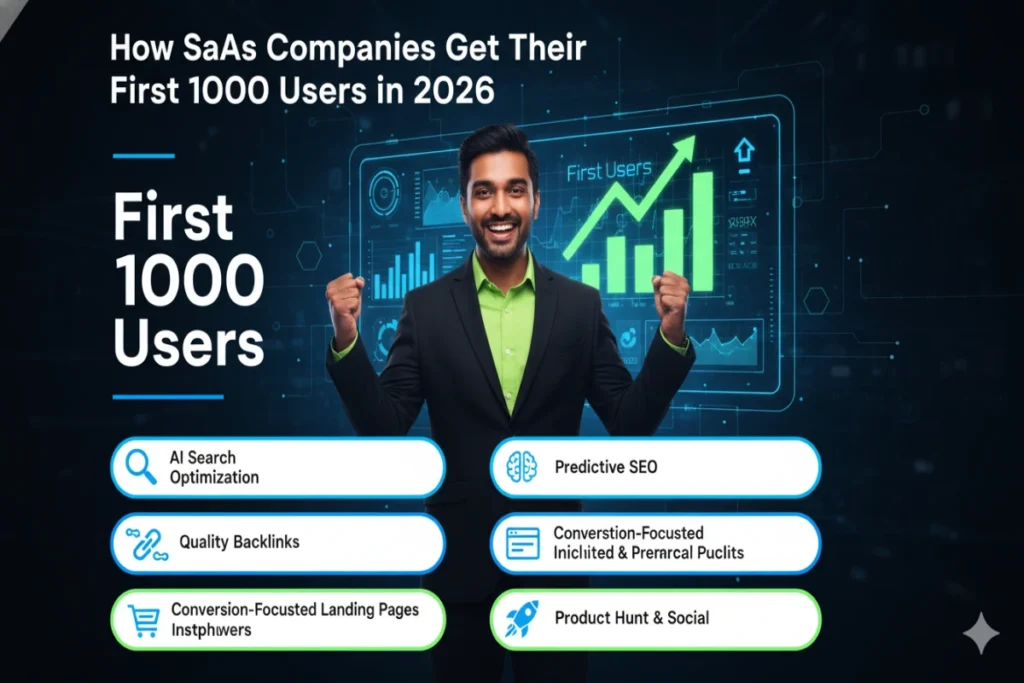
Futuristic SaaS startup growth strategy dashboard showing how SaaS companies get their first 1000 users using AI marketing, SEO, and user acquisition systems.

If you’ve ever launched a SaaS product, you already know the brutal truth: building the product is the easy part. Getting people to actually use it? That’s where most startups quietly die.

How SaaS companies get their first 1000 users is one of the most searched, most debated, and most misunderstood topics in the startup world. And in 2026, the rules have shifted dramatically. The growth hacks that worked in 2019 are dead. The playbooks from 2022 are outdated. The market is noisier, users are smarter, and attention is more fragmented than ever.

But here’s the thing — SaaS startups are still hitting that first 1,000-user milestone every single week. They’re just doing it differently. Smarter. More systematically.

This guide breaks down exactly how they do it.

Why the First 1,000 Users Are a Make-or-Break Milestone

Before diving into strategy, it’s worth understanding why how SaaS companies get their first 1000 users matters so much in the first place.

The first thousand users aren’t just vanity metrics. They represent something far more valuable:

Product-Market Fit Signals — Real users interacting with your product reveal whether you’ve actually solved a meaningful problem. Without this feedback loop, you’re flying blind.

Revenue Foundation — Even at modest conversion rates, 1,000 active users can generate enough revenue to extend your runway, hire a first employee, or fund the next product iteration.

Social Proof and Credibility — When you can say “over 1,000 teams use this,” investor conversations change. Sales cycles shorten. Word-of-mouth kicks in.

Feedback Density — A thousand users generate more bug reports, feature requests, and usage patterns than any amount of internal testing ever could.

Repeatable Acquisition Data — By the time you reach 1,000 users, you’ve started to understand which channels brought them in. That data becomes the blueprint for scaling.

Missing this stage doesn’t just mean slow growth. It means you never gain the insight needed to grow at all.

The Core Problem: Why Most SaaS Startups Stall Before 1,000 Users

Understanding how SaaS companies get their first 1000 users starts with understanding why so many fail to get there.

The most common failure modes are:

Too broad a problem definition. “We’re building a productivity platform for teams” sounds impressive in a pitch deck. It’s useless for early growth. Nobody Googles “productivity platform for teams.” Nobody recommends it to a friend that way. Broad positioning kills early momentum.

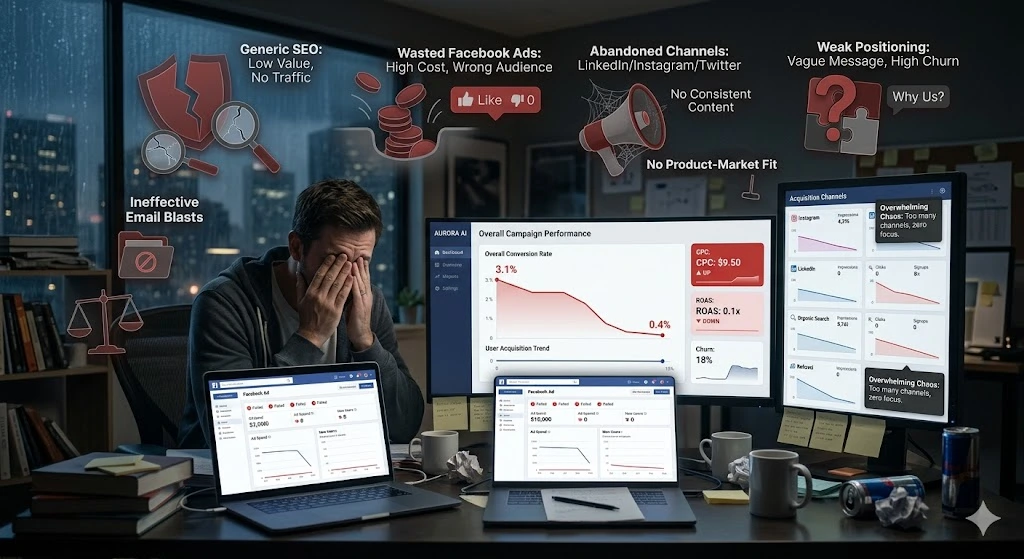
Over-investment in paid acquisition too early. Paid ads can scale something that’s already working. They can’t validate something that isn’t. Founders who pour money into Facebook or Google ads before achieving product-market fit usually burn cash without learning anything useful.

Channel paralysis. Trying to be everywhere at once — Twitter, LinkedIn, SEO, Product Hunt, cold email, communities, partnerships — leads to being genuinely effective nowhere. Early-stage growth requires focus, not diversification.

No content foundation. In 2026, if you don’t exist in search results and AI-generated answers, you effectively don’t exist for a massive portion of your potential audience.

Strategy 1: Ruthlessly Narrow Your Problem

The single most impactful thing a SaaS founder can do early is get specific about the problem they’re solving — not the product they’re building, but the problem they’re addressing.

Compare these two positioning statements:

❌ “We help businesses manage their workflows more efficiently.”

✅ “We help solo consultants track client deliverables and send automated follow-ups without switching between five different tools.”

The second version is immediately actionable for marketing. You know exactly where to find these people (LinkedIn, consultant communities, freelancer forums). You know exactly what words they use when they search for help. You know exactly which pain points to address in your landing page copy.

How SaaS companies get their first 1000 users almost always begins with this kind of precision. The irony is that narrowing your target audience makes it easier to find users, not harder. You’re fishing in a smaller pond, but you know exactly where the fish are.

Strategy 2: Build Content That Captures Intent Before You Build Ads

In 2026, content-led growth has become even more important — and more nuanced. Here’s why.

The modern user discovery journey often looks like this:

  1. A user experiences a problem
  2. They search Google, Perplexity, or ChatGPT for a solution
  3. They encounter an article, comparison, or guide
  4. They click through to a tool
  5. They sign up

If your SaaS isn’t appearing anywhere in steps 2–4, you’re invisible to a massive portion of high-intent users.

How SaaS companies get their first 1000 users through content typically involves building three core content types:

Problem-aware content — Articles like “How to stop losing track of client feedback” that attract users who are experiencing a pain but haven’t yet searched for a solution category.

Solution-aware content — Guides like “Best tools for managing client feedback in 2026” that capture users actively researching options.

Comparison content — Pages like “Tool A vs. Tool B: Which is right for agencies?” that convert high-intent users who are close to a decision.

The key insight here is that this content works continuously after it’s published. A blog post written today can drive signups for years. That’s a fundamentally different ROI profile than paid ads, which stop the moment you stop paying.

Strategy 3: Optimize for Both Traditional SEO and AI Search

Here’s a major shift that separates 2026 growth strategy from what came before: AI-powered search has become a genuine discovery channel.

A significant percentage of users now turn to tools like ChatGPT, Perplexity, and Google’s AI Overviews before or instead of traditional search results. How SaaS companies get their first 1000 users increasingly depends on being visible in both ecosystems.

What does this mean practically?

For traditional SEO: Target long-tail, problem-specific keywords. Prioritize search intent over search volume. Build topical authority in your niche rather than chasing generic high-volume terms.

For AI visibility: Focus on being cited as a credible source. This means earning backlinks from authoritative publications, creating genuinely useful content that AI systems learn to recommend, and ensuring your product appears in tool directories and review platforms that AI tools frequently reference.

The intersection of these two is where how SaaS companies get their first 1000 users in 2026 lives — comprehensive, authoritative content that serves both human readers and AI discovery systems.

Strategy 4: Build Backlinks Early and Strategically

Backlinks remain one of the most powerful ranking signals in 2026, but the approach that works has evolved significantly.

The old playbook — submit to directories, buy links, blast guest posts to irrelevant blogs — not only doesn’t work, it actively hurts your domain authority. Google’s spam detection has become sophisticated enough to identify and discount manipulative link patterns.

The modern approach to link building for early-stage SaaS focuses on:

Niche-relevant guest contributions — Writing genuinely useful articles for publications that your target users actually read. Not for the backlink itself, but for the audience and the credibility signal.

Original data and research — Publishing studies, surveys, or analyses that other publications naturally want to reference. Even a small dataset on a relevant topic can earn dozens of organic links.

Tool listings and directories — Getting listed in curated directories that serve your target market (not generic directories, but niche-specific ones).

Contextual PR mentions — Reaching out to journalists and bloggers who cover your space, particularly when you have a newsworthy angle (product launch, funding, unique data).

For a deeper understanding of how backlink strategy works in modern SEO systems, the team at Moz has published extensive research on what actually moves the needle for domain authority in 2026.

Understanding this early helps how SaaS companies get their first 1000 users through organic channels without wasting months on tactics that no longer work.

Strategy 5: Use Community as a Distribution Channel

One of the most underrated answers to how SaaS companies get their first 1000 users is community-led growth. And it doesn’t require building your own community from scratch.

The strategy is simpler: go where your users already are, and be genuinely useful there.

Reddit remains one of the most powerful organic distribution channels for SaaS tools — provided you approach it correctly. The key word is “approach.” Redditors have finely tuned spam detection and will immediately dismiss any post that reads like a product pitch. But a thoughtful response that solves a real problem, with a casual mention of your tool when relevant, can drive hundreds of signups from a single comment.

Indie Hackers is particularly valuable for B2B and developer-focused SaaS. The audience is sophisticated, startup-curious, and actively looking for tools that solve real problems.

Slack and Discord communities in your niche often have thousands of highly engaged members who are exactly your target audience. Being a recognized, helpful contributor in these spaces before you ever mention your product creates trust that no ad spend can buy.

Product Hunt can generate significant launch day traffic and social proof, though its long-term impact has become more variable. It’s best treated as a launch amplifier rather than an ongoing acquisition channel.

The common thread across all of these: contribution before promotion. Founders who understand how SaaS companies get their first 1000 users through community know that you have to earn the right to promote by first demonstrating genuine value.

Strategy 6: Master One Acquisition Channel Before Expanding

This might be the most counterintuitive piece of advice for early-stage founders: do less.

When you’re trying to hit 1,000 users, the temptation is to try everything simultaneously. SEO, Twitter, LinkedIn, cold outreach, paid ads, Product Hunt, affiliate partnerships — all at once. The result is that you spread your attention so thin that nothing gets the focused effort it needs to work.

The startups that consistently crack how SaaS companies get their first 1000 users pick one primary channel, master it until it’s reliably producing signups, and then layer in a second channel.

Which channel to pick depends on your product and audience:

  • Developer tools often gain traction through technical content, GitHub, Hacker News, and developer communities
  • B2B productivity tools often do well with LinkedIn content, cold outreach, and SEO
  • Consumer-adjacent SaaS often responds well to Twitter/X and community-led approaches
  • Vertical SaaS often benefits from niche publications, trade shows, and direct outreach

There’s no universal answer — but there is a universal principle: go deep before you go wide.


Strategy 7: Build a Landing Page That Converts Without Confusing

Your landing page is doing critical work in how SaaS companies get their first 1000 users — it’s the moment where a curious visitor either becomes a user or bounces forever.

Most early-stage SaaS landing pages fail for one of two reasons: they’re either too vague (all aspirational language, no specifics) or too feature-heavy (a laundry list of capabilities that doesn’t answer the basic question: what does this actually do for me?).

High-converting early-stage landing pages consistently answer four questions:

  1. What does this do? In one plain-language sentence, not a tagline.
  2. Who is it for? The more specific, the better — “solo consultants” converts better than “professionals.”
  3. What problem does it solve? Frame it in terms of the user’s pain, not your features.
  4. Why should I trust this? Social proof, even minimal — “trusted by 200+ freelancers” — meaningfully increases conversions.

The instinct to make landing pages beautiful and elaborate is understandable. The data consistently shows that clarity outperforms aesthetics in early-stage conversion.

Strategy 8: Leverage AI Tools for Speed and Scale

In 2026, AI tools have become a genuine competitive advantage for small teams trying to punch above their weight.

How SaaS companies get their first 1000 users with lean teams increasingly involves AI-assisted operations across:

Content production — Using AI to generate first drafts, research topic clusters, identify content gaps, and accelerate the time from idea to published article.

SEO analysis — AI-powered tools that identify keyword opportunities, analyze competitor content strategies, and surface insights that would take hours to find manually.

Landing page optimization — Tools that generate and test copy variations, improving conversion rates without requiring a dedicated CRO specialist.

Social content — Repurposing long-form content into Twitter threads, LinkedIn posts, and short-form video scripts at scale.

Competitive intelligence — Monitoring competitor content, positioning, and user sentiment across review platforms.

The point isn’t to replace strategic thinking with AI — it’s to eliminate the busywork that consumes founder time, so that strategic effort can be focused on the highest-leverage activities.

Putting It Together: The Early-Stage SaaS Growth System

Understanding how SaaS companies get their first 1000 users is ultimately about systems, not tactics. Individual hacks don’t compound. Systems do.

Here’s what the system looks like when it’s working:

You’ve defined a narrow, specific problem for a clearly identified audience. Your landing page communicates what you do and who it’s for without confusion. You’re consistently publishing content that captures organic search traffic from users who have the problem you solve. You’re active in the communities where your audience spends time, contributing value before promoting anything. You’re building credibility through backlinks and mentions in publications your audience trusts. And you’re tracking which channels are producing signups so you can double down on what works.

This is not a glamorous process. There are no viral moments, no overnight explosions, no growth hacks that change everything. What there is: a repeatable engine that produces users week after week, each user bringing data that helps you build a better product and a more refined acquisition strategy.

The startups that crack how SaaS companies get their first 1000 users are not the ones with the most creative marketing. They’re the ones who build the most consistent systems.

Final Thoughts

How SaaS companies get their first 1000 users in 2026 comes down to a handful of principles that haven’t changed even as the tactics have evolved:

Solve a specific problem for a specific audience. Show up where those people already are. Create content that earns trust over time. Build credibility through genuine quality, not shortcuts. Master one channel before adding another. Make it easy for curious visitors to become committed users.

The tools available to execute these principles have never been better. AI accelerates content production. SEO tools surface opportunities faster. Community platforms make it possible to reach concentrated audiences without a marketing budget. And the information available to founders about what works — guides, case studies, frameworks — is more accessible than ever.

What separates the startups that hit 1,000 users from the ones that stall at 47 is not access to these tools. It’s the discipline to use them systematically, consistently, and with a clear-eyed focus on what actually matters: getting the right users, learning from them, and building something they genuinely can’t imagine working without.

That’s the real answer to how SaaS companies get their first 1000 users. Not a hack. A system.

more posts

Leave a Comment

Your email address will not be published. Required fields are marked *

Scroll to Top