

Most SaaS companies don’t fail because they can’t acquire users—they fail because they can’t keep them. While acquisition gets the initial attention, retention is what actually builds sustainable revenue. In fact, improving retention by just a small percentage can significantly increase long-term profitability, especially as the cost of acquiring new users continues to rise across nearly every niche.
This is where many companies miss a critical opportunity: content is not just for acquisition; it is one of the most powerful SaaS user retention strategies available. By shifting your focus toward content-led engagement, you can use educational, behavioral, and lifecycle content to guide users beyond the initial signup and into deep product adoption.
In this guide, we’ll break down how brands can use content to refine their SaaS user retention strategies, reduce churn, and maximize lifetime value.
Why SaaS Retention Is Harder Than Acquisition
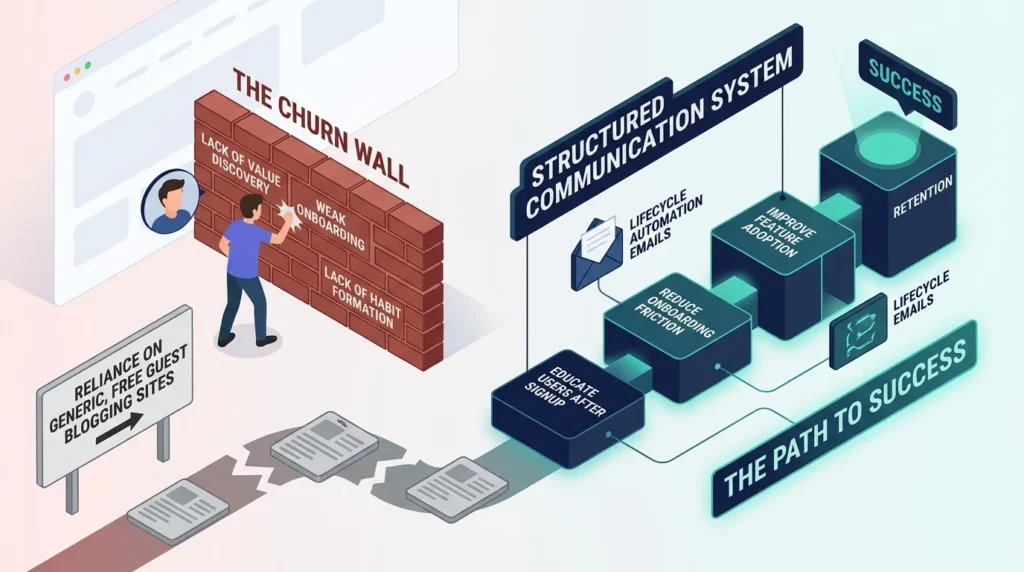
Getting a user to sign up is relatively easy compared to the uphill battle of keeping them active. Most churn occurs because users hit a wall early on. Without a clear path to success, even the most innovative software becomes “shelfware.”
Common reasons for churn include:
Lack of Value Discovery: Users don’t understand the product’s core value quickly enough.
Weak Onboarding: The initial setup is confusing or overwhelming.
Poor Engagement Systems: There is no ongoing education to keep the product top-of-mind.
Lack of Habit Formation: The product hasn’t become a “must-have” part of their daily workflow.
Because of these hurdles, SaaS user retention strategies must be treated as a structured communication system rather than a passive outcome. You cannot simply hope users stay; you must give them a reason to return.
Defining Content-Led Engagement
Content-led engagement is the practice of using high-value information to continuously guide users through their journey inside a product ecosystem. Instead of only publishing blogs for top-of-funnel traffic, successful brands integrate content into their SaaS user retention strategies to build long-term loyalty.
By using content strategically, you can:
Educate Users After Signup: Don’t leave them guessing; show them the “Aha!” moment.
Reduce Onboarding Friction: Use guides to simplify complex setups.
Improve Feature Adoption: Introduce advanced tools through use-case-based content.
Increase Usage Frequency: Remind users of the problems your software solves.
This approach includes everything from in-app tutorials and knowledge base articles to lifecycle automation emails. The goal of these SaaS user retention strategies is simple: help users get value faster and more consistently so they never want to leave.
You May Also Like This:- 175+ Free Guest Blogging Sites for 2026 | The Complete List to Build Real Backlinks
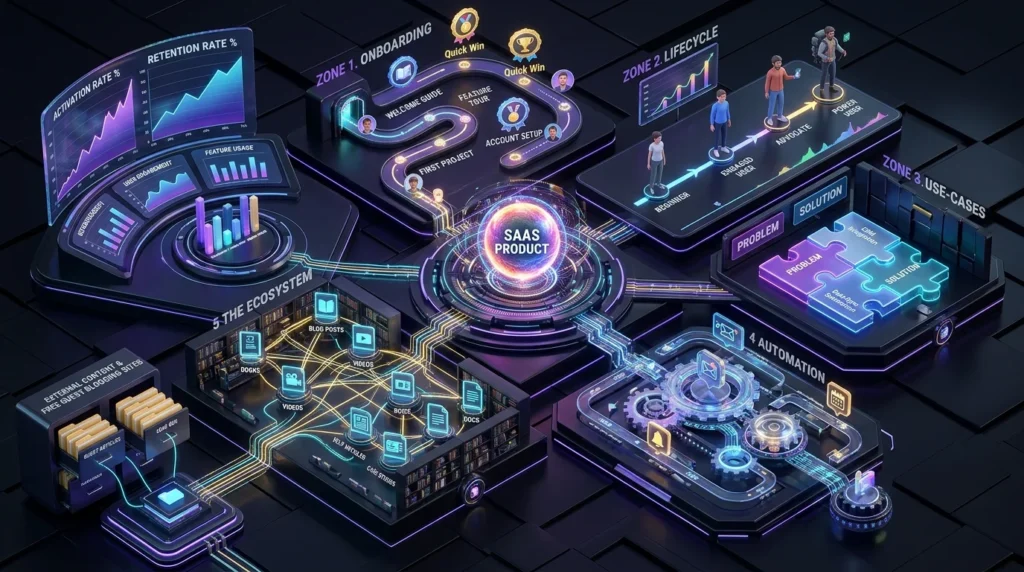
Step 1: Build a Content-Driven Onboarding Experience
The first seven days of a user’s journey are the “make or break” period for any software company. If a new sign-up doesn’t grasp the core utility of your platform almost immediately, they will likely become another churn statistic. To combat this, elite brands prioritize SaaS user retention strategies that turn the onboarding phase into an educational masterclass.
A content-led onboarding system isn’t just about showing where buttons are; it’s about psychology and momentum. By deploying high-value content at the exact moment a user feels stuck, you reinforce the wisdom of their purchase.
Components of a High-Retention Onboarding Flow
To effectively execute SaaS user retention strategies during the initial setup, your content ecosystem should focus on three specific pillars:
Welcome Email Sequences: Move beyond a simple “Confirm your email” message. Your sequence should clearly articulate what the product does, provide the first three action steps, and highlight “quick wins” that users can achieve within their first hour of use.
Deep-Dive Educational Guides: Long-form content is vital here. “Getting started” hubs and detailed feature breakdown articles allow power users to explore the product’s full potential at their own pace.
In-App Content Support: Don’t force users to leave your platform to find answers. Integrating SaaS user retention strategies directly into the UI via tooltips, interactive walkthroughs, and embedded help videos keeps the user focused and reduces cognitive load.
The ultimate objective of this content-heavy approach is to drastically reduce confusion and accelerate the “Time-to-Value” (TTV). When users feel supported by a robust content framework, they are far more likely to transition from “trial users” to “dedicated advocates.”
Step 2: Use Lifecycle Content to Guide User Behavior
Many software companies fall into a common trap: they front-load all their communication during the first week and then go silent. This “set it and forget it” mentality is a recipe for churn. To maintain a healthy bottom line, your SaaS user retention strategies must evolve alongside your customers.
Retention isn’t a one-time event; it’s a continuous relationship. By delivering hyper-relevant lifecycle content based on exactly where a user stands in their journey, you keep the product relevant and indispensable. Whether they are still finding their footing or looking to automate their entire workflow, your content should act as a persistent mentor.
Personalizing the Path to Product Mastery
The most effective SaaS user retention strategies rely on segmenting content to match user maturity. When you deliver the right message at the right time, you transform a simple tool into a vital solution.
Consider these lifecycle content categories:
Beginner Guides: Tailored for new users to reinforce core basics and ensure they don’t get overwhelmed.
Advanced Use Cases: Designed for active users who are ready to expand their usage and see more ROI.
Power User Workflows: Focused on complex integrations and “hacks” that make the software a permanent fixture in their tech stack.
Benefit-Driven Feature Updates: Instead of dry technical logs, explain the “why.”
For example, a weak approach to updates is simply announcing a new tool. High-performing SaaS user retention strategies pivot the narrative. Instead of saying, “We launched a new automation feature,” try: “How to save 5 hours per week using our new one-click automation.”
By shifting the focus from “what the product does” to “what the user achieves,” you ensure that customers continuously discover new value. This layer of persistent education is what separates stagnant apps from market leaders who have mastered SaaS user retention strategies.
Read This Too :- 7 Powerful Reasons to Use an Advanced Meme Generator to Create Viral Memes Online Instantly
Step 3: Educate Users Through Use-Case Content
One of the most potent SaaS user retention strategies involves a fundamental shift in perspective: moving away from what your software is and toward what it does for the user. In the high-stakes world of software, users rarely think in terms of technical features or backend specifications. Instead, they think in terms of pain points, bottlenecks, and daily frustrations.
When you align your content with these real-world problems, you embed your product into the user’s indispensable daily toolkit. By focusing on practical application, your SaaS user retention strategies become more than just marketing—they become a roadmap for professional success.
Bridging the Gap Between Features and Solutions
To keep users from looking at competitors, you must show them exactly how your tool fits into their specific world. Feature-focused messaging often falls flat because it requires the user to do the “mental lifting” of figuring out how to apply a tool. Effective SaaS user retention strategies remove this friction by publishing:
Problem-Solving Guides: Create titles like “How to solve [X specific bottleneck] using our tool” to capture intent and provide immediate relief.
Industry-Specific Workflows: A marketer uses your tool differently than a developer. Tailoring content to specific roles is a hallmark of sophisticated SaaS user retention strategies.
Real-World Implementation Examples: Case studies shouldn’t just be for sales. Showing current users how a similar company achieved a 30% efficiency boost encourages them to replicate those results.
This approach helps users mentally connect your product with their daily work. When they see a direct line between your platform and their productivity, they don’t just use your software—they rely on it. By consistently delivering this high-value, use-case education, you solidify your place in their tech stack and master the most durable of SaaS user retention strategies.
Step 4: Automate Engagement With Content Triggers
In the modern software landscape, the most effective SaaS user retention strategies are those that feel personalized and timely. Static content has its place, but if you want to truly move the needle on churn, your content must respond to how users actually interact with your platform. This is the difference between a generic newsletter and a high-performance behavioral retention engine.
By setting up automated content triggers, you ensure that your helpful resources reach the user at their moment of highest need (or highest risk). Leveraging automation within your SaaS user retention strategies allows you to scale high-touch support without manually monitoring every single account.
Turning Behavior Into Retention Loops
Automation isn’t about being robotic; it’s about being relevant. When content is triggered by specific actions—or lack thereof—it demonstrates that you are paying attention to the user’s success. Integrating these triggers into your broader SaaS user retention strategies creates a safety net that catches slipping users and boosts the power of active ones.
Consider these high-impact automation triggers:
The Reactivation Trigger: If a user hasn’t logged in for three days, don’t just send a “we miss you” email. Instead, send a reactivation guide highlighting a specific, easy-to-achieve task they can complete in minutes.
The Momentum Trigger: Once a user completes their initial onboarding, the window for deeper adoption opens. This is the perfect time to send an advanced tutorial to transition them from a novice to a power user.
The Optimization Trigger: If a user begins using a specific feature frequently, send them a “pro-tips” guide for that exact tool. Providing optimization tips is one of the smartest SaaS user retention strategies to increase perceived product value.
By shifting from a “broadcast” model to a “behavioral” model, you transform your documentation and blogs into a proactive support system. This ensures that your SaaS user retention strategies are always working in the background, guiding every user toward a long-term, successful relationship with your brand.
Read This :- How to Do Keyword Research for Shopify | Complete Beginner’s Guide (2026)
Step 5: Build a Knowledge Ecosystem (Not Just a Blog)
One of the most common mistakes in the software world is treating the company blog as a lonely island, disconnected from the actual product experience. If your articles are just fishing for clicks but don’t help people use your software better, you are missing a massive opportunity. The gold standard for SaaS user retention strategies is the creation of a unified knowledge ecosystem where every piece of information works in harmony to support the user.
High-performing companies understand that a blog is only one small part of the puzzle. To truly move the needle, your SaaS user retention strategies must weave together multiple content formats into a cohesive net that catches users before they fall into the “churn zone.”
Connecting the Dots for User Success
A true knowledge ecosystem isn’t just a collection of links; it’s a strategic web of resources designed to answer questions before they are even asked. When you align your various channels, your SaaS user retention strategies become exponentially more effective.
A robust ecosystem should integrate:
Product-Centric Blog Content: Focus on strategy and industry trends that your tool helps solve.
Interlinked Help Center Articles: Technical documentation that links back to strategic use cases.
Behavioral Email Sequences: Personalized messages that deliver the right guide at the right time.
High-Impact Video Tutorials: Visual demonstrations for users who prefer watching over reading.
Integrated Product Onboarding Flows: In-app guidance that pulls from your existing knowledge base.
All of these elements must be connected around one singular, non-negotiable goal: helping users succeed with the product. When a customer feels like an expert because of the resources you’ve provided, they don’t see your subscription as a cost—they see it as an investment. Ultimately, the most successful SaaS user retention strategies are built on the simple truth that when users achieve their goals using your platform, they don’t churn. They stay, they grow, and they eventually become your biggest advocates.
Step 6: Track Content Impact on Retention
Many SaaS companies fall into the trap of measuring content performance solely through “vanity metrics” like page views or social shares. However, if you want to validate the effectiveness of your SaaS user retention strategies, you must look deeper into the product data. Content is not just a marketing channel; it is a retention asset that should have a measurable impact on user behavior.
To truly understand how your content influences the bottom line, you should track:
Activation Rate: Are users reaching the “Aha!” moment faster after consuming your onboarding guides?
Feature Adoption: Do specific tutorials lead to an uptick in the usage of advanced tools?
Retention Correlation: Is there a statistical difference in the lifespan of users who engage with your knowledge base versus those who don’t?
Campaign-Driven Churn Reduction: Does churn drop following a targeted educational email sequence?
By shifting your analytics focus, you can refine your SaaS user retention strategies based on what actually keeps people paying, rather than just what gets them clicking.
Common Mistakes SaaS Companies Make
Even with the best intentions, many brands fail to see results because their SaaS user retention strategies are fundamentally misaligned. Without a bridge between the product and the prose, content becomes noise rather than value.
Common pitfalls include:
SEO-First, User-Second: Writing content strictly for search engines while ignoring the actual technical hurdles your users face.
The Acquisition Bias: Funneling 90% of the content budget into top-of-funnel blogs while neglecting the “Help” documentation.
Disconnected Silos: Having a content team that doesn’t talk to the product or customer success teams.
Static Strategies: Failing to implement behavioral triggers or automation that deliver content when it’s most needed.
Final Thoughts on Scaling Success
At its core, SaaS retention is not just a product challenge—it’s a communication challenge. Content-led engagement is one of the most scalable SaaS user retention strategies because it allows you to “coach” thousands of users simultaneously.
When SaaS brands shift their mindset from “How do we get more traffic?” to “How do we help users succeed?”, the needle on retention moves naturally. By transforming your product from a tool users try once into a system they depend on daily, you solve the churn puzzle. Implementing these SaaS user retention strategies ensures that your growth is built on a foundation of loyal, successful customers rather than a leaky funnel.
More Posts
How to Scale Revenue Using Content-Driven SaaS User Retention Strategies
Most SaaS companies don’t fail because they can’t acquire users—they...
Read More175+ Free Guest Blogging Sites for 2026 | The Complete List to Build Real Backlinks
Free guest blogging sites remain one of the most powerful...
Read More7 Powerful Reasons to Use an Advanced Meme Generator to Create Viral Memes Online Instantly
Why 99% of Brands Are Leaving Viral Traffic on the...
Read MoreHow to Do Keyword Research for Shopify | Complete Beginner’s Guide (2026)
If you have ever wondered why your Shopify store is...
Read MoreHow Bloggers Can Quickly Get More Blog Traffic with Powerful Long Tail Keywords and Image Optimization
If you’re a blogger struggling to get traffic, you are...
Read MoreTop 8 Free Online Tools to Compress and Resize Images in Seconds
Is Your Website Slow Because of Heavy Images? You’ve poured...
Read More100% Free Video to GIF Converter: Make Perfect GIFs in Minutes
In the fast-paced world of digital communication, sometimes a still...
Read MoreMastering SEO | 12 Expert Tips on How to Do Keyword Research for Free
What You’ll Learn Before we dive into the How To...
Read MoreQR Code Lead Generation | The Complete 2026 Business Guide (Step-by-Step System That Converts Visitors Into Customers)
Why QR Code Lead Generation Is Exploding in 2026 QR...
Read MoreI Built a Tool-Based Website in 30 Days | My 2026 Traffic and Revenue Report (Case Study)
Why I Chose Tool-Based Website Over Blogging Building a tool-based...
Read MoreHow to Quickly Improve Readability Score in 5 Minutes (Step-by-Step Guide for Total Beginners)
Think about the last time you landed on a page...
Read MoreHow to Start a Profitable Niche Blog in 2026: The Ultimate $10k/Month Blueprint
If you have ever wondered how to start a profitable...
Read More