Introduction
Running a digital agency in 2026 without the right SEO tools is like trying to win a Formula 1 race in a station wagon. Your clients expect results. Google’s algorithm evolves faster than ever. And your competitors are already leveraging AI-powered platforms that automate in hours what used to take weeks.
The SEO landscape has fundamentally shifted. Generative AI has reshaped how content is discovered and ranked. Zero-click searches are rising. Search intent is more nuanced than ever. Agencies that rely on gut instinct and a handful of free tools are being left behind — fast.
But here’s the good news: the best SEO tools for agencies in 2026 are more powerful, more intuitive, and more integrated than they’ve ever been. Whether you’re managing 10 clients or 200, the right SEO agency toolkit can help you automate grunt work, surface actionable insights, and deliver the kind of ROI that keeps clients renewing month after month.
This guide breaks down every category of tool you need — with honest assessments, real-world use cases, and a complete workflow to tie it all together.
Why SEO Tools Are Critical for Agencies in 2026
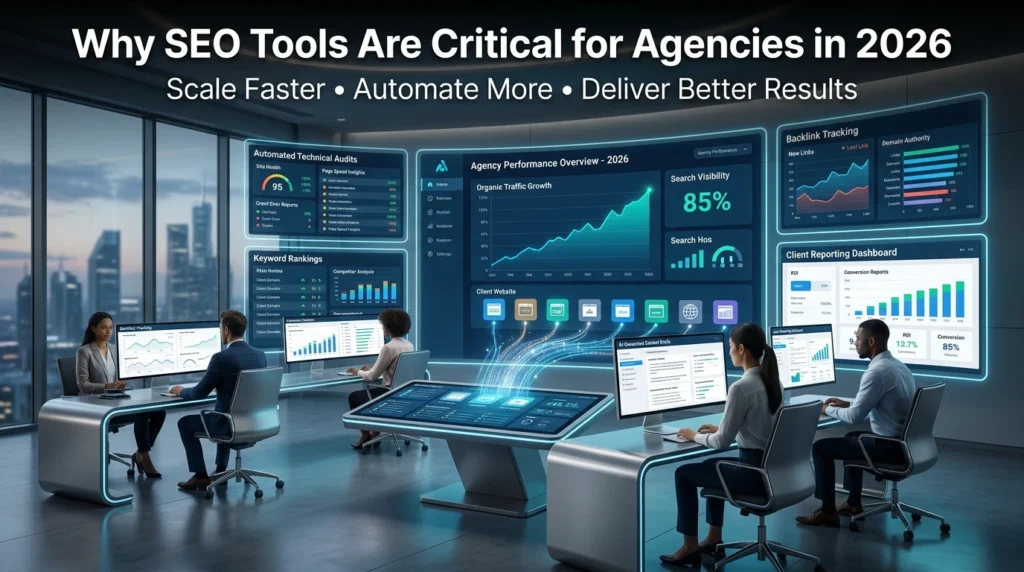
Before we dive into the specific platforms themselves, it is essential to understand why investing in the right software matters more today than ever before.
Scaling client management is no longer a luxury—it is a baseline for survival. Digital marketing firms that fail to efficiently handle 20, 50, or over 100 client campaigns simultaneously will inevitably lose market share to agile competitors. Manual workflows simply cannot scale to meet modern demands. Deploying the best SEO tools for agencies solves this bottleneck by replacing fragmented processes with unified systems.
Automation acts as the ultimate equalizer in a crowded marketplace. A lean, five-person boutique team leveraging the best SEO tools for agencies can easily match or outperform a 50-person enterprise firm that still relies on static spreadsheets. Utilizing features like automated technical audits, hands-free position tracking, and predictive content briefs allows your team to shift their focus from tedious data entry to high-impact strategy.
Furthermore, client reporting has transformed into a major brand differentiator. Modern clients demand more than just standard end-of-month traffic updates; they expect real-time visibility into their organic performance and ROI. Agencies that provide polished, dynamic reporting dashboards retain clients significantly longer and can confidently command premium retainer fees.
The gap in competitive intelligence is also widening rapidly. By utilizing the backlink analysis engines and competitor tracking matrices found in the best SEO tools for agencies, you can uncover hidden keyword gaps and link-building opportunities before your clients’ competitors even realize they exist.
To explore how the industry standards are shifting, you can check out the latest search insights and documentation on Google Search Central. Ultimately, the service providers winning the market are not those with the largest headcount, but those powered by the smartest, most integrated software stacks.
The Best SEO Tools for Agencies in 2026
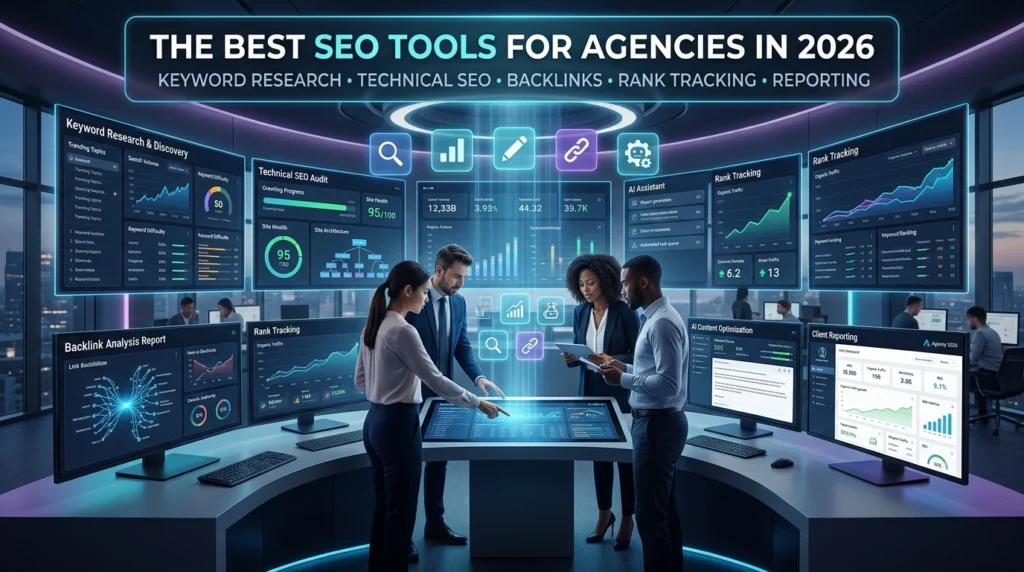
Let’s break down the essential tool categories and the top platforms within each to help you select the best SEO tools for agencies to power your client workflows.
A. Keyword Research Tools for Agencies
Keyword research serves as the foundation of every organic search campaign. In 2026, finding success requires moving beyond simple search volume metrics. Agencies must focus heavily on search intent clustering, topical authority mapping, and uncovering long-tail opportunities before competitors do.
Semrush Keyword Magic Tool
What it does: Semrush’s Keyword Magic Tool provides access to a database containing over 25 billion search terms across more than 140 countries. It offers instant intent filtering (informational, navigational, transactional, and commercial), keyword difficulty (KD) scores, and deep SERP feature analysis.
Why agencies need it: Scaling keyword discovery across diverse client verticals requires a centralized, secure repository. Semrush allows teams to build custom client keyword lists, organize them by semantic topic clusters, and export them directly into content briefs or live rank tracking campaigns.
Real-world use case: A marketing agency managing a boutique e-commerce brand can deploy Semrush to extract over 500 transactional keywords with low difficulty ratings, group them by product category, and align them with a category page optimization blueprint—all in under two hours.
Pros:
Enormous global keyword database with extensive localized coverage.
Advanced search intent filters that streamline content planning.
Flawless data syncing with Semrush’s broader auditing and rank tracking platforms.
Dedicated agency sub-accounts for easier client and team management.
Ahrefs Keywords Explorer
What it does: Widely respected for its data precision, Ahrefs Keywords Explorer provides accurate click metrics, keyword difficulty scores calculated from real linking root domains, and an automated “Also rank for” module that uncovers related search trends.
Why agencies need it: Ahrefs’ click metrics are uniquely valuable for agencies. It reveals not just how many users search for a particular term, but how many actually click an organic listing. In an ecosystem heavily impacted by zero-click SERPs, this distinction is vital for accurate campaign prioritization.
Real-world use case: An account manager handling an enterprise SaaS client can use Ahrefs to pinpoint high-volume keywords where over 70% of searches result in organic website clicks, ensuring budget is allocated to high-yield terms.
Pros:
Industry-leading click-through data and search volume precision.
Detailed organic click-through rate (CTR) predictions.
The “Parent Topic” feature simplifies understanding macro SERP intent.
Connects smoothly with Ahrefs’ content gap and backlink exploration features.
B. Technical SEO Tools
Even world-class copy won’t rank if search engine spiders cannot properly crawl, index, and interpret a website. Technical health is a non-negotiable prerequisite, and digital firms need robust auditing programs that find underlying technical debt at scale.
Screaming Frog SEO Spider
What it does: Screaming Frog is an industry-standard desktop website crawler designed to audit technical SEO infrastructure. It highlights broken internal links, duplicate copy, missing metadata, redirect loops, Core Web Vitals issues, schema markup mistakes, and structural errors.
Why agencies need it: During new client onboarding, a comprehensive Screaming Frog crawl stands out as an essential first deliverable. It maps out a complete technical baseline and highlights immediate site-health wins, handling millions of URLs efficiently.
Real-world use case: Upon inheriting a bloated, 10,000-page e-commerce storefront, an agency runs a full crawl to uncover 847 pages with identical titles, 213 dead links, and severe redirect loops. This immediate diagnostic report outlines the developer roadmap for the first quarter.
Pros:
Cost-effective annual licensing with no hidden per-site lookup limits.
Native API integrations with Google Search Console, Google Analytics, and PageSpeed Insights.
Custom regex extraction capabilities for advanced on-page scraping.
Executes full JavaScript rendering for complex, single-page applications (SPAs).
Google Search Console (GSC)
What it does: Google Search Console is a direct, zero-cost data platform provided by Google. It reveals how a web property performs in search, detailing impressions, clicks, average positioning, indexation health, Core Web Vitals compliance, manual penalties, and crawl errors.
Why agencies need it: GSC is completely mandatory. It remains the only unfiltered window into exactly how Google’s algorithms index a digital property. No premium third-party platform can replace its primary data stream.
Pros:
Completely free, authoritative data directly from the primary source.
The Index Coverage report surfaces indexation roadblocks instantly.
The Performance dashboard details keyword-level impressions and exact user CTR.
Blends naturally with Google Analytics 4 for comprehensive funnel insight.
Sitebulb
What it does: Sitebulb is an architectural website auditing program that visualizes site layouts, internal page rank distribution, and crawl depth. Its intelligent “Hints” protocol automatically organizes site issues by severity and commercial impact.
Why agencies need it: Sitebulb’s visual charts and prioritized fix-lists make it incredibly simple for agency teams to present complex crawl data to non-technical clients. The exportable PDF summaries are polished and boardroom-ready.
Pros:
Highly visual, client-friendly graphs and diagnostic maps.
Smart prioritization algorithms that highlight critical fixes rather than raw error lists.
Historical crawl comparison features to demonstrate technical improvements over time.
Robust JavaScript rendering capabilities.
C. Backlink Analysis Tools
Inbound hyperlinks remain among the most influential organic ranking components. Marketing firms require comprehensive backlink analysis tools to evaluate domain authority, track competitor link velocity, and uncover fresh outreach opportunities.
Ahrefs Site Explorer
What it does: Ahrefs Site Explorer is an industry favorite for incoming link profiling. It maps a comprehensive breakdown of any domain’s link portfolio, tracking referring domains, anchor text distribution, Domain Rating (DR) changes, and live lost/found links.
Why agencies need it: Evaluating a client’s historical backlink equity alongside their primary market rivals is critical for launching an effective link acquisition campaign. The “Link Intersect” feature showcases websites linking to industry rivals but not your client, creating an instant prospect list.
Real-world use case: An agency running a campaign for a B2B logistics firm conducts a Link Intersect study against three top rivals and uncovers 120 high-authority sites linking to all three competitors. These sites become top priority targets for the agency’s guest posting team.
Pros:
The web’s most expansive, hyper-frequently refreshed live backlink database.
Deep historical analysis charts tracking link growth over several years.
Simplifies locating broken link building opportunities on competitor sites.
Extremely powerful competitor link gap analysis capabilities.
Majestic SEO
What it does: Majestic centers its entire architecture around incoming link mapping, offering proprietary trust metrics: Trust Flow (measuring link quality) and Citation Flow (measuring link volume). Its “Topical Trust Flow” outlines the subject matter relevance of an incoming link footprint.
Why agencies need it: Majestic is highly valuable for deep backlink profile audits, toxic link cleanup, and finding niche-specific placement opportunities where contextual alignment outweighs generic domain metrics.
Pros:
Topical Trust Flow offers unique advantages for niche-specific link targeting.
The Historical Index goes back years, serving as an exceptional tool for penalty recovery audits.
The bulk backlink processing engine evaluates massive prospect lists simultaneously.
Invaluable for evaluating link profile quality during disavow list curation.
D. Rank Tracking Tools
Monitoring where your clients rank over time is central to proving campaign return on investment (ROI). Agencies require scalable, automated, and pin-point accurate positional updates.
Semrush Position Tracking
What it does: Semrush Position Tracking tracks daily keyword positions across desktop and mobile devices down to specific zip code and city coordinates. It displays visibility trends, SERP feature wins, and competing share-of-voice charts.
Why agencies need it: Localized search optimization relies heavily on city-level tracking. For multi-location franchises, Semrush lets you configure distinct location profiles under one project, rolling up localized performance into a single report.
Pros:
Highly precise, daily rank updates across hyper-targeted geographic locations.
Tracks specific SERP features like featured snippets, map packs, and PAA boxes.
An easy-to-understand “Visibility Score” that makes client communication simple.
Connects directly with Semrush’s content optimization and technical audit suites.
AccuRanker
What it does: AccuRanker is a premium, dedicated position tracker designed explicitly for agency environments. It features instant keyword rank updates, fully white-labeled report outputs, multi-user sub-accounts, and fast data refresh cycles.
Why agencies need it: For digital firms operating on performance-incentivized agreements, AccuRanker’s on-demand keyword refresh capability is a major asset. Your account managers will never have to present outdated rankings during sudden client reviews.
Real-world use case: Ten minutes before an unplanned client call, an account director refreshes the client’s keyword set inside AccuRanker, entering the meeting with real-time data to build strong account trust.
Pros:
Instant, on-demand rank refreshes that circumvent standard 24-hour waiting periods.
Built around enterprise agency workflows and user management.
Fully automated, brandable client reporting delivery.
Maintains performance without slowdown when tracking tens of thousands of terms.
E. Content Optimization Tools
Producing rank-worthy copy requires strategic, data-driven planning. Modern editing tools tap into semantic artificial intelligence and natural language processing (NLP) to craft assets that naturally address the full scope of a user’s search query.
Surfer SEO
What it does: Surfer SEO dissects the top-ranking web results for any chosen query to build an interactive content blueprint. It outlines recommended word ranges, optimized header counts, required NLP terms, entity inclusion, and a live Optimization Score that adapts as you type.
Why agencies need it: Surfer removes the guesswork from copywriting workflows. Freelancers and in-house writers see exactly which secondary keywords and contextual topics to write about based on real-time ranking requirements. For scaled content production, this tool provides a significant boost to execution speed.
Real-world use case: A high-volume agency producing 40 long-form articles monthly for a financial brand uses Surfer’s content briefs to lower drafting times by 35%. Concurrently, average draft optimization scores rise from 54 to 78, resulting in much faster movement into the top search results.
Pros:
Interactive content editor providing real-time quality grading.
The SERP Analyzer reveals deep correlation patterns across top competitors.
The Content Audit feature identifies existing pages that require updating.
Integrates with content workflows via Google Docs and WordPress extensions.
Clearscope
What it does: Powered by advanced NLP mapping and Google’s core entities, Clearscope evaluates text for topic relevance, contextual depth, and overall readability. It is favored by enterprise-level marketing teams for its straightforward UI and consistent grading criteria.
Why agencies need it: For large digital editorial teams, Clearscope’s grading system helps maintain editorial compliance across dozens of writers. Optimization links can be shared directly with external freelancers without requiring seat licenses.
Pros:
Minimalist, user-friendly workspace that writers adapt to quickly.
An easily understood letter-grade optimization scale (A+ through F).
Great workflow design for managing external content contributors.
Responsive enterprise onboarding and ongoing technical support.
F. SEO Reporting and Analytics Tools
Client retention often hinges on reporting. It is not just about generating great organic traffic; you must communicate those wins clearly. Selecting the best SEO tools for agencies to handle analytics converts complex raw metrics into clear business decisions.
AgencyAnalytics
What it does: AgencyAnalytics is a white-labeled dashboard and reporting platform built specifically for marketing teams. It integrates over 80 independent marketing channels—including Google Analytics, GSC, Ahrefs, Semrush, paid ads, and social networks—into a unified client dashboard.
Why agencies need it: This platform acts as a professional, white-labeled reporting layer. Automated monthly report delivery, customized KPI visualization widgets, and 24/7 client portal log-ins reduce incoming “how is our campaign doing?” client emails significantly.
Real-world use case: An agency managing 60 active retainer accounts uses AgencyAnalytics to fully automate its monthly report distribution. This preserves roughly 15 hours of manual dashboard creation every month—time back for client strategy.
Pros:
True white-label customization utilizing agency branding and custom domains.
Automated reporting cadences via PDF generation or live client access links.
An intuitive drag-and-drop dashboard builder requiring zero developer setup.
Predictable campaign-based pricing models that remain cost-effective at scale.
Google Looker Studio
What it does: Formerly known as Data Studio, Looker Studio is a free data visualization suite from Google that links natively with all core Google assets and hundreds of third-party platforms via external connectors.
Why agencies need it: For digital marketing teams looking to build highly tailored reports without added recurring monthly software costs, Looker Studio is an excellent choice. It offers immense layout flexibility, though it requires more manual preparation than turn-key alternatives.
Pros:
Completely free to use.
Flawless native data syncing with Google Analytics, Search Console, and Google Sheets.
Infinite structural and visual customization options for complex data architectures.
Easily distributed via live web links or embedded directly within client portals.
G. All-in-One SEO Suites
For marketing companies looking to consolidate their software subscriptions, all-in-one SEO platforms provide excellent operational coverage across keyword research, backlink monitoring, tracking, and auditing from a single login.
Semrush
What it does: Semrush stands out as one of the most comprehensive all-in-one software choices available today. It includes keyword discovery, on-page technical health tracking, positional monitoring, incoming link analytics, content optimization, competitive landscape studies, and PPC monitoring.
Why agencies need it: For marketing providers looking for a primary tool to anchor their day-to-day operations, Semrush offers a complete ecosystem. It features tailored agency growth portals, white-labeled client pitches, and vast feature depth, making it a reliable standard for full-service teams.
Pros:
Immense tool variety that easily replaces several single-focus platform subscriptions.
Agency-focused feature add-ons, including custom client management pipelines.
Comprehensive learning resources, certifications, and technical support documentation.
Frequent feature updates, deep competitive analysis modules, and built-in AI tools.
Ahrefs
What it does: Ahrefs has grown from a specialized backlink analyzer into an extensive all-in-one suite. It handles keyword tracking, deep site crawling, position monitoring, content gap discovery, and web-wide index extraction. Its core metrics consistently set industry standards for accuracy.
Why agencies need it: Agencies focused on data accuracy often rely on Ahrefs as their core platform. While Semrush offers incredible feature variety, Ahrefs excels in backlink index size and data precision, giving teams an advantage during competitive link audits and intelligence work.
Pros:
Industry-standard data accuracy across live backlink indices and keyword metrics.
Clean, user-friendly interface design with an intuitive learning curve for new hires.
Continuous deployment of new capabilities, including web explorer tools and content evaluations.
Exceptional performance for reverse-engineering competitor traffic strategies.
To learn more about the technical foundations supporting modern indexation and optimization standards, explore the official guidelines on Google Search Central. Ultimately, the marketing firms winning the market are not those with the largest employee headcount, but those powered by the best SEO tools for agencies integrated into a scalable workflow.
How SEO Agencies Use These Tools Together: A Real Workflow
Understanding individual platforms is only the first step. Knowing how to weave them into a seamless, high-performance agency workflow is what truly drives scalable client success. Below is a breakdown of how an elite digital marketing firm orchestrates a full client engagement by deploying the best SEO tools for agencies at each critical stage of a campaign.
Phase 1: Research & Discovery (Weeks 1–2)
The onboarding stage sets the trajectory for the entire campaign. Agencies utilize a combination of data engines to uncover quick wins and long-term strategic opportunities.
Action Steps: Teams deploy the Semrush Keyword Magic Tool alongside Ahrefs Keywords Explorer to execute comprehensive keyword discovery. They map these search queries into distinct semantic intent clusters rather than broad, unorganized lists.
Competitor Analysis: Simultaneously, account managers run the client’s URL through Ahrefs Site Explorer to map their existing backlink profile while running a content gap analysis against their top three market rivals.
The Goal: By utilizing these as the best SEO tools for agencies for initial discovery, the team builds a data-validated roadmap rooted in actual search traffic potential.
Phase 2: Technical Auditing & Architecture Mapping (Weeks 2–3)
Before publishing content or building links, the technical foundation must be flawless. Spiders must be able to crawl and index the site without hitting structural roadblocks.
Action Steps: Technical specialists launch a deep Screaming Frog crawl to audit underlying code. They plug in native API connections to Google Search Console to extract real-world crawl errors and historical Core Web Vitals trends.
Visualization: The raw crawl data is then imported into Sitebulb to generate highly visual site architecture maps and internal page rank distribution charts.
The Goal: The agency synthesizes these inputs into a prioritized technical fix-list, ranking tasks by development effort versus organic impact.
Phase 3: Strategic On-Page Optimization (Weeks 3–6)
With a clean technical foundation and an organized keyword blueprint, the campaign transitions to content execution. This involves refreshing decaying historical assets and producing highly optimized new ones.
Action Steps: Copywriters use Surfer SEO or Clearscope to overhaul high-potential existing URLs, matching structural layouts to current SERP standards. For fresh assets, content managers generate detailed Surfer briefs that dictate structural headings, word counts, and required semantic entities.
Validation: To ensure search engine spiders process these updates properly, developers validate newly implemented structured data utilizing specialized schema validation tools like Schema.org.
The Goal: Integrating these platforms as the best SEO tools for agencies for content production removes the guesswork from writing, ensuring every published paragraph actively moves the needle toward higher rankings.
Phase 4: Intentional Link Building (Ongoing)
Inbound link velocity and domain authority remain vital ranking components. Agencies must secure high-quality placements safely and at scale.
Action Steps: Link-building teams leverage the Ahrefs Link Intersect tool to build highly targeted outreach lists consisting of websites that already link to multiple industry competitors but not yet to the client.
Quality Control: Before sending pitches, the team qualifies each prospect using Majestic’s Topical Trust Flow to confirm the linking site holds real contextual relevance within the client’s specific business niche.
The Goal: Outreaching only to vetted, high-authority targets maximizes campaign conversion rates while protecting the client’s long-term domain safety.
Phase 5: Continuous Rank Tracking (Ongoing)
Tracking everyday movement across search layouts provides the primary feedback loop regarding whether campaign tactics are succeeding.
Action Steps: The agency configures target keyword sets inside AccuRanker or Semrush Position Tracking to monitor positional shifts across desktop and mobile layouts.
Proactive Management: Analysts set up automated weekly triggers to alert account managers immediately to any sudden algorithmic movements or significant keyword drops.
The Goal: Utilizing these systems as the best SEO tools for agencies for rank tracking ensures the team can defend existing rankings proactively rather than reacting weeks after a drop occurs.
Phase 6: Automated Performance Reporting (Monthly)
Client retention relies heavily on communication. Agencies must translate abstract search metrics into clear business growth indicators.
Action Steps: Analysts funnel all disparate performance metrics from Google Search Console, rank trackers, and web analytics directly into a central AgencyAnalytics dashboard.
Delivery: The platform automatically distributes white-labeled PDF performance summaries or live dashboard links to points of contact on a set monthly schedule.
The Goal: Combining Year-over-Year (YoY) and Month-over-Month (MoM) trend analytics alongside organic conversion growth turns complex data sets into highly visual proof of ROI.
Scaling Through Strategic Software Integration
This end-to-end framework—research, audit, optimize, build, track, and report—creates a highly repeatable, predictable operational engine. When you intentionally connect the best SEO tools for agencies, a lean boutique marketing team can easily execute multi-layered corporate campaigns that traditionally required massive agency headcounts.
AI in SEO Tools: The 2026 Trend You Can't Ignore
Artificial intelligence has officially transitioned from a speculative tech buzzword into a foundational requirement for search success. Today, survival in digital marketing relies heavily on workflow automation. To stay ahead of shifting search behaviors, deploying the best SEO tools for agencies to handle machine learning and semantic data processing is essential.
Here is exactly where sophisticated AI features are redefining modern organic search strategies.
1. Automated Semantic Keyword Clustering
Traditional target-term discovery used to involve manually sorting vast spreadsheets for hours. Modern, AI-driven keyword clustering features—found in dedicated platforms like Keyword Insights and Semrush—can analyze a disorganized list of 10,000 search terms and catalog them into highly accurate topical silos in seconds.
By analyzing user search intent automatically, these engines ensure your production team builds comprehensive content hubs that project clear topical authority to modern search algorithms.
2. Scaled Content Research and Structural Draft Generation
Leveraging generative intelligence within tools like Semrush ContentShake, Surfer AI, and Frase allows marketing teams to accelerate their early-stage copywriting workflows.
These platforms are not designed to replace skilled human copywriters; instead, they serve as advanced operational starting points. By auto-generating optimized article structures and uncovering entity gaps, they reduce production turnaround times by 40% to 60% on foundational content layouts. Utilizing these systems as part of the best SEO tools for agencies enables teams to publish high-utility, semantic copy faster.
3. Predictive Rank Potential Scoring
Chasing keywords purely based on broad search volume metrics is an outdated approach. Leading predictive analytics tools analyze your client’s existing backlink profiles and current domain authority to calculate a custom difficulty metric. This score estimates the direct mathematical probability of a domain ranking for a specific term inside its live competitive landscape.
Integrating this foresight into your tech stack allows account managers to avoid high-competition dead ends and prioritize campaigns that secure fast commercial wins.
4. Anomaly Detection and Technical Monitoring
Proactive site maintenance is key to maintaining accounts. Enterprise platforms like Semrush and Ahrefs now run automated background crawls powered by intelligent anomaly detection.
These machine-learning scripts constantly evaluate performance baselines, alerting account directors to sudden indexation drops, unexpected crawl loops, or sudden traffic shifts long before a client ever opens their tracking app.
5. Automated Internal Link Optimization
Internal link distribution remains an influential element for sharing authority across a domain. AI-powered optimization programs like Link Whisper evaluate web text using natural language processing (NLP) to map contextually sound cross-linking opportunities across thousands of URLs simultaneously.
Streamlining this internal linking architecture ensures search engine crawlers easily discover, index, and contextualize your primary content assets.
Driving Productivity, Not Replacement
The service providers winning the organic search landscape are not looking to replace their specialists with automated bots. Instead, they realize the best SEO tools for agencies are those that maximize human output.
[Manual Workflows] ──(Traditional Agency)──► Days of Data Sorting & Sheet Mapping
[AI-Powered Stack] ──(Modern 2026 Agency)──► Instant Insight Extraction + Strategic Focus
By offloading routine data organization to secure AI systems, your core team can focus on what software cannot replicate: long-term brand strategy, creative storytelling, and building authentic partner relationships.
To explore the formal developer documentation on how algorithmic systems currently process structured data and contextual signals, you can read the latest frameworks directly on Google Search Central.
Choosing the Right SEO Tools for Your Agency
With an overwhelming number of platforms available in the digital marketing ecosystem, selecting the perfect software for your team can feel daunting. To build a high-performance stack, you must evaluate how different platforms align with your operational needs.
When searching for the best SEO tools for agencies, consider these four critical operational pillars:
1. Financial Allocation and Scalability
Your budget dictates your starting point, but it shouldn’t limit your capabilities.
Boutique Teams: For newer or smaller marketing firms, using a comprehensive suite like Semrush or Ahrefs as an operational anchor—paired with free data from Google Search Console (GSC) and custom Google Looker Studio setups—creates a lean yet formidable foundation.
Mid-Sized Firms: Growing businesses looking for the best SEO tools for agencies should layer in specialized infrastructure, such as AccuRanker for hyper-accurate position monitoring and AgencyAnalytics to streamline client-facing data.
Enterprise Operations: Large-scale organizations naturally require premium, specialized software accounts to handle heavy, multi-department workflows.
2. Client Profile and Portfolio Diversity
The structural needs of your clients should directly shape your software selections. For example, e-commerce brands require heavy technical crawling systems and massive keyword tracking capabilities to monitor fluctuating product catalogs.
Conversely, local service businesses require precise city-level rank tracking and Google Business Profile monitoring. For content-driven websites, prioritizing advanced semantic optimization platforms ensures maximum content velocity. Always align your software capabilities with your primary client mix.
3. Team Size and Technical Specialization
A three-person marketing squad needs intuitive dashboards with minimal administrative friction; in this scenario, an all-in-one platform is incredibly efficient.
On the flip side, a 20-person agency can easily divide and conquer with single-purpose software solutions. Dedicated technical auditors can live inside deep site-crawlers, while your outreach team works exclusively within advanced backlink indexers.
4. Cross-Platform Ecosystem Integration
The best SEO tools for agencies never operate in isolation; they communicate seamlessly to prevent data fragmentation. Prioritize software options that feature native integrations with your existing workflows. Look for configurations where your core SEO suite syncs directly with your reporting dashboards, your content optimization software connects to Google Docs or WordPress, and your site crawlers pull live data via API keys from GSC.
[All-In-One Anchor Suite]
       │
       ├──► (API Sync) ──► [Specialized Reporting Dashboard]
       └──► (API Sync) ──► [On-Page Content Editors]
Ultimately, there is no universal software blueprint. The goal is to design a balanced stack that optimizes your specific workflows, fits your current client roster, and scales with your business objectives.
Conclusion: Driving Growth with Purpose-Built Stacks
The marketing organizations dominating the organic search landscape in 2026 are not those with the longest list of software subscriptions. Success belongs to teams utilizing the best SEO tools for agencies within a highly organized, strategic workflow.
Every element of your software stack serves a distinct purpose in your retention engine:
Keyword Intelligence: Uncovers highly profitable search intent.
Technical Auditing: Keeps your client’s site architecture flawless.
Link Analytics: Reveals backlink opportunities rivals have completely missed.
Rank Monitoring: Keeps your campaign results transparent and accountable.
Content Optimization: Ensures every published URL earns its place on search engine result pages (SERPs).
Automated Reporting: Transforms raw data into clear, visual proof of ROI.
Build your toolkit intentionally. Begin with a powerful all-in-one anchor platform, integrate specialized tools where you require deep data, automate your client communication dashboards, and let machine learning handle repetitive tasks like keyword clustering and technical anomaly detection. By investing in the right infrastructure today, you ensure your business remains ahead of the curve for years to come.
To dive deeper into standard industry protocols for search performance and technical indexing, check out the official developer documentation on Google Search Central.
Frequently Asked Questions (FAQ)
Q1: What are the best SEO tools for agencies to use right now?
The best SEO tools for agencies depend on your internal workflows, but the industry standards center on Semrush and Ahrefs for comprehensive, all-in-one search data. For specific tasks, agencies widely trust Screaming Frog for technical site health audits, AccuRanker for real-time positional tracking, Surfer SEO for automated content briefs, and AgencyAnalytics for unified client reporting.
Q2: What core software features should every agency have as a baseline?
At an absolute minimum, an organic search agency requires a tool stack that covers four operational areas: a free connection to Google Search Console for direct indexing data, a reliable keyword research and site auditing platform (like Semrush or Ahrefs), a scalable rank tracker, and a polished reporting solution to communicate campaign value to clients.
Q3: Is Semrush or Ahrefs more effective for multi-client agency workflows?
Both platforms are phenomenal, and many growing agencies maintain subscriptions to both. Semrush offers immense feature breadth—including competitive PPC data, social media management tools, and content generation widgets—making it a favorite for full-service marketing companies. Ahrefs is highly revered for its backlink index precision and link intersect features, making it the preferred choice for teams focused heavily on link acquisition and competitive intelligence.
Q4: How much budget should a growing agency allocate toward search marketing software?
Software expenditures scale alongside your active client volume. A boutique agency managing 10 to 20 clients typically spends between $300 and $600 monthly on core software. Mid-sized agencies managing over 50 clients should budget between $1,000 and $2,500 per month for a highly advanced toolkit that includes high-frequency rank tracking, content optimization software, and white-labeled dashboards.
Q5: Are AI-driven features in modern search platforms worth the investment?
Yes. AI-powered features have evolved into indispensable productivity multipliers. Automated semantic keyword clustering, predictive ranking difficulty scores, and machine-learning anomaly alerts save specialists hours of manual data manipulation. Utilizing these features within the best SEO tools for agencies allows your team to spend less time formatting spreadsheets and more time engineering high-level client strategies.
Q6: What is the most effective automated reporting platform for client retention?
AgencyAnalytics stands out as an exceptional dedicated reporting tool due to its clean white-label options, 80-plus native marketing integrations, and automated scheduling. For agencies seeking maximum visual customization without recurring monthly software fees, Google Looker Studio provides a powerful, free alternative, though it demands a steeper technical setup curve.
Q7: How do enterprise agencies manage software access across dozens of accounts?
Enterprise-tier software accounts feature advanced agency management modules, custom sub-account access levels, and dedicated client tracking portals. The secret to scaling operations is to standardize your core stack early. By building templated onboarding checklists, uniform audit criteria, and standardized reporting dashboards, your team can seamlessly manage new client campaigns without operational friction.
more posts