


Pay Per Call Marketing Exposed | 5 Powerful Steps to Effortlessly Generate High-Ticket Leads

Pay Per Call Marketing Explained beginner guide showing phone call lead generation, call tracking, and high-ticket customer acquisition strategies.

You’ve probably heard that display ads are dying. And honestly? The numbers back it up. The average click-through rate on display ads hovers around 0.1% — yet a single phone call to a personal injury law firm can be worth $300–$500 in commission. That’s the power of Pay Per Call Marketing.

In this guide, you’ll learn exactly what pay per call marketing is, how it works, which niches pay the most, and how to start generating high-ticket leads in 2026 — even if you’re starting from scratch.

What Is Pay Per Call Marketing?

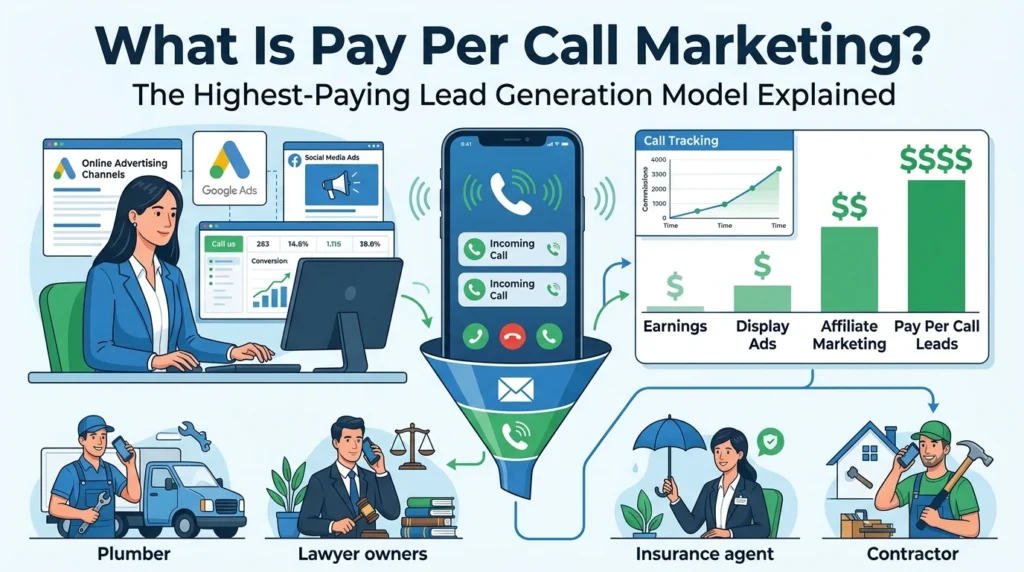
What is pay per call marketing illustration showing inbound phone leads, call tracking, lead generation funnel, and high-ticket customer acquisition compared with display ads and affiliate marketing.

Understanding how to generate premium leads is the cornerstone of any successful digital strategy. Among the most lucrative performance-based frameworks available today is pay per call marketing. This advertising model allows publishers and media buyers to earn substantial commissions by routing qualified inbound phone calls directly to businesses looking for new customers.

Unlike traditional display advertising—where you might only earn a few cents for every thousand impressions—this method shifts the focus to high-value, human-to-human interactions. When a prospect picks up the phone to contact a service provider, such as an emergency plumber, a defense attorney, or a localized insurance agent, they aren’t just browsing; they are looking to buy. Because these live conversations represent highly motivated prospects, businesses are more than willing to pay top dollar for them.

To see how pay per call marketing stacks up against other digital monetization strategies, consider the clear differences in value and intent below:

Monetization MethodAvg. Payout Per ActionBuyer Intent
Display Ads (CPM)$0.50–$5.00 per 1,000 viewsVery Low
Affiliate Link Clicks$1.00–$50.00 per conversionMedium
Pay Per Call Leads$20.00–$500.00+ per callVery High

How Pay Per Call Marketing Works

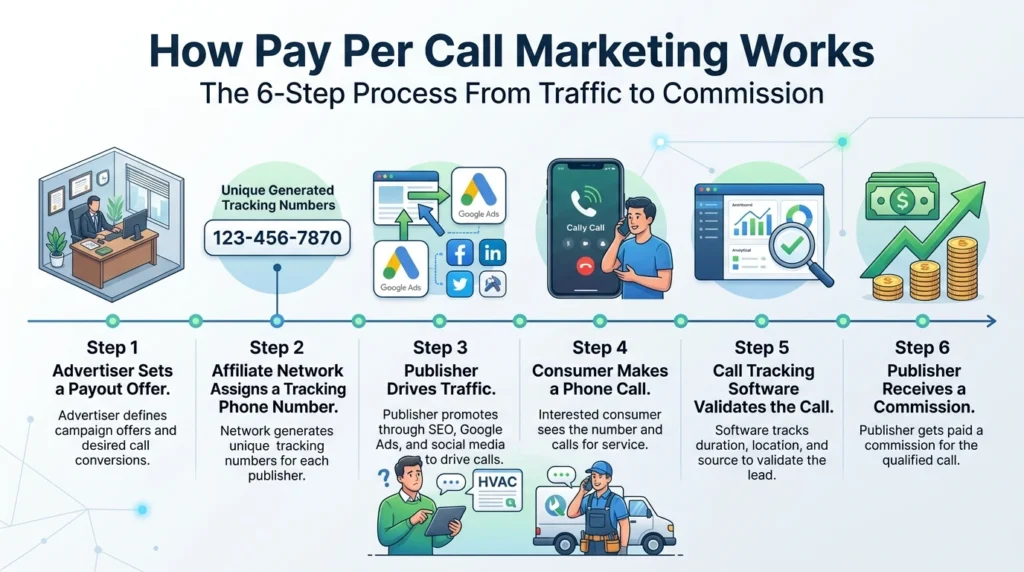
While it might sound complex initially, the operational mechanics of pay per call marketing are remarkably straightforward. The entire ecosystem functions seamlessly through a structured six-step lifecycle:

1. The Advertiser Defines the Offer

A business determines its acquisition goals and establishes a specific payout structure. For example, a national roofing brand might agree to pay $75 for every unique, qualified call that lasts at least 90 seconds.

2. The Network Allocates Campaign Routing Numbers

Affiliate networks or tracking platforms assign a unique, trackable phone number to your specific publisher account. This ensures every single inbound call routed through your promotions is instantly captured, recorded, and credited to your efforts.

3. The Publisher Drives High-Intent Traffic

As the marketer, you deploy targeted marketing campaigns. This can include optimizing SEO landing pages, running localized Google Ads, or creating social media content that prompts users to call. For instance, a homeowner dealing with a burst pipe at midnight searching for an “emergency plumber near me” is highly incentivized to hit the call button immediately.

4. The Consumer Connects

The prospective customer dials your unique tracking number and is immediately routed through the system directly to the advertiser’s sales team or dispatch center.

5. The Inbound Call is Validated

The tracking software automatically analyzes the call parameters against the advertiser’s strict criteria. This verification typically checks for geographic location, unique caller ID, and the minimum required talk time duration.

6. The Publisher Receives Their Commission

Once the call meets the pre-established qualification benchmarks, the commission is credited to your dashboard. The beauty of this model is that the publisher gets paid for the lead itself; a final sale does not necessarily have to close for you to earn your payout.

Real-World Scenario: Imagine you own a niche home improvement authority site and publish an article titled “How Much Does a New HVAC System Cost?” A homeowner in Phoenix reads your guide in the middle of a summer heatwave, clicks your tracking link to call, and speaks with a local technician for four minutes. Because you bridged that gap, you instantly earn a $35 to $80 commission for a single phone call.

Why Pay Per Call Leads Are So Valuable

Why pay per call leads are valuable illustration showing high-intent customers, live phone conversations, higher conversion rates, increased customer lifetime value, and greater business revenue.

Brands don’t hand out large commissions without a clear return on investment. According to industry insights from leading marketing authorities like HubSpot, inbound leads generated via direct consumer action hold immense corporate value.

Here is exactly why businesses prioritize pay per call marketing over standard form fills:

  • Unmatched Buyer Intent: When someone takes the time to physically dial a number, they have already bypassed the passive browsing phase. They are experiencing an immediate pain point and have actively chosen to dedicate their time to resolving it right now.

  • Superior Conversion Benchmarks: Live phone conversations convert into paying customers at a rate roughly 10 to 15 times higher than standard web forms. While a traditional digital landing page form might convert at a modest 2% to 3%, a live inbound phone call frequently boasts conversion rates between 30% and 50%.

  • Instant Operational Synergy: Inbound calls completely eliminate the friction of delayed follow-ups, spam filters, or complex email nurturing sequences. The business connects with the buyer at the exact moment their purchasing desire peaks.

  • Substantial Customer Lifetime Value (LTV): High-paying verticals deal with high-value clients. A new corporate insurance client could easily be worth thousands annually, while a personal injury legal case could net tens of thousands. Because the long-term payouts are so vast, these enterprises can easily justify spending $100 to $500 to get a qualified prospect on the line through pay per call marketing.

Highest Paying Pay Per Call Niches

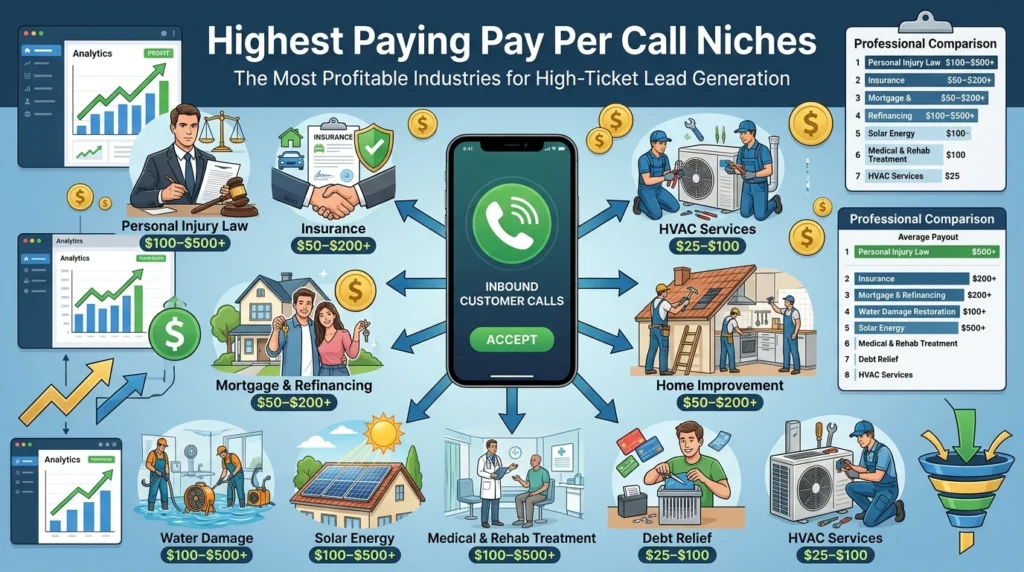
When launching a lead generation campaign, it quickly becomes clear that not all market sectors yield the same returns. In performance-driven advertising, the most lucrative segments are those where the customer lifetime value (LTV) or immediate transaction value is exceptionally high. Because a single phone call can translate into thousands of dollars in revenue for a business, advertisers in these high-ticket industries are highly motivated to pay premium rates to publishers.

Succeeding in pay per call marketing requires aligning your traffic generation efforts with verticals that exhibit massive customer demand, high emotional urgency, or significant contract values. To maximize your revenue potential, focus on the top sectors where incoming phone leads consistently command premium payouts:

NicheTypical Payout RangeWhy Advertisers Pay Premium Rates
Personal Injury Law$100 – $500+ per callLegal contingency fees from accident settlements can net millions.
Insurance (Auto, Health, Life)$25 – $100 per callHigh consumer retention rates provide long-term recurring premium revenue.
Mortgage & Refinancing$50 – $150 per callExceptionally large loan principles yield major commission-based payouts.
Water Damage & Restoration$75 – $300 per callCrisis-driven property disasters demand immediate, high-ticket remediation.
Solar Energy Systems$50 – $200 per callResidential and commercial system installations routinely cost $15,000 to $30,000+.
Medical / Rehab Treatment$50 – $200+ per callUrgent healthcare scenarios backed by premium insurance payouts drive massive demand.
Home Improvement (Roofing, Windows)$30 – $100 per callSubstantial residential contractor project costs combined with sharp seasonal spikes.
Debt Relief & Financial Services$30 – $80 per callConsumers facing financial distress bring intense emotional urgency to calls.
HVAC Repair & Services$20 – $75 per callHigh-volume emergency calls lead to lucrative, long-term maintenance contracts.

Deeper Analysis: Why High-Value Verticals Dominate the Space

The underlying driver behind these substantial payouts is simple mathematics. The businesses funding these campaigns do not operate on thin retail margins. Instead, they leverage advanced data tools and intelligent tracking infrastructure provided by specialized platforms like Ringba to calculate precisely how much revenue an exclusive, real-time voice conversation brings to their bottom line.

Legal and Financial Verticals

In the legal sphere, specifically personal injury law, the acquisition of a single victim from a major car accident can result in six- or seven-figure payouts for a law firm via contingency fees. Paying $400 for an exclusive, vetted phone consultation is an incredibly efficient customer acquisition strategy for them. Similarly, financial sectors like mortgage refinancing and debt relief deal with complex financial instruments where consumer trust must be established quickly. A live phone conversation creates an immediate human connection that digital web forms simply cannot replicate.

High-Ticket Home and Emergency Services

Home services represent an evergreen goldmine for anyone utilizing a pay per call marketing strategy. When a homeowner experiences a flooded basement at two in the morning, they do not casually fill out a contact form and wait three days for an email reply. They need an emergency restoration team on-site immediately. Because these crisis-driven scenarios bypass the standard shopping-around phase, the inbound conversion rates are incredibly high.

Furthermore, non-emergency home upgrades like residential solar energy deployment, premium roofing installations, and complete HVAC system overhauls carry substantial structural execution costs. Since these projects routinely start at several thousand dollars, home service providers gladly allocate a significant portion of their promotional budget to source qualified, exclusive incoming calls.

Ultimately, scaling your performance earnings depends on targeting sectors where customer friction is naturally solved by a live phone call. By focusing on these high-payout niches within your pay per call marketing campaigns, you position your portfolio to capture premium commissions from high-value, intent-driven consumer traffic.

Read this too:

👉 Tool Website Case Study (30 Days Build)

👉 15 Website Monetization Strategies That Actually Work in 2026

Best Traffic Sources for Pay Per Call Marketing

Succeeding in the digital lead generation landscape requires pairing your campaigns with the right target audience. In pay per call marketing, the traffic sources you choose dictate your cost per acquisition, call duration, and overall conversion rates.

Because you are routing live prospects to businesses over the phone, you must focus on channels that capture consumers at the exact moment their intent peaks. The most effective traffic acquisition channels for scaling your campaigns include:

Search Engine Optimization (SEO)

Organic search remains the most sustainable, high-yield traffic source for long-term pay per call marketing success. When an individual searches for phrases like “emergency dentist open now” or “top car accident lawyer in Atlanta,” they are experiencing an active crisis or an immediate financial need.

To maximize organic returns, your content production should target local SEO elements, service-area landing pages, and search queries with informational or commercial intent (e.g., “How Much Does a Roof Replacement Cost in [City]?”). This approach attracts highly qualified visitors right at their final decision-making stage, letting you capture premium inbound calls organically.

  • The Upside: Entirely free organic traffic that compounds in value over time, boasting exceptionally high conversion intent.

  • The Downside: Requires patience, typically taking three to six months before ranking signals materialize into consistent call volume.

Google Search Ads (PPC)

Pay-per-click (PPC) search advertising on Google is the fastest method to validate a new niche or scale an active campaign. Google’s dedicated call-only ads display a prominent phone number directly on the search engine results page (SERP), allowing mobile users to connect immediately without ever visiting an external website.

Targeting granular, high-intent phrases like “roof repair near me” or “HVAC emergency repair” ensures your budget targets active buyers. While cost-per-click (CPC) rates can be high ($15 to $50+) in hyper-competitive service sectors, the corresponding call payouts are often large enough to yield massive net margins.

  • The Upside: Generates immediate traffic with precise demographic, keyword, and geographic targeting controls.

  • The Downside: Testing phases can become capital-intensive if campaigns are not actively monitored.

Strategic Content Marketing

Publishing educational blog posts, detailed buyer’s guides, comprehensive comparison matrixes, and authoritative “best of” lists captures prospects in the consideration phase. An asset covering “5 Clear Signs You Need a Strategic Roof Replacement” will naturally draw thousands of monthly organic visitors, providing a steady funnel of users who can be systematically directed toward your click-to-call assets.

  • The Upside: Builds long-term authority and functions as a permanent digital asset.

  • The Downside: Demands ongoing editorial dedication and consistent structural updates.

Conversion-Optimized Landing Pages

A dedicated landing page designed specifically for mobile optimization is essential for any modern media-buying campaign. For top-tier performance, your lander must focus on a single user action: getting the visitor to click and call. Non-negotiable design elements include a highly visible, frictionless click-to-call button, a clear headline, a strong value proposition, and trust signals like user reviews or industry awards.

Paid Social Media Marketing

Social channels like Facebook and Instagram are highly effective for specific B2C verticals, such as home upgrades, financial relief, or localized health insurance options. Leveraging Meta’s lead generation ad formats lets you incorporate click-to-call functionality into your creatives, while granular retargeting pixels ensure your brand stays visible to prospects who previously engaged with your landers.

  • The Upside: Offers massive audience reach paired with lower initial traffic acquisition costs.

  • The Downside: Exhibits lower baseline search intent than Google, requiring highly compelling visual creatives to break through user inertia

Best Pay Per Call Networks for Beginners

Partnering with an established, reliable network is critical to securing stable call routing, fair payment terms, and optimized tracking numbers. According to performance industry benchmarks tracked by authoritative platforms like AffPaying, choosing a partner requires analyzing structural operational criteria.

Before applying to a performance network, evaluate these five core criteria:

Evaluation FactorWhat Beginners Must Look For
Reputation & LongevitySelect platforms with verifiable multi-year track records and positive independent publisher reviews.
Tracking InfrastructureEnsure the platform provides real-time timestamps, geographic routing, call recording, and advanced fraud filtering.
Payout ConsistencyPrioritize networks offering flexible weekly or bi-weekly disbursement terms via reliable gateways like PayPal, ACH, or wire.
Vertical Inventory DepthConfirm the network has direct relationships with top-tier buyers in your specific chosen niche.
Dedicated Publisher SupportA responsive, experienced affiliate manager can provide keyword lists, landing page templates, and compliance guidance.

Understanding Network Architectures

The programmatic landscape of pay per call marketing is divided into three distinct organizational models, each presenting unique structural advantages depending on your traffic volume:

  • Performance Marketing Platforms: These operations maintain direct relationships with enterprise brand advertisers. They offer higher payout caps and long-term stability, but often require publishers to prove consistent compliance and traffic volume.

  • Aggregator Networks: These platforms pool diverse offers from hundreds of separate advertisers into a single dashboard. This structure makes them highly accessible for beginners looking to experiment with multiple verticals simultaneously without managing individual brand approvals.

  • Direct Advertiser Programs: Skipping the middleman entirely allows you to negotiate directly with an enterprise brand’s internal media team. While this model unlocks maximum payout margins and exclusive terms, it demands substantial volume capabilities and professional performance history.

By selecting the right combination of high-intent search traffic and a reliable performance network, you can build a highly scalable, automated digital asset portfolio.

Pay Per Call Marketing vs Affiliate Marketing

When selecting a digital monetization strategy, performance marketers frequently weigh traditional affiliate marketing against pay per call marketing. While standard affiliate methods focus on digital actions like link clicks, email sign-ups, or shopping cart checkouts, the voice-driven model centers entirely on routing qualified human conversations.

Traditional affiliate marketing often requires massive traffic volume to generate a sustainable income. In contrast, pay per call marketing is much more forgiving; you need significantly fewer visitors because the conversion rate from a qualified prospect to an active caller is remarkably high.

The structural trade-offs between these two performance frameworks highlight why so many media buyers are shifting toward voice-based lead generation:

Evaluation FactorTraditional Affiliate MarketingPay Per Call Marketing
Primary Conversion EventClick, form submission, or digital saleInbound, qualified phone call
Average Payout Per Action$1.00 – $100.00$20.00 – $500.00+
Baseline Conversion Rate1% – 5% of web clicks15% – 40% of inbound calls
Consumer Buying IntentLow to MediumExtremely High
Market Competition LevelExceptionally High (Saturated)Medium (Expanding market)
Traffic Volume RequirementsHigh volume required for scalingLower volume, premium quality
Campaign Setup DifficultyLow to MediumMedium (Requires call routing)

Common Mistakes Beginners Make

Succeeding in pay per call marketing requires strategic precision. Because tracking networks monitor lead quality metrics closely, running unoptimized campaigns can quickly drain your budget.

Avoiding these five common rookie mistakes will protect your profit margins and preserve your network relationships:

1. Selecting Low-Paying Verticals

  • The Mistake: Promoting low-tier offers that pay out a meager $5 to $10 per connection. This leaves virtually zero room for a healthy return on investment (ROI) once you factor in content creation costs or digital ad spend.

  • The Strategy Fix: Extensively research payout baselines before committing to a vertical. Target high-value industries that guarantee a minimum payout of $30 to $50+ per qualified call.

2. Funneling Untargeted Traffic

  • The Mistake: Buying broad, generic traffic and forcing it toward highly specialized services. Pushing general curiosity clicks to a high-ticket personal injury law firm destroys your campaign performance.

  • The Strategy Fix: Keep your promotional copy tightly aligned with your target vertical. Ensure home services traffic goes exclusively to home service centers, and legal inquiries route directly to legal professionals.

3. Neglecting Overall Call Quality

  • The Mistake: Relying on misleading or spammy tactics just to get people to dial. Advertisers use advanced tracking to monitor average talk time; sending low-quality, confused callers will result in reversed commissions or immediate account termination.

  • The Strategy Fix: Prioritize consumer intent above all else. A single inbound caller with an urgent, legitimate need for a service provider is worth more than a dozen confused browsers.

4. Operating Without Comprehensive Conversion Data

  • The Mistake: Failing to track which specific landing pages, ad variations, or organic keywords are actually driving your profitable phone leads.

  • The Strategy Fix: Implement professional call-tracking software and use granular UTM parameters. Connecting every single call back to its exact marketing source allows you to optimize your budget effectively.

5. Deploying Poorly Structured Landing Pages

  • The Mistake: Directing high-intent traffic to a cluttered, slow-loading web page that lacks a clear call-to-action (CTA). This completely destroys your conversion rates.

  • The Strategy Fix: Keep your design layout clean, lightning-fast, and entirely mobile-optimized. Ensure the absolute focal point of the page is a highly visible, clickable phone link.

How to Start Pay Per Call Marketing in 2026

If you want to build a sustainable, recurring revenue stream using pay per call marketing, you need a structured approach. This practical, no-fluff deployment roadmap is designed to get your first campaign off the ground efficiently:

1.Select an High-Ticket Niche:Week 1.

Identify a high-value vertical with strong commercial intent—such as HVAC, roofing, emergency plumbing, personal injury law, or residential solar energy. Research competitive landscapes and current advertiser payout rates before finalizing your choice.

2.Apply to Specialized Networks:Week 2.

Submit publisher applications to two or three reputable performance marketing platforms. Be entirely transparent about your traffic generation strategies, as modern network managers look for publishers who possess a clear, compliant plan.

3.Establish a Localized Authority Site:Weeks 3-4.

Register a clean, brandable domain name relevant to your chosen market sector. Build a responsive WordPress website using a fast, lightweight theme designed primarily for mobile phone navigation.

4.Publish Intent-Driven Content:Weeks 5-8.

Draft 10 to 20 comprehensive articles targeting commercial and informational keywords. Focus on phrases like “Average Cost to Replace a Roof in Atlanta,” “How to Verify a Licensed HVAC Contractor,” or “Signs Your Home Needs Emergency Water Remediation.”

5.Optimize Your Digital Assets for Inbound Calls:Ongoing.

Position prominent click-to-call buttons across all mobile viewports. Integrate persuasive micro-copy like “Call now for an immediate emergency dispatch” or “Speak directly with a licensed insurance expert today” to naturally prompt phone interactions.

6.Analyze Tracking Data and Scale Your Wins:Month 3+.

Evaluate your data to pinpoint which pages, search terms, and regions generate the longest call durations. Double down on those high-performing clusters, and systematically reinvest your earnings into expanding your content footprint or launching targeted search ad campaigns.

According to industry data from lead generation performance trackers like Search Engine Journal, user behavior has shifted heavily toward immediate resolution. Capturing an end-consumer exactly when they are ready to voice-connect with a service provider provides a permanent competitive edge over standard digital marketing models.

By focusing your energy on high-intent search queries, choosing premium niches, and continually optimizing your assets for mobile users, you can successfully build and scale a resilient pay per call marketing business.

Example of a high-traffic utility tool monetized through SEO + ads:
👉 Free Video to GIF Converter Tool

Viral tools like meme generators are powerful traffic acquisition assets:

👉 Meme Generator for Viral Content

Tools That Help Generate More High-Ticket Leads

Succeeding in pay per call marketing requires more than just picking a lucrative industry; you must equip your campaign with data-driven tools. Transitioning from guessing what your audience wants to leveraging exact user behavior insights is what separates profitable publishers from struggling beginners.

By integrating the right software stack, you can identify hidden opportunities, automate manual optimization tasks, and ensure that your landing pages convert high-intent traffic into profitable voice connections.

The following software categories provide the operational backbone for successful pay per call marketing execution:

Tool TypePrimary Core PurposePractical Value for Pay Per Call Marketing
Search Intelligence (Ahrefs, Semrush)Identifies search patterns of target callersPinpoints high-intent, low-competition keywords with immediate transactional intent.
On-Page Optimization (Surfer SEO, NeuronWriter)Optimizes content structures against live SERP competitorsBoosts organic rankings for localized service pages and buyer-intent information assets.
Enterprise Call Tracking (CallRail)Attributes incoming phone calls back to precise digital sourcesHighlights your most profitable pages, ads, and search queries via dynamic number insertion.
Technical SEO Auditing (Screaming Frog, Sitebulb)Detects critical underlying site infrastructure issuesEliminates hidden mobile-responsiveness bottlenecks, broken links, and slow page loading speeds.
Long-Tail Semantic Generators (AnswerThePublic, Keyword Tool)uncovers hyper-targeted user search queriesCaptures hyper-specific consumer questions driven by an immediate, urgent need.
Keyword Density Analysis (Copywritely, SEO Review Tools)Verifies natural keyword integration patternsProtects your web assets from over-optimization penalties enforced by major search engines.

Frequently Asked Questions

Do I need a large budget to get started with pay per call?

No. If you choose the organic SEO route, your initial setup costs are limited to standard web hosting and a domain name. While paid media campaigns (like Google Call-Only Ads) require an active ad budget to cover upfront click costs, organic content marketing allows you to build long-term, high-intent assets using only sweat equity.

How do advertisers prevent fraud or accidental dials?

Advertisers establish precise buffer criteria within performance networks. To earn a commission, an inbound call must pass automated qualification filters—such as a mandatory minimum duration (e.g., 60 to 90 seconds), geographic sorting, and unique caller identification checks.

Can I run campaigns in multiple niches at the same time?

While it is technically possible, beginners should focus on mastering a single vertical first. Each industry carries unique consumer pain points, compliance requirements, and keyword search patterns. Perfecting a single funnel in a niche like emergency plumbing or auto insurance before expanding is the fastest path to sustainable revenue

Ready to Build Your First High-Ticket Lead Machine?

Success in pay per call marketing relies on a clear operational truth: delivering real value to motivated buyers at their exact moment of need. When you combine high-intent search traffic with carefully analyzed verticals, you exit the low-margin volume game and begin commanding premium commissions based on lead quality.

A single well-written, locally optimized article that ranks for a phrase like “emergency water damage restoration in Phoenix” can continuously generate high-paying inbound phone calls month after month—all without requiring a recurring ad spend.

Your immediate next step: Select one profitable niche from the analytical frameworks covered in this guide, extract three to five hyper-specific long-tail keywords that an urgent customer would search for, and publish an informative asset that solves their problem. Ensure your contact numbers are prominent, mobile-optimized, and effortless to click.

Leave a Comment

Your email address will not be published. Required fields are marked *

Scroll to Top