

Expansion & Upsell Strategies | Complete 2026 Guide
Stop relying solely on new signups to hit your revenue targets. Instead, learn how top-performing software companies utilize expansion loops, upsells, cross-sells, and strategic land-and-expand playbooks to push Net Revenue Retention (NRR) past 120% — all without increasing your customer acquisition costs.
Understanding how to grow SaaS revenue starts with maximizing value from existing customers before increasing acquisition spend.
A staggering number of software organizations are leaving significant money on the table every single month. Growth teams pour heavy budgets into paid advertising, cold outreach, and top-of-funnel content to win net-new customers. Meanwhile, they completely overlook the fastest, most cost-effective, and highly predictable growth engine sitting right in front of them: their current user base.
This is a massive strategic inefficiency. Industry data tracked by organizations like the Harvard Business Review consistently reveals that acquiring a new customer costs five to seven times more than expanding an existing relationship. Despite this reality, the vast majority of growth teams spend 80% of their energy chasing the small fraction of revenue generated by new logos, leaving the compounding value of customer retention and account expansion virtually untouched.
If you are looking for a definitive roadmap on how to grow SaaS revenue, building an internal expansion engine is your best path forward. For a broader framework covering acquisition, retention, monetization, and scaling, read our complete SaaS Growth Strategy 2026 guide. This comprehensive guide will break down that exact process. You will learn everything from mastering the four distinct types of account expansion to setting up the dashboards, playbooks, and internal customer success motions that make recurring growth repeatable. Whether your team is at $200K ARR aiming for your first million or scaling past $5M toward the $10M mark, these core principles apply across every stage of your growth journey.
Let’s dive into building your predictable revenue machine.
1. Why Expansion Revenue Is the Most Efficient SaaS Growth Lever
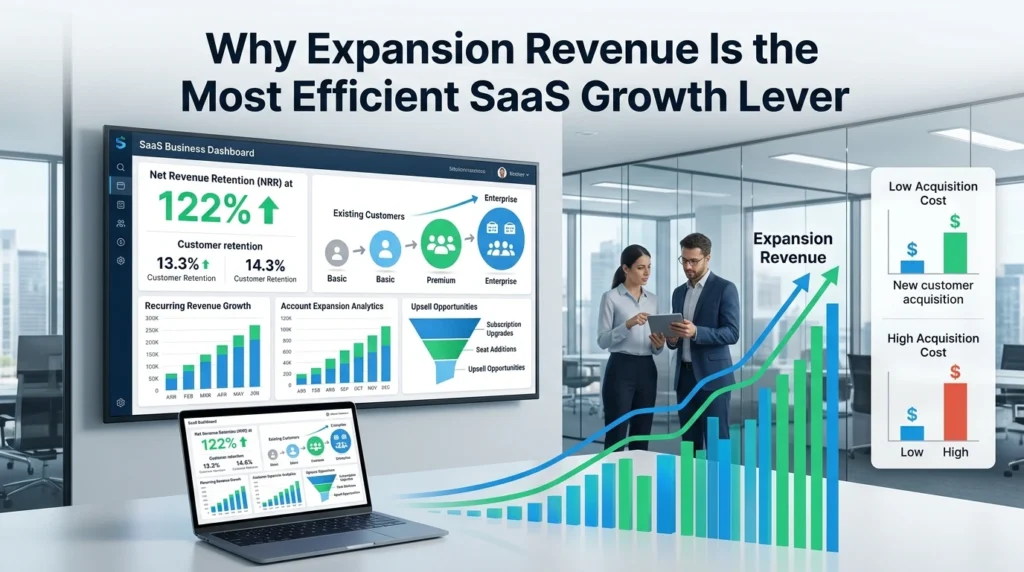
Here is a statistic that will completely reframe how you approach subscription-based growth: data from Bain & Company reveals that increasing your customer retention rates by just 5% can boost your bottom-line profits by anywhere from 25% to 95%. That is not a typo. The compounding math behind retaining and expanding your current customer accounts stands as one of the single most dominant forces in the subscription landscape.
However, simply keeping your users around is only half the battle. If you want to know how to grow SaaS revenue at maximum efficiency, you must focus heavily on expansion revenue. This includes any additional income generated from your current clientele via tier upgrades, cross-sells, seat add-ons, and increased usage. This specific lever is what ultimately separates good software companies from industry giants.
The Unit Economics Argument
Every single time your team wins a brand-new customer, you incur a heavy Customer Acquisition Cost (CAC). This financial burden encompasses marketing budgets, sales salaries, software tools, and the hours your team invests in lead generation, product demos, and contract negotiations. For the average B2B software vendor operating within the $1M to $10M ARR bracket, CAC typically ranges between $3,000 and $15,000 per account, depending heavily on your sales motion.
Companies that master how to grow SaaS revenue often prioritize expansion over expensive customer acquisition campaigns
Conversely, driving account expansion costs just a tiny fraction of that amount. The relationship is already established, you deeply understand their specific use cases, and organizational trust has been solidified. Furthermore, the grueling legal reviews are already out of the way. A perfectly timed upsell discussion led by a Customer Success Manager might take less than 30 minutes, yet it can effortlessly unlock between $500 and $5,000 in monthly recurring revenue (MRR).
| 5–7x | 110–130% | 25–95% |
| Lower cost to expand vs. acquire | NRR at top-quartile SaaS companies | Profit lift from 5% retention increase |
How NRR Above 100% Creates Compounding Growth
Net Revenue Retention (NRR) remains the ultimate North Star metric for subscription health. When your NRR scales past the 100% threshold, your existing user base naturally expands on its own—even if your sales reps close zero new business in a given month. This is the definition of organic, compounding growth.
Consider how this dynamic impacts your long-term valuation. A software brand sitting at $5M ARR with a 115% NRR will naturally expand its baseline business to $5.75M within a single year solely through internal expansion. When you layer net-new customer acquisition on top of that foundation, your overall growth trajectory accelerates drastically. Industry leaders like Snowflake, Datadog, and Twilio built their legendary market valuations on NRR figures north of 130%, ensuring that internal expansion effortlessly outpaces customer churn.
Compare that to an organization plagued by a 90% NRR. This means they drop 10% of their total revenue foundation annually due to cancellations and subscription downgrades. Every dollar poured into top-of-funnel marketing is actively working to patch a leaky bucket. Growth ceases to feel like a scalable engine and starts feeling like an endless treadmill.
The strategic takeaway is clear: before allocating more capital to your acquisition marketing budget, you need to master how to grow SaaS revenue from within by optimizing your NRR. A business at $2M ARR with a 120% NRR will comfortably outpace a competitor at the exact same ARR with an 85% NRR within 18 months—even if that competitor spends double on paid ads.
2. The 4 Types of SaaS Expansion Revenue

Not all revenue expansion strategies are created equal. Before you design your strategic growth playbook, you must identify which expansion methodology aligns naturally with your product framework, pricing architecture, and customer behavior. There are four distinct pillars of account growth, and top-tier software enterprises typically deploy a mix of at least two.
If you are mapping out exactly how to grow SaaS revenue, mastering these four specific methodologies will give you a predictable roadmap for compounding your current customer accounts.
Type 1: Upsells (Plan Upgrades)
Upselling involves transitioning an existing customer from their current subscription tier to a premium, higher-priced tier. This is the most prevalent expansion mechanism in the industry. It functions best when your pricing tiers are separated by high-value, sophisticated functionalities rather than restrictive, artificial boundaries.
The foundation of how to grow SaaS revenue is choosing the right expansion model for your pricing structure
The secret to maximizing upsells lies in timing and contextual relevance. Forcing an upgrade conversation simply because a user crossed an arbitrary data threshold can feel restrictive. Conversely, introducing an upgrade because you notice the user implementing manual workarounds that your higher tier resolves natively feels like proactive customer care.
Best for: Tiered-feature pricing models (Starter vs. Professional vs. Enterprise).
Trigger signals: Consumption approaching tier thresholds, explicit inquiries about gated features, overall organizational growth.
Average uplift: A 40% to 80% lift in MRR per account.
Type 2: Cross-Sells (Additional Products or Add-Ons)
Cross-selling is the practice of introducing an established customer to standalone products, complementary modules, or distinct feature add-ons. Software giants like HubSpot execute this flawlessly; a customer might register initially for the Marketing Hub, but they eventually integrate the Sales Hub and Service Hub as their internal departments scale.
Successful cross-selling requires a diversified product portfolio or a modular architecture. It also demands deep account trust. If a user hasn’t fully adopted your core product, they will resist buying secondary modules. Therefore, matching the offer to the customer’s journey stage is vital.
Best for: Multi-product companies, platform ecosystems, add-on marketplaces, and API platforms.
Trigger signals: Deep adoption of the foundational product, requests for net-new use cases, horizontal corporate expansion.
Average uplift: A 25% to 60% boost in Annual Contract Value (ACV) per account.
Type 3: Seat Expansion (More Users)
Per-seat pricing scales in lockstep with your user’s corporate expansion. When your customers scale their headcount, your subscription revenue scales alongside them. As their departments adopt your software enthusiastically, adoption spreads virally across different business units, making account growth organic rather than sales-driven.
Slack remains the gold standard for this mechanic. A deployment might begin within a small 5-person engineering team, spread to 50 employees across marketing, and eventually become the unified communication fabric for the whole enterprise. Each new user added represents a seamless, frictionless expansion event.
Best for: Collaboration tools, CRM platforms, productivity suites, and user-dependent software.
Trigger signals: Corporate hiring surges, new team onboarding, cross-department adoption.
Average uplift: Linear growth matching headcount; often 20% to 200% over two years in high-growth accounts.
Type 4: Usage-Based Expansion (More Consumption)
Usage-based pricing (UBP) has quickly become one of the fastest-growing models in software. Instead of capping features or seats, you bill customers based on their direct consumption metrics, such as API requests, data volume stored, or messages sent. This is the foundation for market leaders like Snowflake, Twilio, and Stripe.
With UBP, figuring out how to grow SaaS revenue becomes fully automated: as your customers’ business volumes scale, their product consumption increases, and your billing adjusts upward naturally. No formal sales pitch is required. Revenue scales dynamically with user success, aligning incentives between vendor and customer.
Best for: Infrastructure software, API services, developer platforms, and data warehousing.
Trigger signals: Spikes in transaction volumes, new integration deployments, macroeconomic customer growth.
Average uplift: Expansion scales fluidly and automatically alongside the customer’s operational success.
Alignment Matrix: Matching Pricing Models to Growth Motions
To implement these concepts effectively, look at how your underlying commercial model dictates your primary path to expansion:
| Your Pricing Model | Primary Expansion Motion |
| Tiered SaaS (Starter/Pro/Enterprise) | Upsells + Seat expansion |
| Multi-product / Platform ecosystems | Cross-sells + Upsells |
| Per-seat collaboration tools | Seat expansion (Primary) |
| API / Infrastructure products | Usage-based expansion |
| Horizontal B2B SaaS applications | Upsells + Cross-sells + Seats |
To explore more deeply how industry leaders architect these commercial frameworks to maximize long-term client retention, review the comprehensive operational playbooks hosted by the SaaS Academy.
3. Net Revenue Retention (NRR) Explained

Net Revenue Retention is the single most accurate metric for predicting the long-term viability, health, and growth trajectory of any subscription business. If your team is limited to tracking just one performance indicator, it should undeniably be this one. Venture capitalists and institutional investors view it as the ultimate confirmation of true product-market fit, sustainable customer value, and self-sustaining expansion potential.
How to Calculate NRR
NRR measures the exact percentage of recurring revenue retained from your current customer cohort over a specific timeframe (usually monthly or annually). This calculation accounts for the positive impact of expansions alongside the negative impacts of account downgrades and complete churn.
The standard algebraic formula is structured as follows:
Real-World Example: Suppose your company begins the month with $100,000 in MRR from your current customer base. Throughout the month, account upgrades add $18,000 in new revenue. Conversely, subscription contractions (downgrades) remove $4,000, while customer churn removes $6,000.
If you want to understand how to grow SaaS revenue, improving NRR should be one of your highest priorities
What Good NRR Looks Like by Stage
Understanding standard industry benchmarks is vital if your primary goal is to figure out how to grow SaaS revenue from within your existing customer base. Target numbers shift significantly as an organization matures:
| Stage | Acceptable | Healthy | Elite |
| Early-stage ($0–$1M ARR) | 85–95% | 100–105% | 110%+ |
| Growth-stage ($1–$10M ARR) | 95–105% | 108–118% | 120%+ |
| Scale-stage ($10M+ ARR) | 100–108% | 110–125% | 130%+ |
| Enterprise SaaS | 100–110% | 115–125% | 135%+ |
Internalizing these specific benchmarks helps frame your overall operational performance:
NRR below 100%: Your core customer revenue base is actively shrinking. Your sales team must constantly acquire net-new logos just to maintain flat revenue, creating an exhausting growth treadmill.
NRR at 100–110%: Your baseline book of business is growing modestly. While this is respectable, it leaves substantial room for strategic optimization.
NRR at 110–120%: This indicates a highly effective expansion motion. Your software delivers continuous utility, and your customer success team is executing flawlessly.
NRR above 120%: This represents world-class performance. Your current customer base is directly financing your scale, creating the compounding growth loop that top investors actively look for.
Why Investors Treat NRR as the Primary Metric of Health
When a software startup opens a fundraising round, two core variables dominate investor conversations: top-line growth rate and NRR. Sophisticated capital allocators place immense weight on this data point for several structural reasons.
First, an elite retention rate establishes absolute proof of product-market fit in a way that written testimonials or qualitative case studies never can. It demonstrates to the market that your users don’t just stick around—they willingly increase their financial commitment to your platform over time. That is the clearest sign of a product delivering compounding enterprise value.
Second, a healthy retention profile acts as a massive lever for capital efficiency. When assessing how to grow SaaS revenue, organizations maintaining an NRR north of 120% can scale much faster while burning far less cash. Because their internal user base heavily finances their forward momentum, their CAC payback windows shorten dramatically, even with lean sales and marketing budgets. According to data and research aggregated by Gartner, capital efficiency remains a primary driver of long-term software valuations.
Strategic Rule of Thumb: Subscription software companies maintaining an NRR above 120% routinely command 2x to 3x higher ARR multiples during capital raises and M&A transactions compared to competitors sitting below the 100% threshold—even when both businesses feature identical top-line growth rates.
4. The Land-and-Expand Playbook
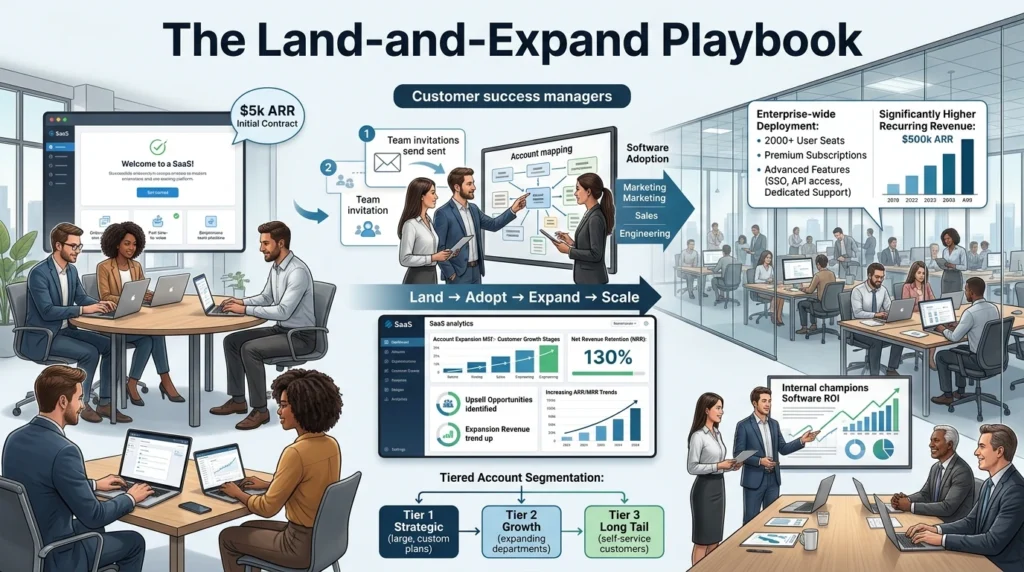
Land-and-expand is a deliberate go-to-market playbook where you intentionally close a smaller initial contract, embed yourself quickly, deliver fast time-to-value, and then systematically scale the account over time. It is far more than a basic sales methodology—it is a product design philosophy, a pricing architecture decision, and a foundational mandate for your customer success organization.
The alternative approach—trying to extract the largest possible contract value upfront—drastically slows down your sales velocity, increases your churn risk via over-sold accounts that fail to realize value, and creates highly brittle revenue. Conversely, a well-executed land-and-expand strategy yields faster close rates, superior customer retention, and natural upgrade pathways woven directly into your software.
Designing Your Product for Land-and-Expand
This framework only succeeds if your application delivers clear, undeniable utility at a modest scale before unlocking enterprise-grade value. The initial “land” must feature low enough friction that an isolated internal champion can onboard their team without requiring extensive IT oversight, complex procurement loops, or prolonged proof-of-concept periods.
Define your minimum valuable product scope: Identify the leanest possible version of your platform that successfully resolves a highly painful, specific problem for an individual team or workflow.
Architect an organic expansion pathway: Pinpoint exactly where the ROI compounds when a customer imports more data, integrates secondary applications, or adds more team members.
Build product-led viral loops: Allow end-users to effortlessly invite cross-functional colleagues, or configure settings where sharing a report requires the recipient to create an account.
Gate features built for corporate governance: Ensure single-user value is unlocked immediately, while reserving multi-team administrative tools and advanced security layers for higher pricing tiers.
Many successful founders learn how to grow SaaS revenue by building products that naturally encourage account expansion.
ICP Segmentation for Expansion Potential
Not all logos present identical growth opportunities. When engineering your expansion mechanics, prioritize signing accounts that possess substantial baseline head-room. This means filtering your Ideal Customer Profile (ICP) not just by their propensity to buy, but by their capacity to scale.
High-growth signals include rapid corporate hiring (headcount expanding 20%+ Year-over-Year), operation in a sector where your utility scales in lockstep with their transaction volumes, and large enterprise structures featuring multiple siloed departments that can adopt your software independently.
Tier your closed-won accounts by their expansion headroom at the point of the initial sale, rather than treating it as an afterthought.
Allocate high-touch Customer Success Management (CSM) resources to Tier 1 accounts from day one.
Audit your estimated expansion potential against actual realized account expansion every quarter to refine your ICP scoring algorithms.
Champion Mapping and Account Tiering
Every major expansion event requires a dedicated internal champion—a power user who genuinely loves your product, internalizes its ROI, and wields the institutional influence to advocate for wider organizational adoption. Actively uncovering, nurturing, and empowering these stakeholders represents the most lucrative relationship investment you can make in your active accounts.
Champion mapping requires a granular understanding of who uses your tool daily, who benefits from its outputs, who owns the budget, and who possesses the political capital to push for cross-departmental adoption. Because staff turnover happens, corporate structures shift, and champions switch companies, keeping these internal account maps updated is an ongoing necessity.
| Account Tier | Profile & Coverage Model |
| Tier 1 (Strategic) | ACV $10K+, rapid headcount growth, multi-department viability — weekly CSM touchpoints, dedicated account mapping, and quarterly executive business reviews. |
| Tier 2 (Growth) | ACV $2K–$10K, moderate expansion indicators — monthly CSM check-ins, pooled CSM coverage structures, and bi-annual usage audits. |
| Tier 3 (Long Tail) | ACV under $2K, self-serve expansion tracks — fully automated account health monitoring, contextual in-app nudges, and targeted lifecycle email campaigns |
5. When and How to Trigger Upsell Conversations
Timing dictates everything when expanding accounts. An upgrade pitch delivered at the wrong moment feels like an aggressive cash grab. The exact same offer introduced at the perfect moment, framed explicitly around the user’s operational goals, feels like a helpful optimization. The core variable is whether you are blindly reacting to an arbitrary ceiling or proactively uncovering paths on how to grow SaaS revenue for your customer.
Behavioral Signals That Predict Upgrade Readiness
Your product telemetry is your most potent sales intelligence asset. While most software organizations log rich behavioral data, few successfully route those insights to their CSMs or account executives. Building a dynamic signal-to-action workflow converts passive backend usage data into active, high-margin revenue.
The highest-intent behavioral triggers in B2B software include:
Usage thresholds approaching (80–90%): The client is extracting undeniable value—so much so that they are running out of capacity. This is the optimal moment to initiate an upgrade discussion, as they have just actively proven their own ROI.
Interaction with gated features: When an active user clicks an interface element and encounters an informational modal or upgrade prompt, their click behavior demonstrates explicit feature intent.
Rapid team onboarding: If your platform telemetry or HR integrations indicate that a customer has onboarded numerous employees over the last month, a seat-expansion motion should be initiated automatically.
High single-user engagement with cross-team sharing: A power user who frequently exports reports or invites external guests is a natural candidate for an organizational land-and-expand play.
Support inquiries regarding functional limits: When a user submits a ticket asking “Can I execute workflow X?” and the resolution is “Yes, that is natively supported on our Professional plan,” that support ticket should immediately flag an upsell opportunity.
Customer behavior data often reveals the fastest opportunities for how to grow SaaS revenue without adding new customers.
In-App Upgrade Moments
Self-serve contextual upgrade paths represent the most scalable expansion channel for product-led growth (PLG) setups. Executed with empathy, they streamline the user experience; executed poorly, they feel intrusive. The differentiating factor is context and value framing.
An effective in-app conversion prompt relies on three core tenets: it appears natively within the workflow where the specific limit or feature is actively triggered; it clearly illustrates the immediate outcomes unlocked upon upgrading; and it offers a frictionless, self-serve transaction path that completely bypasses the need for a sales call.
Display gated functionalities directly within the user interface, styled with a clean “unlock” prompt rather than hiding them or using generic upgrade banners.
Frame your upgrade call-to-actions entirely around user outcomes: “Upgrade to automate this workflow for your entire department” always outperforms a generic “Upgrade to Pro” button.
For higher-ACV accounts, route in-app upgrade intent directly to a dedicated CSM via webhooks rather than forcing an immediate self-serve credit card checkout.
Continuously A/B test your upgrade prompt timing, messaging, and visual real estate—minor iterations routinely drive a 20% to 40% lift in conversion rates.
CSM-Led Expansion Plays
For customer accounts sitting above specific ACV thresholds, automated in-app nudges are insufficient. Human-centric, CSM-led expansion is required to navigate large corporate hierarchies, manage complex multi-stakeholder deals, and guide consultative sales conversations that a simple interface button cannot duplicate.
The most reliable CSM expansion playbooks operate within a highly structured Quarterly Business Review (QBR) framework. Instead of treating the QBR as a boring retrospective data dump, position it as a forward-looking strategy session built to map out the next phase of the user’s business journey—introducing the premium product capabilities required to get them there.
The QBR Expansion Framework: Begin by aligning on the customer’s strategic business objectives for the upcoming quarter. Quantify the exact outcomes they have already achieved using your software. Highlight the operational gap between their current technical capabilities and their upcoming goals. Introduce the specific premium tier or add-on module designed to bridge that gap, presenting the entire business case in their corporate language (e.g., hours reclaimed, risk mitigated, or revenue unlocked) rather than reciting a list of features.
6. Cross-Sell Strategy for SaaS
Cross-selling is the specific expansion motion that requires the highest degree of patience. Unlike standard feature upsells, which occur within an application the user already knows and values, cross-selling asks a customer to allocate additional budget toward a completely adjacent, unfamiliar product line. Consequently, the trust barrier is higher, and timing becomes paramount.
The Golden Rule of Cross-Selling
Never attempt to cross-sell an account that has not realized complete, demonstrable value from their foundational purchase. This rule appears obvious, yet teams violate it constantly. A customer who is only ninety days into their journey and still configuring your core product is not ready to hear a sales pitch about your brand-new analytics add-on. They will perceive the outreach as an annoying distraction at best, or complete organizational tone-deafness at worst.
The optimal time to introduce an adjacent product module is immediately following a major customer value milestone. The account must exhibit a flawless health score, high platform adoption, and an established relationship of trust with their CSM. When these parameters are met, introducing a complementary application feels like a natural expansion of their operational success, not an aggressive sales pitch.
Timing, Packaging, and Bundling Tactics
How you package and position an adjacent offer directly dictates its market adoption. Several packaging mechanics consistently maximize cross-sell velocity:
Lead with the customer’s friction, not your product’s features: “I noticed your analytics team is manually exporting CSVs into sheets every Monday—here is how our automation add-on eliminates that manual work” will always outperform “Have you seen our new automation module?”
Align cross-sells with contract renewals: Commercial renewals represent a natural strategic window to present optimized account packages. Proposing a 20% price increase for an upgraded bundle that injects massive operational value feels highly collaborative; making the identical financial ask mid-contract can feel opportunistic.
Provide frictionless sandboxes to highly active users: Let the software execute the sales pitch on your behalf. An active user who tests an advanced add-on module for 14 days and directly experiences the efficiency gains will convert at exponentially higher rates than an account pitched entirely over a slide deck.
Engineer natural product cross-over points: Design your product architecture so that unlocking success within Module A naturally exposes logical workflows that require Module B. The internal linking of platform value is primarily a product-led user experience task, not just a sales initiative.
Cross-selling remains one of the most overlooked strategies for businesses focused on how to grow SaaS revenue.
Cross-Sell Sequencing by Customer Health Score
An account’s holistic health score—a weighted index comprising product usage frequency, feature adoption depth, customer support ticket sentiment, and recent NPS data—must serve as the ultimate gatekeeper for your cross-sell campaigns. Only accounts flagged with excellent health should receive proactive expansion offers.
| Health Score | Cross-Sell Approach |
| Green (80–100) | Initiate proactive cross-sell dialogues, activate unprompted sandbox trials of adjacent modules, and introduce expansion options during scheduled QBRs. |
| Yellow (50–79) | Execute a success intervention first: uncover existing workflow friction, resolve outstanding technical debt, and revisit expansion paths in 30 to 60 days. |
| Red (0–49) | Strict retention playbooks only: escalate the account, diagnose the root cause of under-utilization, and deploy a comprehensive recovery plan before presenting any commercial offers |
7. Reducing Involuntary Churn to Protect Expansion Gains
This section focuses on an area that the vast majority of software companies severely underinvest in: involuntary customer churn. While your growth teams are busy constructing sophisticated upsell tracks and land-and-expand playbooks, hard-earned revenue is quietly slipping out the back door every single month due to processing errors, expired corporate credit cards, and systemic payment friction.
Comprehensive subscription research by Recurly shows that optimizing your failed payment recovery paths via advanced dunning sequences, smart retry logic, and automated card-on-file updates can recover an average of 8.6% of your total annual subscription revenue in the first twelve months alone. For an organization operating at a $2M ARR baseline, that equates to $172,000 in instantly recovered recurring revenue for what is essentially a basic operational configuration.
The Anatomy of Involuntary Churn
Involuntary churn has absolutely nothing to do with product utility, customer sentiment, or user satisfaction. The client genuinely wants to maintain their subscription and continue utilizing your platform; they are simply completely unaware that their backend payment transaction failed. This represents the easiest form of revenue loss to reverse because the buyer is already fully incentivized to remain a customer.
Credit card expiration: The single largest driver of payment failures, occurring with predictable frequency during annual contract renewal cycles.
Insufficient account balances: Frequently a temporary corporate cash-flow timing issue; retrying the transaction on a data-backed schedule regularly resolves the issue.
Card re-issuance due to fraud: When a corporate buyer updates their physical card details following a data breach, they routinely forget to update peripheral SaaS billing dashboards.
Billing address mismatches: A common issue within mid-market and enterprise segments where localized accounting data changes following corporate restructuring or acquisitions.
Reducing preventable churn is a critical step in how to grow SaaS revenue sustainably over the long term.
Dunning Management Best Practices
Dunning represents the structured, automated communication framework used to alert customers of transaction errors and supply them with a secure, frictionless path to update their financial credentials. A expertly designed dunning sequence gracefully converts the majority of processing errors into successful account recoveries.
Deploy proactive pre-expiry outreach: Dispatch an automated notification 30 days prior to a card’s documented expiration date based on vault metadata, rather than waiting for the actual transaction to fail.
Implement data-driven smart retries: Avoid retrying failed cards daily, which degrades user relationships and triggers bank fraud alerts. Instead, spaces retries across an optimized cadence—such as Day 1, Day 3, Day 7, and Day 14.
Tailor notification copy to the specific error code: Ensure that a notification for an expired card reads completely differently than a notification for an unexpected bank decline, providing context-specific instructions for each.
Offer multiple paths for account updates: Allow users to update their credentials via an authenticated in-app dashboard, a secure single-use email hyperlink, or through direct outreach from a CSM for high-value enterprise contracts.
Configure a generous grace period: Maintain complete platform access for 7 to 14 days while actively working to resolve billing discrepancies. Cutting off access instantly creates massive user frustration and drives voluntary cancellations.
Software Tools for Involuntary Churn Recovery
While standard subscription billing systems include baseline dunning settings, leveraging specialized recovery software can dramatically optimize your financial retention rates far beyond native platform limits:
Stripe Billing: Provides reliable out-of-the-box smart retries and configurable notification templates, serving as an excellent baseline for early-stage startups.
Chargebee & Recurly: Deliver highly sophisticated enterprise dunning logic, comprehensive A/B testing frameworks for email recovery copy, and deep analytics on payment success vectors.
Churnkey & ProfitWell Retain: Represent specialized revenue retention platforms that leverage machine-learning models to optimize retry execution down to the exact hour, combined with hyper-personalized cancellation flow interventions.
8. Building an Expansion Revenue Dashboard
You cannot optimize what you do not actively measure. While almost every software organization maintains a basic dashboard to track top-line MRR and raw customer cancellation rates, remarkably few build dedicated expansion dashboards that grant revenue, customer success, and product leaders the granular visibility required to act on account growth opportunities.
Constructing a unified data view is a one-time analytics setup that yields continuous revenue dividends. A world-class expansion dashboard must track several core metrics to inform your overall strategy on how to grow SaaS revenue:
The Core Expansion Metrics to Track
| Metric | Tracking Cadence | Operational Insight | Target Benchmark |
| Net Revenue Retention (NRR) | Monthly | Measures the absolute revenue health and compounding scale of your active user base. | Target: >110% |
| Expansion MRR Growth | Monthly | Quantifies the net-new dollar volume unlocked entirely from your existing accounts. | Look for an upward trend line |
| Upsell Conversion Rate | Monthly | The exact percentage of targeted upgrade campaigns that successfully close. | Target: 15–25% |
| Time-to-Expand | Per Cohort | The average duration (in days) from an account’s initial sign-up to their first expansion event. | Lower is better across tiers |
| Account Health Score | Real-time | A composite index alerting teams to sudden behavioral drops across your client base. | Trigger alerts on Yellow/Red drops |
| Expansion Source Breakdown | Monthly | Segments expanding revenue by type: feature upsells, cross-sells, seat additions, or usage data. | Identifies your core growth engine |
| Gross Revenue Retention (GRR) | Monthly | Measures the baseline stability of your revenue before adding any expansion gains. | Target: >90% for B2B |
| Expansion Pipeline Velocity | Weekly | Evaluates the total contract value of identified expansion opportunities moving through your pipeline. | Track like an active sales pipeline |
Recommended Tool Stack
The ideal software stack for your expansion analytics depends heavily on your current annual recurring revenue and the depth of data segmentation required:
Early stage ($0–$1M ARR): Baremetrics or ProfitWell. Both software solutions plug directly into your Stripe gateway, providing clean NRR visualizations, expansion breakdowns, and churn analysis instantly with low setup costs.
Growth stage ($1M–$10M ARR): ChartMogul or Recurly Analytics. These platforms enable advanced customer cohort analysis, deep segmentation by historical plan type or location, and robust synchronization with your central CRM.
Scale stage ($10M+ ARR): Gainsight or Totango. These enterprise platforms overlay comprehensive customer success behavior directly on top of your financial metrics, centralizing health metrics, behavioral alerts, and automated CSM playbooks within a single workflow engine.
Cross-stage framework: Maintain a highly visible Google Sheets or Notion dashboard updated weekly. Broad internal data visibility naturally aligns cross-functional team behavior.
Accurate reporting is essential when measuring progress on how to grow SaaS revenue initiatives.
9. Real SaaS Examples of Expansion-Led Growth
Theoretical playbooks are helpful, but studying real-world application is far more instructive. Let’s analyze how three of the most successful software enterprises in corporate history engineered their scaling machines primarily around internal account expansion rather than chasing net-new customer acquisition.
Slack: Seat Expansion as a Viral Growth Engine
When Slack entered the market, it engineered seat-based expansion directly into its product fabric. The application featured natural viral loops: to collaborate efficiently with an internal team member, you had to invite them to the workspace. Consequently, every corporate hiring wave served as an automatic account expansion event.
Slack’s go-to-market strategy centered on landing within an isolated, highly technical team—such as engineering or product design—and allowing adoption to spread horizontally as other departments noticed the communication benefits. By billing strictly per active user, their revenue scaled automatically alongside real customer usage. They didn’t need account managers to execute upsell pitches; the product generated its own internal demand.
Core Strategic Lesson: Architect your user experience so that the software’s core value multiplies as more colleagues join the workspace. Combining cross-team virality with per-seat billing structures creates an expansion engine that requires zero outbound sales overhead.
HubSpot: Cross-Sell and Platform Ecosystem Scaling
HubSpot originally launched as a simple inbound marketing tool, yet they scaled into a multi-billion dollar enterprise by systematically expanding the breadth of adjacent modules a single customer could utilize. A business that initially registered for their core Marketing Hub eventually added Sales Hub, Service Hub, CMS Hub, and Operations Hub over time.
HubSpot’s unified customer data platform (CDP) ensured that every single module added to a user’s technical stack exponentially increased the utility of their existing modules. Cross-selling wasn’t deployed simply to extract more money; it was engineered to unlock deeper product value. Each platform addition made the client significantly more embedded in the HubSpot ecosystem, driving switching costs up and churn down.
Real-world case studies provide valuable insights into how to grow SaaS revenue through expansion-led growth models.
Notion: PLG Seat Expansion at Scale
Notion unlocked a premium multi-billion dollar valuation by mastering product-led, bottom-up viral expansion. Individual professionals discovered the tool for personal note-taking, fell in love with the flexible interface, and quickly shared custom workspaces with their direct teammates. Those teams then naturally expanded their usage to department-wide plans.
Notion’s monetization model was brilliantly calibrated to offer a robust free entry point—completely removing top-of-funnel acquisition friction—while establishing logical upgrade triggers as data volume, team collaboration, and workspace permissions grew. Their reported NRR ranks in the elite tier because once an enterprise constructs its internal knowledge graph, operating manuals, and project wikis inside Notion, moving away becomes practically impossible.
Core Strategic Lesson: Offering a free subscription tier is a highly effective “land” tactic, not a failure to monetize. Designing software for viral adoption at the individual level creates massive, high-intent seat expansion opportunities at the corporate level.
10. Expansion Revenue Playbook by Company Stage
Account expansion strategies are completely dependent on your organizational maturity. The workflows that move the needle at $200K ARR are fundamentally distinct from the playbooks required at $5M ARR, which change again as you cross $15M ARR. Use this staged operational playbook to deploy the right retention motions at the optimal time.
Stage 1: $0–$1M ARR — Manual CSM and Pattern Recognition
At this initial stage, your company lacks the massive customer volume and deep data telemetry required to engineer automated expansion pipelines. Your primary goal right now is direct customer proximity, intense curiosity, and the internal discipline to document every user interaction.
Your expansion motion at this stage is executed entirely by founders or your initial customer success hires. Do not worry about building for infinite scale yet; focus on discovering repeating patterns. Identify which specific customer profiles expand, when they upgrade, what behavioral events preceded the expansion, and what specific messaging unlocked the expansion conversation.
Conduct manual QBRs with every single customer contributing over $1K in MRR—even if it requires a basic 30-minute video call.
Log every account expansion event within a centralized spreadsheet, detailing the client profile, deal size, timing, and core catalyst.
Isolate the shared characteristics across your first ten expansion events; that data forms the baseline for your future automated playbooks.
Configure automated dunning parameters within Stripe or your preferred gateway—this represents the lowest-effort, highest-margin path to protect your early revenue.
Pinpoint your top three active accounts by expansion potential and dedicate disproportionate personal attention to their success.
The process of how to grow SaaS revenue evolves significantly as a company moves through different growth stages.
Stage 2: $1M–$10M ARR — Systemized Expansion Plays
As you cross the million-dollar ARR threshold, you possess enough active accounts to construct repeatable processes, enough usage data to isolate predictive triggers, and enough cash flow to invest in specialized customer success tooling and headcount. This is the exact phase where account expansion transitions from an unscripted art form into a highly systemized process.
Your core objectives during this growth phase include formalizing your expansion-focused ICP scoring, designing your first mathematical health score model, implementing structured QBR tracks for your Tier 1 and Tier 2 accounts, and reviewing a unified expansion dashboard every single week.
Launch a formalized customer health score based on easily tracked metrics, such as weekly login frequencies, core feature adoption depth, and support ticket sentiment.
Draft a comprehensive, shared expansion playbook for your CSM organization that details exact behavioral triggers, approved email templates, script talk-tracks, and account escalation paths.
Build an isolated expansion pipeline directly inside your CRM, treating internal account growth opportunities with the exact same visibility as net-new sales cycles (complete with deal stages, probability percentages, and close dates).
Appoint your first dedicated customer success specialist tasked specifically with expansion quotas as a core performance metric alongside standard logo retention.
Adopt a specialized billing analytics application like ChartMogul or Baremetrics to unlock reliable, real-time visibility into your exact NRR and cohort performance.
Stage 3: $10M+ ARR — Automated Signals and Enterprise Expansion
At this mature operating scale, your total volume of customer accounts makes manual monitoring across all tiers impossible. Concurrently, your enterprise contracts become highly complex, requiring institutional navigation. Your primary goal becomes intelligent operational segmentation: building robust automation for your long-tail users while deploying high-touch strategic programs for enterprise accounts.
During this phase, you must invest heavily in product-led expansion infrastructure—embedding usage telemetry deeply into your application architecture so that expansion intent flags itself to your growth teams automatically without requiring manual account audits.
Deploy an enterprise customer success platform like Gainsight or Totango to orchestrate automated behavioral monitoring, algorithmic playbook alerts, and centralized CSM workflow tracking.
Assemble a specialized enterprise expansion sales team completely independent from your new-logo sales department, focusing their entire energy on mining net-new ARR from within your largest accounts.
Integrate sophisticated product analytics software (such as Amplitude, Mixpanel, or Heap) to surface complex, usage-based upgrade indicators directly to your CSM team dashboards.
Launch a formal Executive Sponsor Program for your top twenty strategic accounts, pairing client leaders directly with a member of your C-suite rather than relying solely on a CSM relationship.
Form a structured Customer Advisory Board (CAB) to deeply engage your core expansion champions, allowing their insights to surface roadmap opportunities that drive high-value feature upsells.
Putting It All Together: Your 90-Day Expansion Revenue Sprint
Shifting your focus toward account expansion isn’t an isolated project with a fixed end date—it represents a complete cultural transformation in how your entire enterprise approaches sustainable scaling. The absolute best path to kickstart this momentum is to launch a concentrated 90-day operational sprint designed to stack immediate revenue wins and establish internal proof points.
Days 1–30: Diagnose and Baseline
[ ] Calculate your true baseline NRR across historical cohorts and establish an aggressive but realistic 12-month target.
[ ] Audit your dunning infrastructure and optimize smart retry logic alongside card-update templates within your billing platform today.
[ ] Identify your top ten active customer accounts possessing the largest expansion potential and schedule a strategy-focused QBR with each.
[ ] Analyze your system logs to uncover the top three behavioral actions that highly correlate with an organic intent to upgrade.
[ ] Structure a dedicated expansion pipeline within your CRM and populate it immediately with your high-potential accounts.
Days 31–60: Build the Engine
[ ] Document your initial one-page expansion playbook, outlining specific triggers and customer success talk-tracks.
[ ] Roll out a basic customer health scoring system—even a manual tracking spreadsheet is perfectly fine for early execution phases.
[ ] Conduct your first wave of optimized QBRs, taking meticulous notes on technical friction points and future customer growth objectives.
[ ] Finalize your automated expansion MRR dashboard and review metrics collectively every single week.
[ ] Design, deploy, and launch your first in-app upgrade prompt positioned directly in front of your highest-value gated feature.
Days 61–90: Iterate and Scale
[ ] Audit your conversion data to isolate which expansion triggers yielded revenue and which QBR frameworks generated sales opportunities.
[ ] Refine your messaging scripts, email templates, and trigger criteria based on real-world adoption data rather than internal assumptions.
[ ] Turn a highly successful expansion account into a powerful asset by requesting an official case study or enterprise referral.
[ ] Establish firm quarterly expansion MRR quotas and specific NRR improvement milestones for your teams for the upcoming half-year.
[ ] Deliver a comprehensive feature brief to your product team mapping out the top three application upgrades required to accelerate expansion.
While this guide focuses specifically on expansion revenue, it represents just one component of a complete growth system. For a comprehensive framework covering AI-powered marketing, customer acquisition, retention, monetization, and scaling, explore our SaaS Growth Strategy 2026: The Complete AI-Driven Marketing, Monetization & Scaling System.
Ultimately, mastering how to grow SaaS revenue requires a combination of retention, expansion, and customer success excellence.
Related Posts in This Series
How to Build Winning SaaS User Retention Strategies Through Content
How SaaS Companies Get Their First 1000 Users | The Complete 2026 Growth Playbook
How to Scale Revenue Using Content-Driven SaaS User Retention Strategies
The Best AI Tools to Grow SaaS Business (Used by Top Startups)
SaaS Growth Case Study 2026 | How a Startup Reached 100K Users in 90 Days
- SaaS SEO Strategy 2026 | How to Rank Your Software Product on Page One
more posts