
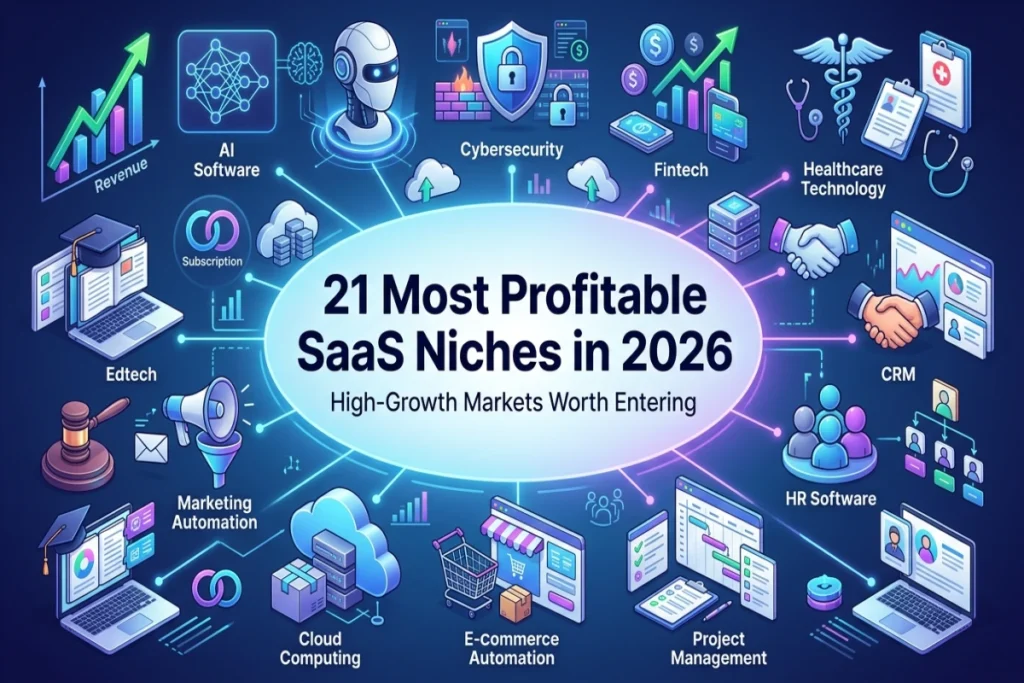
The global SaaS market is on a relentless climb — projected to surpass $1.2 trillion by 2030, with over 30,000 SaaS companies already operating worldwide. Yet most founders ask the same question before writing a single line of code: which niche is actually worth entering?
Choosing the right niche is the highest-leverage decision you’ll make as a SaaS founder. Build in a shrinking market and perfect execution still can’t save you. Build in one of the most profitable SaaS niches and even a simple product can generate significant recurring revenue. This guide breaks down 21 high-growth software markets — covering demand signals, monetization models, competition levels, and realistic revenue benchmarks — so you can make that decision with clarity.
What Makes a SaaS Niche Profitable?
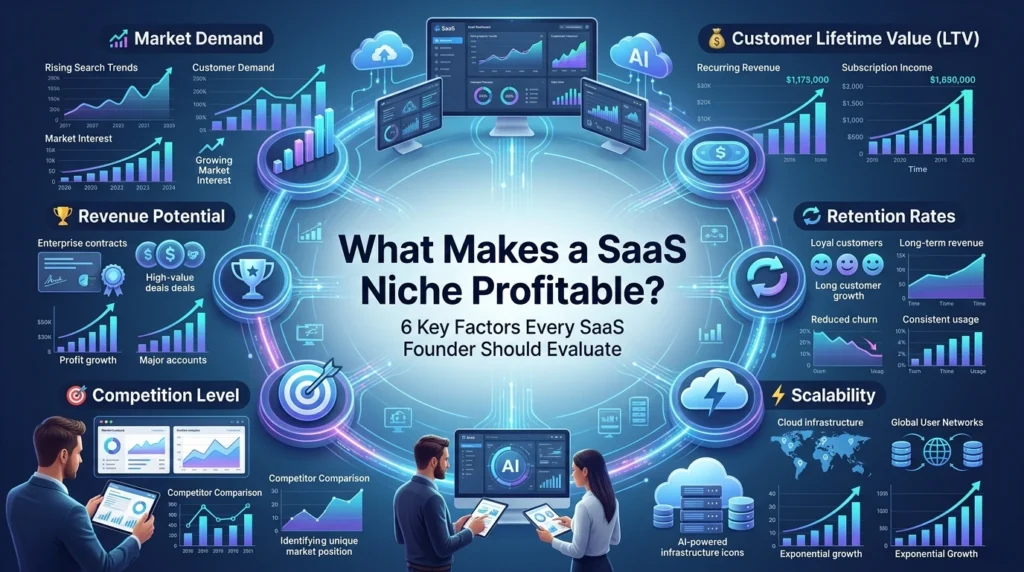
Not all software categories offer the same earning potential. Before committing to a specific market, it is essential to evaluate the Most Profitable SaaS Niches across six fundamental pillars:
Market Demand: Look for an expanding, clearly identifiable pain point that target buyers are actively trying to solve. High organic search volume often signals strong transactional intent.
Customer Lifetime Value (LTV): In the business-to-business (B2B) software space, annual customer churn averages around 5–7%. This is significantly lower than consumer mobile applications. A higher LTV allows you to spend more aggressively on acquiring new users.
Retention Rates: Software that integrates deeply into daily company operations builds long-term, compounding revenue. Operational platforms, payroll tools, and medical practice management applications frequently see Net Revenue Retention (NRR) benchmarks surpass 110%.
Scalability: The financial margins of software products naturally improve as user bases expand. Focus on sectors where cloud hosting and infrastructure costs do not grow at the same linear pace as your customer acquisition.
Competition Level: Existing market rivals validate real consumer demand. However, spaces dominated by tech giants like Salesforce, HubSpot, or Adobe require a highly specialized approach—typically through vertical industry specialization or proprietary AI integrations.
Revenue Potential: Enterprise-focused sectors like HR technology, legal tech, digital healthcare, and fintech command much higher average contract values (ACV). Conversely, consumer-focused products require massive user volume to succeed. You must choose which business model fits your goals.
The Quick Validation Test
Before building a product within the Most Profitable SaaS Niches, confirm the opportunity with a quick sanity check: Can you easily locate 50 qualified prospects today who would pay between $50 and $500 monthly for a working solution? If you can confidently answer yes, you have found a viable, real-world market.
Read These Too:
21 Most Profitable SaaS Niches in 2026
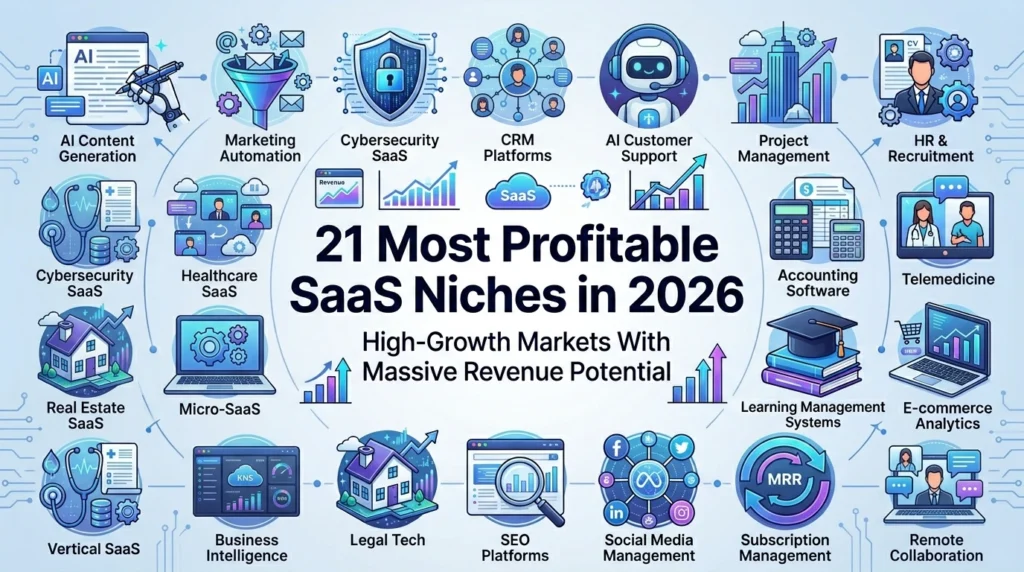
01. AI Content Generation Tools
Demand Dynamics: Very High
ARR Trajectory: $100K–$10M
Execution Difficulty: Medium
The market for automated content production expanded dramatically after 2023 and shows zero signs of slowing down. Today, corporate marketing teams and agencies require specialized software that goes far beyond basic text generation. Platforms capable of producing high-converting ad copy, localized e-commerce descriptions, SEO-optimized articles, and automated video scripts command elite pricing structures.
Growth Catalyst: The demand for digital content is infinite, but internal marketing headcounts remain limited.
Target Audience: Digital marketing agencies, high-volume e-commerce brands, and independent creators.
Monetization Playbook: Tiered per-seat licenses or consumption-based token models.
The Winning Angle: Avoid generalist text bots. Hyper-focused vertical platforms (e.g., AI tailored specifically for medical compliance documentation or legal briefs) easily outperform broad alternatives.
02. AI Customer Support Platforms
Demand Dynamics: Very High
ARR Trajectory: $500K–$20M
Execution Difficulty: High
Intelligent support systems—ranging from automated ticketing routing to conversational AI agents—have become foundational infrastructure for customer experience teams. Businesses that traditionally spend $50,000 annually on human support reps are eager to pay $10,000 for software that instantly resolves 60% of inbound queries. The direct return on investment (ROI) makes this one of the Most Profitable SaaS Niches to sell into.
Target Audience: Growth-stage B2B software companies, enterprise e-commerce platforms, and fintech startups.
The Winning Angle: Build deep, seamless integrations with existing helpdesks like Zendesk, Intercom, or Freshdesk. Specializing in a specific industry vertical allows you to bypass generic competition.
03. Cybersecurity SaaS
Demand Dynamics: Explosive
ARR Trajectory: $1M–$50M
Execution Difficulty: High
Global cyber threats continue to inflict trillions of dollars in economic damages. Small and medium-sized businesses (SMBs), which have historically lacked enterprise-grade protection, are now prime targets. Within this sector, compliance automation tools (such as SOC 2 readiness, automated vendor risk assessments, and phishing simulations) are exceptionally lucrative because modern corporate procurement policies explicitly mandate them.
Target Audience: Risk-exposed SMBs, mid-market enterprises, and internal compliance officers.
Monetization Playbook: Annual recurring revenue (ARR) contracts paired with exceptionally strong net dollar retention.
The Winning Angle: Launching a compliance tracking tool or employee security training portal presents a much lower barrier to entry than building core infrastructure firewalls.
04. Marketing Automation Software
Demand Dynamics: High
ARR Trajectory: $200K–$10M
Execution Difficulty: High
While enterprise giants like HubSpot and Marketo dominate upper-tier corporations, the SMB ecosystem remains highly fragmented. Creating vertical-specific marketing automation—engineered exclusively for boutique gyms, dental practices, or real estate brokers—wins on workflow depth and contextual relevance over horizontal scale.
The Winning Angle: Build features so deeply attuned to one target sector that generalist alternatives cannot match your workflow efficiency.
Monetization Playbook: Scaled subscription tiers based on database contact volume or monthly email limits.
05. CRM Platforms
Demand Dynamics: High
ARR Trajectory: $100K–$25M
Execution Difficulty: Medium
Customer Relationship Management (CRM) remains the most consistently purchased category in the B2B software world. The path to profitability avoids launching another broad CRM; instead, success lies in building dedicated platforms for distinct professional roles, such as freelance consultants, mortgage brokers, or independent event coordinators. These vertical CRMs naturally command higher average contract values (ACV) and lower user churn.
06. Project Management Software
Demand Dynamics: Steady
ARR Trajectory: $100K–$5M
Execution Difficulty: Medium
Horizontal platforms like Asana, Monday.com, and Linear hold massive market share, but highly customized project trackers built for construction managers, architecture studios, or creative firms have carved out highly defensible, incredibly stable revenue. Success depends entirely on deep workflow alignment rather than chasing feature parity with the market leaders.
07. HR and Recruitment Software
Demand Dynamics: High
ARR Trajectory: $200K–$15M
Execution Difficulty: Medium
Employee onboarding, talent sourcing, performance metrics, and labor compliance represent persistent pain points for growing corporations. For founders exploring the Most Profitable SaaS Niches, AI-powered resume screening, skills-assessment tools, and workforce analytics software are exceptionally lucrative categories. Fast-growing SMBs remain underserved by legacy enterprise HR software suites.
08. Accounting and Bookkeeping SaaS
Demand Dynamics: Evergreen
ARR Trajectory: $150K–$10M
Execution Difficulty: Medium
Financial software boasts incredibly high customer lifetime value (LTV) because moving historical ledger data is a logistical nightmare for most business owners. Premium opportunities lie in building automated bookkeeping engines, real-time cash flow forecasting dashboards, and specialized tax compliance systems for unique operations like e-commerce sellers or non-profit organizations.
09. Telemedicine Platforms
Demand Dynamics: Very High
ARR Trajectory: $500K–$30M
Execution Difficulty: High
Virtual healthcare delivery has transitioned from an emergency alternative to a permanent standard. Software that securely connects medical professionals with patients, facilitates remote physiological monitoring, or tracks chronic care plans is scaling rapidly. The severe regulatory and security requirements in healthcare act as an excellent competitive moat for companies that successfully navigate them early.
10. Online Learning Management Systems (LMS)
Demand Dynamics: High
ARR Trajectory: $100K–$8M
Execution Difficulty: Low–Medium
Corporate learning and development (L&D), professional certifications, and the independent creator economy are driving massive demand for educational hubs. The most direct path to traction is building niche LMS portals tailored to specific professional sectors, coding bootcamps, or hands-on trade schools. Integrating adaptive, AI-driven learning pathways provides an immediate competitive advantage.
11. E-commerce Analytics Software
Demand Dynamics: High
ARR Trajectory: $100K–$5M
Execution Difficulty: Low–Medium
Direct-to-consumer (DTC) brands constantly require advanced multi-channel marketing attribution, automated inventory forecasting, and deep customer cohort analysis that standard native marketplace dashboards fail to provide. Bulletproof data syncing with Shopify, WooCommerce, and major ad networks results in highly compressed, efficient sales cycles.
12. Subscription Management Platforms
Demand Dynamics: Growing
ARR Trajectory: $200K–$15M
Execution Difficulty: Medium
As digital and physical businesses alike pivot toward recurring monetization, they require robust tools to manage complex billing cycles, dunning management (failed payment recovery), plan proration, and retention data. While horizontal players exist, immense opportunity remains for vertical billing systems built explicitly for digital publishers, enterprise memberships, or niche SaaS startups.
13. Social Media Management Tools
Demand Dynamics: Steady
ARR Trajectory: $50K–$3M
Execution Difficulty: High
Legacy suites like Buffer, Hootsuite, and Sprout Social maintain a firm grip on general brand management. However, highly targeted micro-tools—such as LinkedIn-focused scheduling apps, creator-first short-form video pipelines, or industry-specific social listening software—enjoy rapid adoption by avoiding broad feature wars.
14. SEO and Keyword Research Platforms
Demand Dynamics: High
ARR Trajectory: $100K–$10M
Execution Difficulty: Medium
Even with the rise of conversational AI engines, search engine optimization tools are seeing elevated demand. Digital brands require precise systems to track rank volatility, audit competitor movements, and map out semantic content networks. While the broad consumer SEO space is crowded, specialized optimization platforms built for local businesses or multi-client agencies remain highly underserved.
15. Real Estate SaaS Solutions
Demand Dynamics: Growing
ARR Trajectory: $100K–$8M
Execution Difficulty: Low–Medium
The real estate sector is notoriously slow to integrate new technology, opening up massive windows of opportunity for software builders. Property management systems, tenant background checks, automated leasing workflows, and vacation rental optimization tools all enjoy eager, highly capitalized buyer bases that appreciate high contract values and long retention cycles.
16. Legal Technology Software
Demand Dynamics: Surging
ARR Trajectory: $200K–$20M
Execution Difficulty: Medium
Artificial intelligence is actively reshaping legal research, contract reviews, corporate due diligence, and active case management. Boutique law firms, solo practitioners, and corporate legal departments are integrating cloud software at record rates. Professional willingness to pay is incredibly high, provided the system satisfies rigorous data security criteria.
17. Healthcare Practice Management
Demand Dynamics: Very High
ARR Trajectory: $300K–$25M
Execution Difficulty: High
Administrative scheduling, patient billing pipelines, Electronic Health Record (EHR) configurations, and insurance claim tracking are essential requirements for medical providers. Because most existing legacy setups are outdated and frustrating to navigate, clean startups that combine a flawless user experience with strict HIPAA compliance expand rapidly via peer referrals within provider networks.
18. Business Intelligence Platforms
Demand Dynamics: High
ARR Trajectory: $200K–$15M
Execution Difficulty: Medium
With enterprise data expanding exponentially, operational teams want intuitive dashboard interfaces that do not require dedicated data science departments. Embedded analytics (BI modules white-labeled directly inside other applications), code-free visual models, and sector-focused analytics for restaurants or supply chains represent exceptional sub-niches.
19. Remote Team Collaboration Tools
Demand Dynamics: Steady
ARR Trajectory: $50K–$5M
Execution Difficulty: High
Distributed workflows are a permanent fixture for knowledge workers worldwide. Software that refines asynchronous communication, organizes virtual offices, indexes meeting data, or maintains company culture sees consistent market traction. The massive Zoom and Slack monopolies restrict general software entry, but highly technical solutions optimized for engineers, designers, or product teams are thriving.
20. Vertical SaaS for Specific Industries
Demand Dynamics: Explosive
ARR Trajectory: $200K–$30M
Execution Difficulty: Low–Medium
This stands as one of the single most explosive overarching trends across the global software landscape. Vertical SaaS—platforms constructed exclusively to run one distinct industry (e.g., commercial HVAC companies, auto dealerships, hair salons, or specialized law firms)—enjoys much higher contract value and massive organic referral networks. According to data on B2B SaaS Net Revenue Retention benchmarks from Optifai, verticalized platforms frequently outpace generic counterparts by hitting median NRR rates near 118%. The playbook is incredibly straightforward: identify a sector heavily dependent on old spreadsheets and manual phone calls, and build a unified operating system to replace them.
21. Micro SaaS Products
Demand Dynamics: Growing
ARR Trajectory: $1K–$500K
Execution Difficulty: Low
Micro SaaS applications—compact, single-feature utilities built to solve one specific point of friction—are perfect entry points for solo developers and bootstrapped entrepreneurs. Examples include specialized browser extensions that format social media text, premium workplace templates, or small integrations that automate team goal-tracking. These require minimal overhead capital, allow for rapid validation, and routinely generate comfortable monthly recurring revenue (MRR) for lifestyle business owners
SaaS Niche Comparison Table
When analyzing potential software investments or planning a new product launch, a side-by-side market evaluation is indispensable. According to industry data from Gartner’s software adoption forecasts, SaaS applications are projected to capture up to 85% of total enterprise software spending. To help you map out your development or acquisition strategy, the framework below outlines the market demand, competitive density, average annual recurring revenue (ARR) potential, and technical execution barriers across the Most Profitable SaaS Niches.
SaaS Niche Comparison Matrix
| Sector / Niche | Market Demand | Competitive Intensity | ARR Revenue Potential | Technical Difficulty |
| AI Content Generation | Very High | High | $100K–$10M | Medium |
| AI Customer Support | Very High | High | $500K–$20M | High |
| Cybersecurity SaaS | Explosive | High | $1M–$50M | High |
| Marketing Automation | High | High | $200K–$10M | High |
| CRM Platforms | High | High | $100K–$25M | Medium |
| Project Management | Steady | High | $100K–$5M | Medium |
| HR & Recruitment | High | Medium | $200K–$15M | Medium |
| Accounting SaaS | Evergreen | Medium | $150K–$10M | Medium |
| Telemedicine | Very High | Medium | $500K–$30M | High |
| LMS / eLearning | High | Medium | $100K–$8M | Low–Medium |
| E-commerce Analytics | High | Low–Medium | $100K–$5M | Low–Medium |
| Subscription Mgmt | Growing | Medium | $200K–$15M | Medium |
| Social Media Mgmt | Steady | Very High | $50K–$3M | High |
| SEO Platforms | High | High | $100K–$10M | Medium |
| Real Estate SaaS | Growing | Low–Medium | $100K–$8M | Low–Medium |
| Legal Tech | Surging | Low | $200K–$20M | Medium |
| Healthcare Practice | Very High | Medium | $300K–$25M | High |
| Business Intelligence | High | High | $200K–$15M | Medium |
| Remote Collaboration | Steady | Very High | $50K–$5M | High |
| Vertical SaaS | Explosive | Low | $200K–$30M | Low–Medium |
| Micro SaaS | Growing | Low | $1K–$500K |
How to Choose the Right SaaS Niche
Finding your ideal market requires aligning real-world demand with your specific technical and professional advantages. To identify where you fit within the Most Profitable SaaS Niches, follow this step-by-step validation roadmap:
Leverage Existing Domain Knowledge: The most direct path to sustainable revenue is serving a market you understand inside out. For instance, a veteran healthcare administrator will intuitively build superior medical practice management software compared to a generalist developer. They naturally grasp daily workplace bottlenecks, complex industry regulations, and the exact language spoken by target buyers.
Validate Before Writing Code: Before investing in software engineering, conduct 20 to 30 customer discovery interviews with target users. Combine this qualitative data with a high-converting landing page to collect early waitlist signups. If you cannot capture the attention of at least 50 highly interested prospects before launching development, the market signal is too weak.
Conduct Honest Competitive Analysis: Audit platforms like G2, Capterra, and active Reddit communities to analyze the critical one-star and two-star reviews of existing industry software. The structural value proposition of your new product should directly solve the most common frustrations and feature gaps noted by your competitors’ users.
Model Unit Economics Early: Carefully calculate your target Average Contract Value (ACV), expected user churn, and customer acquisition costs before publishing your pricing page. SaaS pricing benchmarks show that underpricing is a common pitfall, as founders frequently project their own price sensitivities onto enterprise buyers, leaving substantial money on the table.
Map Distribution Channels First: The most engineered software product within the Most Profitable SaaS Niches is completely worthless if you cannot reach your audience. Determine whether your ideal users are best acquired via organic search engine optimization (SEO), digital communities, outbound sales strategies, partner networks, or native platform integrations. Establish your go-to-market architecture before starting development.
You May Also Like These:
Common Mistakes SaaS Founders Make
Warning: The graveyard of software startups is filled with products that were built entirely before they were properly validated. These five missteps account for the vast majority of early-stage corporate failures.
1. Building Prior to Market Validation
Spending months writing code for a product only to discover that no one wants to pay for it is completely avoidable. You must secure market commitment before engineering. Leveraging interactive Figma mockups, private waitlist campaigns, or manual concierge versions of your solution allows you to test real commercial interest in weeks. This prevents wasted runway before you target the Most Profitable SaaS Niches.
2. Ignoring Long-Term Retention Metrics
Acquiring new users is meaningless if they cancel their subscriptions within 90 days. According to comprehensive industry analysis from Webapper, high churn is one of the top preventable causes of software death. If your monthly logo churn surpasses 5%, you are dealing with an fundamental product-market fit problem, not a marketing budget issue. You must seal the cracks in your user experience before pouring capital into traffic acquisition.
3. Neglecting the Onboarding Experience
The majority of subscription cancellations happen within the first 30 days of setup. If new users cannot uncover their core “aha moment” almost immediately, they will abandon the application. Rather than scaling aggressive outbound sales, allocate early resources into intuitive user onboarding flows, explicit activation milestones, and proactive customer success programs.
4. Underpricing Your Value Proposition
Slapping a cheap $9 monthly price tag on a tool intended for enterprise buyers signals sub-par quality. Research existing market alternatives, determine your buyer’s actual budget authority, and anchor your pricing tiers strictly to the financial ROI you deliver. Never price your software based on what feels personally comfortable.
5. Attempting to Target Everyone
Declaring that your software “is perfect for any business” is a fatal positioning mistake. When you refine your focus on specific, highly technical sectors, your overall messaging sharpens, your customer acquisition cost (CAC) drops, and user retention inherently goes up. Winning the Most Profitable SaaS Niches requires dominating a micro-segment before trying to expand outward.
Monetization Strategies for SaaS Businesses
Selecting the optimal revenue generation model relies on your specific market segment, target buyer profiles, and the inherent complexity of your product. To build a sustainable growth engine within the Most Profitable SaaS Niches, implement a strategy tailored to how your audience naturally buys and scales.
Tiered Subscription Plans: Structuring your offer into clear packages (such as Starter, Professional, and Business tiers) remains the foundational B2B framework. The secret to maximizing conversions is defining strict, value-driven differentiation between each tier. This limits decision paralysis and creates frictionless upgrade paths as your users expand.
Freemium Acquisition Models: Providing a free tier is highly effective when your customer acquisition cost (CAC) is exceptionally low and your product inherently drives viral, usage-based conversions. However, this strategy backfires if free tier users never upgrade, or if they drain your active technical infrastructure and support resources without generating financial returns.
Enterprise Custom Contracts: Targeting large organizations with personalized corporate contracts yields significantly higher average contract values (ACVs), ranging anywhere from $15,000 to over $500,000 annually. While this strategy demands a dedicated, high-touch sales process, it dramatically extends your long-term customer lifetime value (LTV) and establishes highly predictable cash flow.
Usage-Based and Hybrid Models: Charging consumers based on direct infrastructure utility—such as billing per API call, volume of data processed, or tokens consumed—aligns your incoming revenue directly with consumer value delivery. According to modern SaaS benchmarks and pricing data from Zylo, hybrid strategies that combine a stable base subscription with variable consumption meters have spiked in popularity, driven primarily by the variable infrastructure costs of modern AI tools.
White-Label Licensing: Licensing your software to independent agencies or third-party enterprise partners who rebrand and sell it as their own is a powerful distribution play. This multiplier effect expands your overall market share and drives predictable recurring revenue without inflating your internal marketing or advertising budgets.
Strategic Integration Marketplaces: Listing your product directly inside massive digital ecosystems—such as the Shopify App Store, Salesforce AppExchange, or HubSpot Marketplace—unlocks immediate access to highly motivated, warm buyers. These platforms serve as self-funding acquisition channels that reduce your dependency on paid ads
Read This Too:
Future SaaS Trends to Watch
The groundwork for the next generation of industry leaders is being established right now. Founders aiming to capitalize on the Most Profitable SaaS Niches over the coming years must closely monitor these macro shifts:
Autonomous AI Agents: Software is shifting from human-operated assistants to independent agents capable of managing complex, multi-step operations. Agentic, native software architectures are progressively replacing traditional dashboard-centric tools by owning actual business outcomes.
Hyper-Vertical Specialization: The migration away from broad, horizontal software toward hyper-specific vertical tools is moving faster than ever. Industry-specific systems are capturing a dominant share of corporate IT budgets as late-adopting sectors hit their digital maturity thresholds.
No-Code and Low-Code Infrastructure: Solutions engineered to democratize tech development for non-technical workers (such as visual application builders and automated data pipelines) remain a high-growth segment. Removing the traditional developer bottleneck continues to be a top corporate priority.
Embedded Financial Services: Integrating native transaction processing, commercial lending protocols, and insurance options directly into existing operational workflows allows SaaS platforms to unlock secondary monetization engines while drastically increasing customer retention.
Advanced Predictive Analytics: Moving past retrospective dashboard reporting to forward-looking foresight creates massive competitive advantages. Platforms that accurately forecast subscriber churn, flag at-risk clients, or project cash flow solve problems companies will gladly pay premium rates for.
Domain-Specific Artificial Intelligence: While generalized large language models remain helpful, AI systems deeply trained on precise medical records, financial compliance data, or legal discovery files are driving true digital transformation across enterprise ecosystems.
According to industry research from BetterCloud on cloud software evolution, organizations are moving away from rigid point solutions toward integrated platforms that prioritize computational intelligence and automated workflow execution
You May Like These:
Conclusion: Choosing Your Most Profitable SaaS Niche
The Most Profitable SaaS Niches in 2026 share a distinct, repeatable pattern: they resolve complex, high-liability business friction for enterprise buyers who possess both the financial capacity and immediate operational intent to invest in solutions. Fully autonomous AI-native engines, hyper-vertical software architectures, and compliance-dependent tools (such as modern cybersecurity systems, legal tech, and clinical healthcare software) consistently deliver maximum revenue velocity combined with minimal user price sensitivity.
However, the definitive “best” sector is not simply the market with the largest total addressable revenue ceiling—it is the exact micro-segment where you hold an unfair execution advantage. Your specialized domain experience, localized industry network, and distinct distribution channels matter just as much as broader market demand. An industry expert who has spent a decade managing real-world workflows will consistently build a more defensible product than a generalist developer, moving with precision within the Most Profitable SaaS Niches.
Always validate commercial interest before deploying code. Conduct at least 30 targeted customer discovery interviews with real buyers before building your application architecture. The startup founders winning in 2026 are not merely those moving at maximum speed—they are the ones navigating in the absolute right direction.
Frequently Asked Questions (FAQ)
Which SaaS niches boast the highest profitability indicators right now?
Advanced compliance automation, specialized healthcare practice systems, and autonomous AI customer support platforms consistently showcase superior annual contract values (ACVs) and durable retention rates. That said, true profitability is fundamentally tied to a founder’s specialized industry insights. Today, vertical SaaS frameworks—software custom-built for one precise field—represent the highest-return environments for early-stage builders due to lower generic competition and highly concentrated customer referral loops.
Is launching an artificial intelligence software startup still a lucrative path?
Yes, but success requires moving past basic horizontal wrappers. AI-driven products that manage high-value, multi-step professional operations (like automated legal document discovery, programmatic medical billing, or autonomous helpdesk workflows) are highly lucrative. Conversely, basic text generation tools face intense commoditization as baseline LLM hosting costs continue to fall. The winning framework is embedding AI as the invisible processing core of a domain-specific software product, rather than trying to market the AI model itself.
What are the top low-competition software sectors available for new builders?
Highly focused vertical SaaS, legal tech innovations, specialized property management tools, and granular multi-channel e-commerce analytics exhibit lower competitive saturation relative to crowded horizontal tracking tools like generic CRMs or basic task managers. The premium low-competition opportunities reside in legacy industries where the dominant tools were engineered over a decade ago and have failed to adapt to modern user experience standards or automated workflows.
What level of recurring revenue can an early-stage SaaS product realistically generate?
The revenue bandwidth is vast and depends entirely on your core pricing model. Bootstrapped micro-SaaS utilities routinely scale to between $2,000 and $20,000 in monthly recurring revenue (MRR) under solo operators. Business-focused SMB software companies often capture between $1 million and $5 million in ARR within a few years of release. Meanwhile, enterprise-grade products in high-ACV markets like cybersecurity easily breach $10 million+ ARR thresholds. Growth comes down to contract value: retaining 100 clients at a $5,000 ACV creates a $500,000 ARR business, whereas the same user base at a $50,000 enterprise tier yields $5 million in ARR.
What exactly is the difference between vertical and horizontal SaaS?
Vertical SaaS refers to cloud software engineered exclusively to manage the operational workflows of a specific industry or profession, whereas horizontal SaaS provides broad utilities (like spreadsheet tools or payroll engines) meant to serve any corporate entity regardless of sector. Classic examples of vertical platforms include Procore for industrial construction or Mindbody for fitness studios. Because vertical software integrates deeply with the exact regulatory requirements and day-to-day operations of its target market, it naturally commands superior net revenue retention, organic word-of-mouth growth, and pricing power.
Is it still viable to build and launch a Micro SaaS product independently?
Absolutely. Building highly targeted micro-applications remains an exceptional monetization strategy for independent developers and solo entrepreneurs. The unit economics of micro-products have improved: advanced development tools dramatically compress engineering timelines, no-code cloud platforms lower initial infrastructure overhead, and launch marketplaces like AppSumo or Product Hunt supply instant global audiences. A hyper-focused micro-utility that eliminates a specific operational bottleneck can easily maintain a profitable $5,000 to $20,000 MRR footprint.
Final Thoughts
The underlying dynamics of the Most Profitable SaaS Niches are not hidden secrets—they are predictable, structural patterns. They require identifying highly technical issues, serving distinct customer segments, and delivering software that integrates natively into active business workflows. Your ultimate objective as a creator is to pinpoint where these industry patterns cross paths with your personal expertise, and validate those assumptions relentlessly. Capital rewards hyper-specificity, execution patience, and radical customer focus. Start narrow, build deep, and the recurring revenue will follow.