

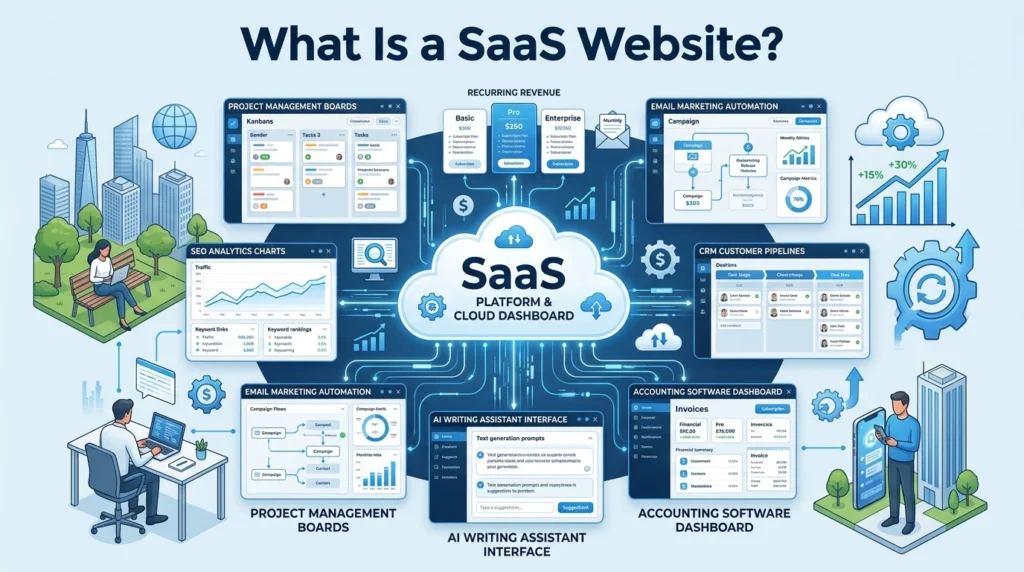
The Software as a Service framework has revolutionized the digital economy, establishing itself as one of the most lucrative setups in the modern tech ecosystem. When analyzing how SaaS websites make money, the core structural advantages of the model explain why these businesses achieve such massive valuations.
Unlike traditional retail or transactional e-commerce, cloud-based software companies leverage unique operational leverage points that maximize profitability.
Key Operational Advantages of the SaaS Framework
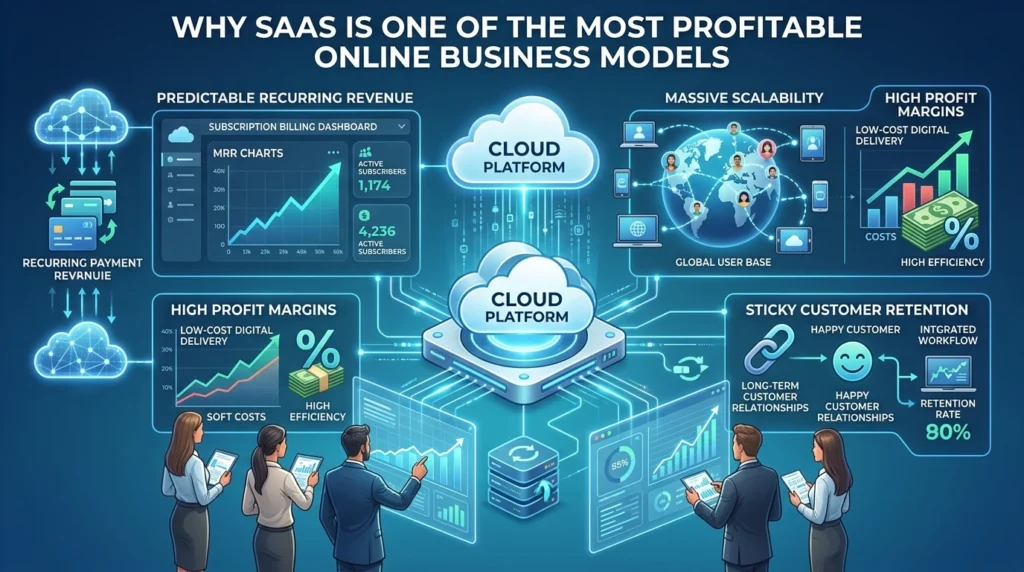
Predictable Recurring Revenue: Instead of relying on unpredictable, one-off purchases, software platforms function on continuous subscription models. Customers pay on a monthly or annual cycle, providing companies with highly predictable monthly recurring revenue (MRR) that stabilizes cash flow and simplifies financial planning.
Massive Scalability: Once the primary codebase is built, a single software application can comfortably serve thousands—or even millions—of global users simultaneously. According to cloud infrastructure benchmarks compiled by Gartner, scalable cloud architectures mean companies don’t face physical supply chain bottlenecks when onboarding new clients.
High Profit Margins: The initial capital required to research, design, and program software is undeniably front-heavy. However, once development costs are covered, the marginal cost of delivering the service to an additional user drops to nearly zero, resulting in exceptional gross margins.
Sticky Customer Retention: Because modern enterprises bake these platforms directly into their daily operations (such as relying on a specific CRM or project management suite), switching costs are incredibly high. This deeply integrated dependency keeps customer churn significantly lower than customer turnover rates seen in standard subscription boxes or retail programs.
Because of these compounding operational benefits, analyzing how SaaS websites make money involves looking beyond simple single-stream sales. The innate flexibility of cloud software allows digital businesses to unlock and optimize multiple diverse revenue channels simultaneously. This multi-tiered monetization capability is precisely what cements cloud computing as a premier global business model.
Read this too:
 Tool Website Case Study (30 Days Build)
15 Website Monetization Strategies That Actually Work in 2026
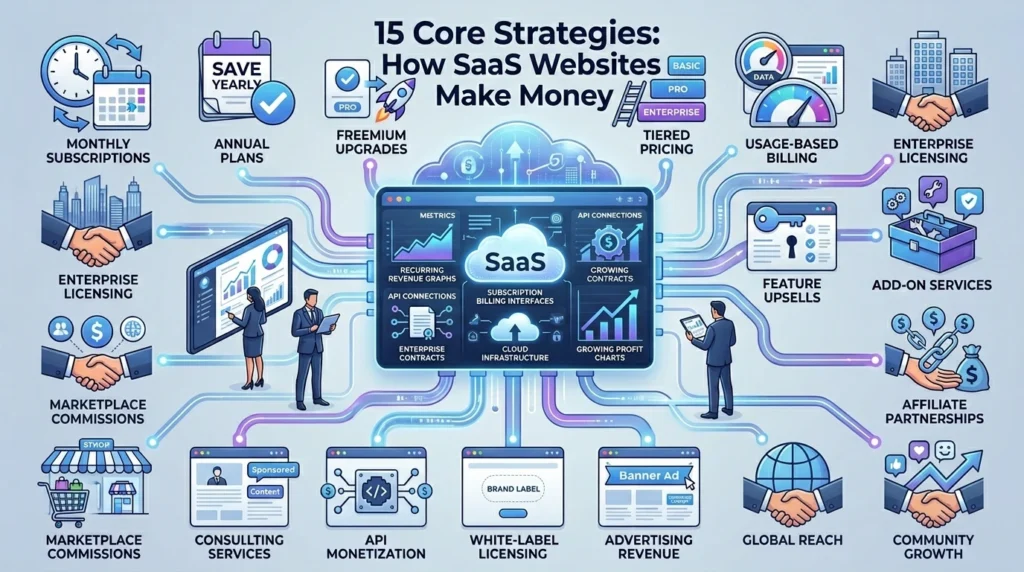
Building a profitable cloud software platform requires a strategic monetization framework. If you want to understand how SaaS websites make money, you need to look at the flexible pricing structures they use to attract different customer segments.
Below, we break down the five most prevalent revenue strategies utilized by industry leaders to drive growth and maximize profitability.
1. Monthly Subscription Plans
The foundation of modern cloud software monetization relies heavily on recurring monthly billing. Under this arrangement, clients pay a set, recurring fee every 30 days to retain access to their software dashboards and tools.
Standard Pricing Tier Breakdown Example:
Starter Plan: $9 per month (designed for solo users)
Professional Plan: $29 per month (optimized for growing teams)
Business Plan: $99 per month (built for full operational scales)
Why This Framework Succeeds: Monthly subscription infrastructure provides businesses with highly predictable, recurring revenue streams. Simultaneously, it aligns with standard corporate operational budgeting, allowing small businesses to avoid massive upfront software procurement costs while drastically increasing overall customer retention rates.
2. Annual Subscription Plans
To secure long-term commitments, savvy operators structure their payment terms to incentivize upfront annual billing. Companies typically offer a financial incentive—usually ranging from 15% to 25% off the total cost—to encourage users to pay for a full year of service in advance.
Monthly Cost Equivalent: $20/month ($240 total over 1 year)
Annual Package Price: $192/year upfront (A 20% total savings for the client)
By shifting users onto annual agreements, platforms secure immediate, predictable cash flow that can be instantly reinvested into product development. This approach dramatically reduces annualized customer churn (the rate at which customers cancel subscriptions) and yields more stable long-term financial forecasting metrics. Ultimately, pushing upfront annual options significantly elevates total customer lifetime value (LTV).
3. The Freemium Model
The freemium strategy is a highly effective customer acquisition framework. It gives users completely free access to a basic version of the software, while reserving advanced capabilities, deeper integrations, or higher processing thresholds behind a premium paywall.
| Free Tier Capabilities (User Acquisition) | Premium Tier Functionality (Monetization Engine) |
| • Limited concurrent projects | • Advanced data analytics & customized reporting |
| • Basic, standardized data summaries | • Unlimited cloud workspace allocation |
| • Restricted local or cloud data storage | • Seamless multi-user team collaboration tools |
This low-friction entry point allows companies to build massive, highly engaged user bases organically. Over time, as a user’s operational needs expand, they naturally hit the platform’s usage ceilings, converting casual free users into high-value paying customers.
4. Tiered Pricing Structures
Rather than offering a single, rigid product option, companies design multi-tiered pricing architectures. This targeted approach ensures that the product appeals to multiple distinct buyer personas simultaneously, maximizing market share and boosting overall average revenue per user (ARPU).
Basic Tier: Stripped-down, affordable functionality tailored specifically for beginners, freelancers, or hobbyists.
Pro Tier: A robust, feature-rich suite designed to support the operational demands of scaling mid-sized businesses.
Enterprise Tier: Custom-tailored packages featuring dedicated support, advanced security protocols, and custom service-level agreements (SLAs) optimized for large-scale organizations.
By capturing market demand across multiple budget levels, businesses can extract maximum value from both price-sensitive startups and budget-flush enterprise accounts.
5. Usage-Based (Pay-As-You-Go) Pricing
Mirroring standard utility billing, usage-based models charge clients based on their exact consumption metrics within a billing cycle. This flexible framework is increasingly popular among developer tools, infrastructure services, and artificial intelligence companies.
Common consumption metrics include tracking API calls, gigabytes of cloud storage, automated email dispatches, or processing credits used by generative models. According to cloud infrastructure usage studies by McKinsey & Company, this strategy removes entry barriers for small teams by keeping initial costs low.
As a client’s business grows, their software usage expands naturally, ensuring the software vendor’s revenue scales automatically alongside their customer’s success.
Example of a high-traffic utility tool monetized through SEO + ads:
Viral tools like meme generators are powerful traffic acquisition assets:
6. High-Value Enterprise Licensing
While self-serve plans handle the volume, enterprise-level licensing delivers massive revenue spikes. Large corporations and government entities require specialized security frameworks, custom deployment configurations, and tailored legal contracts before onboarding a new platform.
To close these high-value corporate deals, platforms offer specialized enterprise packages that typically feature:
Dedicated Account Support: Direct access to dedicated account managers and technical support engineers.
Enterprise-Grade Compliance: Strict adherence to international security frameworks, custom single sign-on (SSO) integrations, and data compliance protocols.
Bespoke System Integrations: Custom API connections and engineering support to link the tool with existing legacy enterprise platforms.
Corporate Onboarding Programs: Tailored team training sessions and custom documentation to ensure smooth organization-wide adoption.
Because corporate procurement cycles are extensive, a single annual enterprise contract can easily generate tens of thousands—or even millions—of dollars in recurring contract value from one client organization.
7. Strategic Feature-Based Upselling
Once a user is comfortably onboarded, feature-based upselling serves as a primary engine for expansion revenue. This strategy focuses on keeping entry-level tiers highly affordable while gating advanced, productivity-boosting tools behind premium upgrades.
The core objective is to deliver incredible value in the foundational plans while encouraging scaling businesses to upgrade as their operations become more complex. Common features reserved for premium tiers include:
Advanced Analytics: Deep-dive reporting tools, predictive modeling, and customizable dashboards.
White-Label Ecosystems: The power to strip away the vendor’s brand identity and insert custom agency logos.
Complex Automation Sequences: Advanced multi-step logic workflows that eliminate manual data entry.
Granular Team Management: Sophisticated permission settings and collaborative workspaces for large cross-functional teams.
8. High-Margin Add-On Services
Another highly efficient method explaining how SaaS websites make money without constantly needing to acquire new traffic is the strategic sales of optional add-ons. Instead of forcing a user to jump to a completely new billing tier, add-ons let users customize their existing plans with modular upgrades.
Why Add-Ons Work: They allow power users to buy more of exactly what they need, optimizing profitability without adding user friction or forcing a full plan migration.
| Common Add-On Upgrades | Operational Value |
| Incremental Storage | Grants additional gigabytes or terabytes of cloud space as data footprints grow. |
| Seat Expansions | Allows teams to add individual users or seats to their current tier on an as-needed basis. |
| Premium Asset Packs | Unlocks exclusive design frameworks, pre-configured workflows, or industry templates. |
| Dedicated API Access | Provides developer keys to build custom internal integrations and automation hooks. |
9. Strategic Affiliate Marketing Partnerships
Monetization does not always have to come directly from proprietary software code. Many prominent platforms supplement their primary revenue by acting as trusted resource centers, recommending complementary third-party products to their existing user bases.
By incorporating specialized partner tracking links within their knowledge bases, community forums, and email newsletters, platforms earn healthy referral commissions. Popular affiliate pairings include:
Managed web hosting providers and cloud infrastructure networks.
Domain registrars and specialized cybersecurity tools.
Complementary data analytics or search engine optimization (SEO) software suites.
Integrated payment gateways or specialized transactional email marketing solutions.
When managed authentically, these affiliate networks turn software dashboards into highly profitable digital ecosystems.
10. Premium White-Label Licensing
White-label licensing allows a software vendor to sell its core platform infrastructure to third-party companies, who then rebrand and market the tool as their own proprietary creation.
According to software partnership frameworks outlined by organizations like HubSpot, this strategy serves as a powerful catalyst for fast-tracked business growth. Marketing agencies, consulting firms, and enterprise resellers particularly value white-label solutions because it allows them to offer proprietary tech stacks to their clients without spending years on software engineering. For the originating vendor, white-label agreements secure large upfront contracts and unlock entirely new revenue channels with minimal marketing spend.
Understanding the diverse avenues of how SaaS websites make money—from white-label licensing to usage expansions—shows why modern software platforms are incredibly resilient, highly scalable, and structurally optimized for long-term profitability.
11. API Monetization and Developer Ecosystems
An Application Programming Interface (API) allows external software applications to communicate directly with your platform. By selling programmatic access to their core infrastructure, software companies open up a massive, highly scalable business-to-business (B2B) revenue stream. Instead of interacting with a user interface, developers pay to pull data, processing power, or specialized functionality straight into their own custom systems.
Common variations of this framework include:
AI Models and Processing APIs: Charging per token or computational query to run machine learning tasks.
Data Aggregation and Enrichment APIs: Providing real-time financial tracking, market trends, or search metrics.
Payment Infrastructure APIs: Charging a processing fee to securely handle financial transactions.
Marketing Automation APIs: Enabling external platforms to instantly trigger outbound communication pipelines.
12. Monetizing Free Tiers with Targeted Advertising
For platforms that adopt a broad customer-acquisition strategy, a massive free user base can be monetized directly through digital advertising. This framework allows businesses to keep their tool accessible to casual users while turning traffic, impressions, and user engagement into steady cash flow.
To avoid degrading the user experience, platforms utilize highly tailored digital formats:
Contextual Display Banners: Integrating clean, relevant visual advertisements within secondary dashboard margins.
Sponsored Industry Placements: Spotlighting relevant third-party services that complement the tool’s core functionality.
Native Platform Advertising: Weaving promotional tools naturally into the user’s standard activity feed.
According to ad monetization guides by tech publications like TechCrunch, this model allows consumer-facing software tools to build massive market share without sacrificing immediate operational profitability.
13. High-Ticket Consulting and Professional Services
Enterprise software deployment can be incredibly complex. To ensure successful implementation, many vendors offer premium consulting and professional services alongside their standard digital subscriptions. These high-ticket packages help organizations transition smoothly away from legacy frameworks.
These high-margin service offerings typically include:
Dedicated Implementation and Setup Assistance: Configuring custom internal workspaces to align with client workflows.
Data Migration and System Architecture Integration: Safely transferring vast legacy databases into the cloud environment.
Bespoke Strategy Consulting: Analyzing performance data to maximize the business ROI of the platform.
Corporate Team Training Seminars: Hosting tailored onboarding bootcamps to drive organizational adoption.
14. Capitalizing on Marketplace Commissions
One of the most powerful milestones for a software company is transitioning from a standalone tool into a comprehensive digital ecosystem. By launching a dedicated marketplace, a software vendor allows third-party developers, designers, and creators to sell add-ons directly to its user base.
Third-Party Sale → Core Platform Processes Transaction → Vendor Collects 15%-30% Commission → Creator Receives Payout
Whether structured as an application marketplace, a custom plugin storefront, or a community template repository, the hosting company takes a percentage-based cut of every transactional exchange. This marketplace ecosystem creates a highly lucrative, passive source of income that scales effortlessly alongside community participation.
15. Leveraging Strategic Partnerships and Brand Sponsorships
Established platforms can leverage their niche market authority to secure lucrative corporate sponsorships. When a platform commands the daily attention of thousands of professionals, complementary non-competing brands are willing to pay a premium to put their services in front of that highly targeted audience.
These joint monetization initiatives frequently feature:
Collaborative Co-Marketing Initiatives: Co-producing educational webinars, research reports, or industry whitepapers.
Sponsored Application Integrations: Featuring specific tools within default app connection dashboards.
Preferred Strategic Placements: Highlighting verified service partners within internal resource centers.
Reciprocal Affiliate and B2B Referral Frameworks: Earning substantial finders’ fees for sending qualified sales leads to partner companies.
Implementing these diverse strategic channels shows exactly how SaaS websites make money sustainably, highlighting why cloud platforms remain one of the most profitable business models in the global digital economy.