
introduction
Most SaaS companies burning $8,000 to $25,000 per month on paid advertising quickly realize that user acquisition stops the exact moment the budget dries up. In contrast, the software brands building sustainable, compounding growth are leveraging a smarter approach. High-intent organic search traffic converts at up to 3.5 times the rate of paid ads—and every high-ranking position you secure continues to drive leads indefinitely.
To help you capture this demand, this guide outlines a modern, actionable SaaS SEO Strategy 2026. This is not theoretical fluff; it is a step-by-step framework covering advanced keyword research, topical authority mapping, on-page optimization, technical health, link acquisition, and how to navigate the shift toward AI-assisted search.
Whether you are a solo founder launching a bootstrapped tool or a growth-stage marketing team looking to slash your customer acquisition costs (CAC), this is the definitive playbook you need to dominate the search engine results pages (SERPs). According to search engine guidelines from Search Engine Land, creating deeply valuable, user-first content remains the ultimate foundation for organic success.
Why SaaS SEO Is Different in 2026
Optimizing search visibility for a software product requires a completely different approach than managing an e-commerce storefront or a traditional lifestyle blog. Your target audience isn’t merely shopping for a standalone item; they are hunting for a robust solution to a pressing business bottleneck, frequently months before pulling out a credit card. Embracing this shifting paradigm forms the cornerstone of a successful SaaS SEO Strategy 2026.
The Reality of Modern B2B Software Acquisition
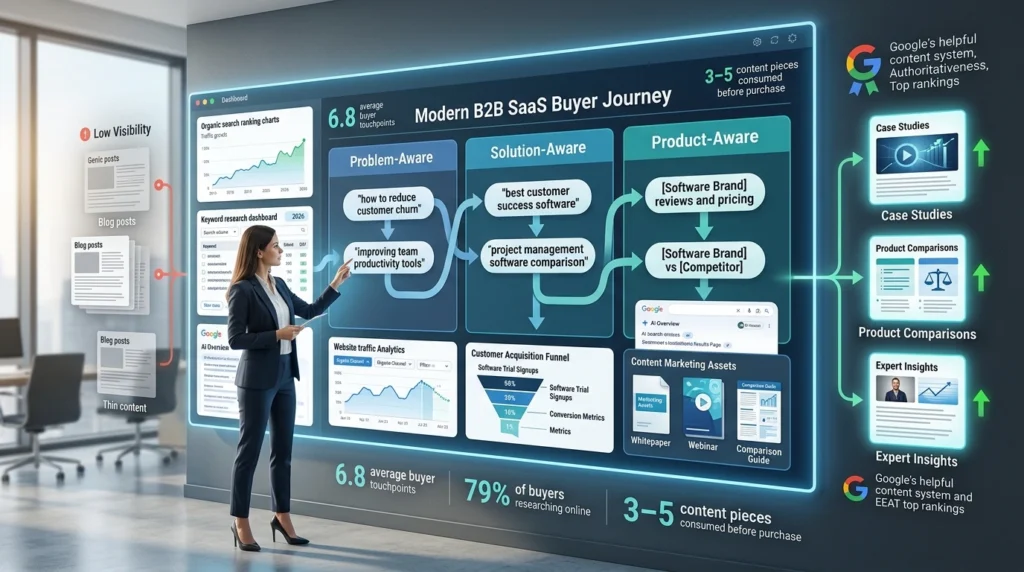
To build an impactful pipeline, your marketing team must navigate the highly non-linear path that modern buyers take:
6.8 Touchpoints: The average number of interactions a prospect has with a brand before making a final purchasing decision.
79% of Buyers: The overwhelming majority of B2B SaaS decision-makers who conduct independent online research before ever speaking to a sales representative.
3 to 5 Pieces of Content: The volume of articles, whitepapers, or case studies a prospect consumes before actively engaging with an account executive.
Decoding the SaaS Buyer Journey for Search
Prospects advance through three clear phases of awareness. Dominating the search engine results pages (SERPs) means tailoring your SaaS SEO Strategy 2026 to address each specific stage:
1. Problem-Aware (Top of Funnel)
At this juncture, users recognize a bottleneck in their workflow but are unaware that software can fix it. They turn to Google with queries like “how to reduce customer churn” or “why are my free trial users not converting.” While these informational phrases yield high search volume, they carry lower immediate purchasing intent. Your objective is to establish authority and capture mindshare early.
2. Solution-Aware (Middle of Funnel)
Here, prospects understand that software categories exist to solve their pain points. Their search patterns shift toward more commercial phrases, such as “best customer success software” or “churn reduction tools.” These terms offer moderate search volume but significantly higher intent. Roundups, feature deep-dives, and industry-specific landing pages are critical to winning this phase.
3. Product-Aware (Bottom of Funnel)
Buyers are now narrowing down their final shortlist. They execute highly transactional searches like “[Your Product] vs [Competitor]”, “[Your Product] reviews”, or “[Your Product] pricing”. Although these keywords have the lowest monthly search volume, they yield the highest conversion rates and directly drive pipeline revenue.
Critical Insights for the Current Search Landscape
The Quality Shift: Google’s continuous algorithmic focus on helpful, reliable information has fundamentally rewritten the rules of organic growth. Surface-level, mass-produced content fails to rank. Success today demands demonstrable subject-matter expertise, proprietary data, and genuine utility.
Furthermore, the widespread rollout of AI Overviews has transformed how informational queries behave, often answering basic questions directly on the search results page. Data analyzed by Search Engine Journal indicates that while top-of-funnel informational clicks have experienced downward pressure, high-intent commercial and transactional queries remain incredibly resilient.
The strategic takeaway is clear: an enterprise-grade SaaS SEO Strategy 2026 must prioritize high-intent, middle-, and bottom-of-funnel content to capture traffic that safely bypasses AI summaries and converts directly into trials and demos.
SaaS Keyword Research Strategy
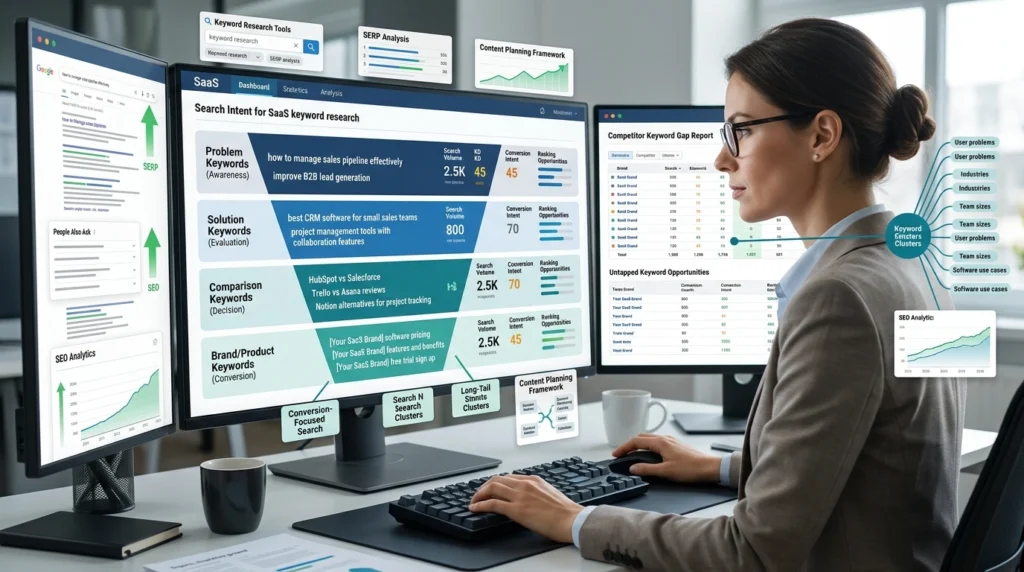
A high percentage of software marketing campaigns fall short because they approach keyword research backward. They waste resources chasing broad, high-volume search phrases they cannot realistically win, or prioritizing vanity terms that fail to generate actual signups. A winning SaaS SEO Strategy 2026 maps search terms directly to the buyer’s journey, securing quick victories in accessible niches before expanding outward.
The Core Principle: The guiding question shouldn’t be “which keyword boasts the highest monthly search volume?” Instead, ask yourself: “What exact phrase is my ideal customer typing into Google the moment before they realize they need my software?”
The Four Essential Keyword Categories for Software Products
To systematically build out your search pipeline, you must classify your targets into four distinct buckets based on where the user sits in your acquisition funnel:
| Category | Example (CRM SaaS) | Volume | KD (Difficulty) | Conversion Intent |
| Problem Keywords | how to manage sales pipeline effectively | High | Low | Awareness (Top of Funnel) |
| Solution Keywords | best CRM software for small sales teams | High | Medium | Evaluation (Middle of Funnel) |
| Comparison Keywords | HubSpot vs Salesforce for startups | Medium | Medium | Decision (Bottom of Funnel) |
| Brand/Product Keywords | [Your Product] pricing, [Your Product] reviews | Low–Med | Low | Purchase (Conversion) |
Uncovering High-Yield, Accessible Software Keywords
The most profitable search terms share three common traits: they are highly specific long-tail phrases (typically four to seven words), they align perfectly with a distinct customer “job-to-be-done,” and they feature moderate search volume paired with weak or outdated content currently sitting on page one.
Implementing an advanced SaaS SEO Strategy 2026 requires a structured, multi-channel approach to uncover these hidden gems:
1. Leverage Customer Vernacular Over Internal Jargon
Conduct interviews with 5 to 10 of your most active users. Ask them directly: “What phrases did you type into Google before finding our solution?” The natural vocabulary your target audience uses to articulate their pain points will always yield better search results than internal product terminology. While your development team might call your tool a “churn analytics platform,” your prospects are typing “why are my customers cancelling” into the search bar.
2. Isolate Competitor Keyword Gaps
Utilize professional market intelligence platforms like Ahrefs to cross-reference your domain against your top market rivals. Identify high-value phrases where two or more competitors rank in the top ten positions but your site is completely absent. To find immediate revenue-generating wins, filter this data to reveal terms with a Keyword Difficulty (KD) score under 40 and a monthly search volume exceeding 300 queries.
3. Extract Value from “People Also Ask” (PAA) Frameworks
Search your core software category on Google and click to expand several of the “People Also Ask” dropdown boxes. Every single question generated by this feature represents a search query that Google has already validated. These real-world user questions serve as exceptional subheadings (H2/H3) and FAQ segments, and they explicitly show you the structural format Google wants to see to award your site a featured snippet.
4. Capitalize on Highly Specific Modifier Patterns
Long-tail informational patterns consistently outperform broad, generic industry terms. Ranking a new or mid-tier site for “project management software” is an incredibly steep hill to climb. However, targeting “best project management software for remote creative teams” is highly winnable. It also converts at a substantially higher rate because the user has already pre-qualified their unique operational requirements.
High-Value Software Search Patterns to Deploy
Integrating these proven syntax models into your content production queue is a cornerstone of an aggressive SaaS SEO Strategy 2026:
how to [solve problem] for [specific industry]best [product category] software for [team type][competitor name] alternative for [specific use case]how to [achieve desirable verb] without [major pain point][competitor A] vs [competitor B] [current year]saas [product category] tools for [company size]how to reduce [negative business metric] in saas[core feature] software for [specific professional role]
Building Topical Authority Around Your SaaS Product
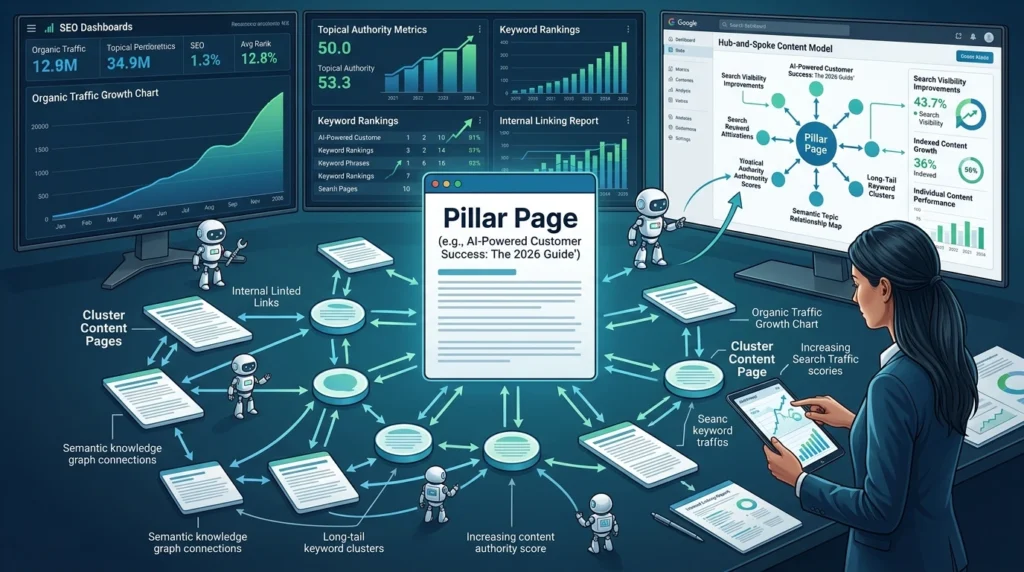
Google’s modern core ranking systems have fundamentally evolved away from assessing isolated pages to prioritizing entire web domains that demonstrate deep, undeniable expertise within a specific subject matter. For modern software brands, this structural pivot means that publishing a single standalone article is no longer enough. To capture premium organic visibility, you must construct an interconnected content network that signals to search engines that your platform is the absolute, definitive resource in your niche.
Developing this comprehensive level of subject expertise requires a highly structured, scalable SaaS SEO Strategy 2026. By organizing your site around logical informational themes, you can signal deep relevance and secure stable positions across competitive search queries.
The Pillar-Cluster Content Architecture
The cornerstone of a successful SaaS SEO Strategy 2026 is the pillar-cluster content framework. This architecture structures your site’s hierarchy in a way that maximizes internal link equity and simplifies how search engine bots crawl your resources.
       [ Core Category Pillar Page ]
         /          |          \
  [Cluster 1]  [Cluster 2]  [Cluster 3]
       \            |          /
     ( Bidirectional Internal Links )
The Pillar Page: A comprehensive, high-level manual (typically spanning 3,000 to 5,000 words) addressing your foundational category—such as “The Ultimate Guide to Enterprise Asset Management”. This resource skims across every relevant subtopic and targets highly competitive, broad search queries.
The Cluster Posts: A collection of 8 to 15 granular supporting guides (roughly 1,500 to 3,000 words each) diving deep into isolated subthemes. These specialized resources capture highly specific, long-tail phrases and feed authority directly back to the primary page.
Internal Linking Infrastructure: Every individual cluster article must link back to the central pillar page using precise, context-rich anchor text. Concurrently, the pillar page cross-links out to every single cluster asset. This establishes an unbroken topical web that search spiders can seamlessly parse.
The Compound Yield: As this network expands, the main pillar page receives a sustained algorithmic lift powered by the collective authority of the supporting posts. Meanwhile, the supporting articles secure quick individual wins, causing the entire domain’s visibility to rise in tandem.
According to long-term performance data compiled by HubSpot, migrating from unstructured blogging to a deliberate hub-and-spoke configuration remains one of the most reliable ways to scale search footprint. In practice, software firms executing a complete cluster model around a unified concept routinely experience organic traffic increases of 2.3x to 4.1x within a single six-month window compared to companies publishing disjointed, ad-hoc material.
Scale Requirements: How Many Content Hubs Do You Need?
A focused, mid-market B2B software platform should actively develop 3 to 5 distinct topical hubs, with each cluster mirroring a major, real-world workflow problem that your software solves.
Before branching out into secondary domains of thought, commit to creating a foundational hub page backed by at least 8 specialized supporting articles. When configuring your SaaS SEO Strategy 2026, remember that exhaustive depth always triumphs over superficial breadth; search engines consistently reward the brand that completely owns an industry niche over a competitor that merely scratches the surface of many.
On-Page SEO for SaaS Pages That Actually Convert
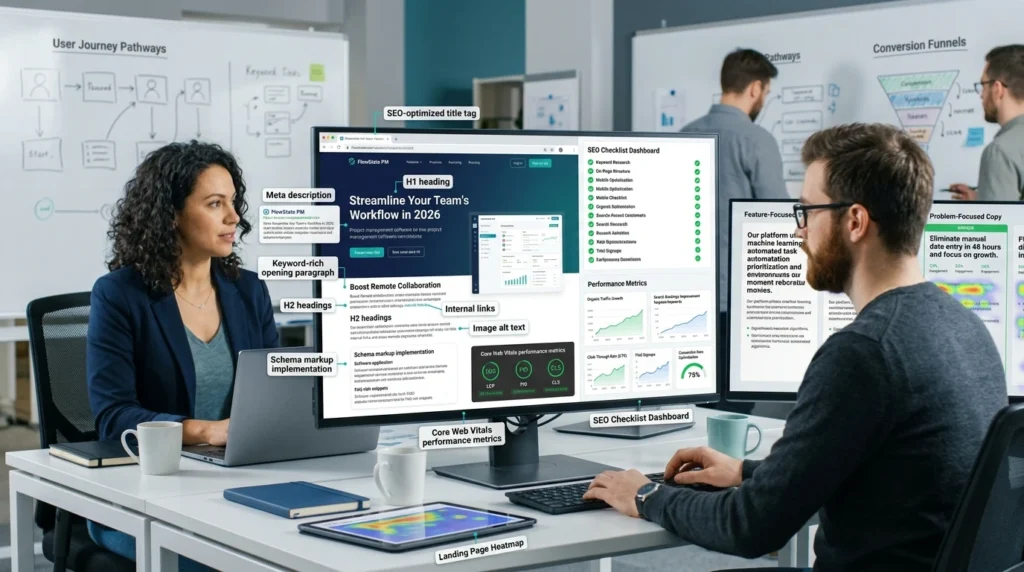
Executing effective on-page optimization for a software product differs fundamentally from managing a traditional blog. Your digital assets must simultaneously satisfy two distinct entities: search engine algorithms and the human decision-makers evaluating your product. A landing page that secures top rankings but fails to capture product signups is nothing more than an expensive vanity metric.
To turn search volume into recurring revenue, your entire optimization framework should align with a sophisticated SaaS SEO Strategy 2026. Balancing technical precision with persuasive copywriting is the only way to convert casual readers into high-value platform trials.
The SaaS Page Optimization Checklist
To ensure your content satisfies modern ranking criteria while driving pipeline growth, audit every asset against this rigorous on-page framework:
Title Tag Structure: Position your target keyword within the first 60 characters. For informational assets, lead with a distinct benefit—for instance, “SaaS SEO Strategy 2026: The Step-by-Step Growth Playbook” performs significantly better than a generic, uninspired title.
Meta Descriptions: Aim for 150 to 160 characters. Integrate your primary keyword organically, highlight a compelling benefit or proprietary data point, and conclude with an explicit call to action (e.g., “Access the definitive playbook”).
H1 Headers: Deploy exactly one H1 per URL. It must contain your primary target keyword, match the core premise of your title tag, and avoid wasting premium real estate on your company brand name.
The Critical First 100 Words: Ensure your core phrase appears within the opening paragraph. Search crawlers look at the lead text to establish immediate topical relevance, so never bury your main thesis.
H2 Headers as Semantic Hubs: Treat your subheadings as opportunities to capture secondary keyword variations. Transforming validated user queries from Google’s “People Also Ask” feature into H2 headers naturally strengthens your page depth.
Descriptive Image Alt Text: Every visual asset must feature descriptive, keyword-conscious alt text. File names like
saas-seo-strategy-framework.pngoffer far more contextual value than a defaultscreenshot-12.png.Clean URL Infrastructure: Keep slugs brief, lowercase, and separated by hyphens. Opt for clean hierarchies like
/saas-seo-strategy-2026/instead of dynamic, unreadable parameters.Advanced Schema Markup: Implement structured data to maximize your search engine real estate. Apply
Articleschema to informational content,FAQPagecode to Q&A components, andSoftwareApplicationmarkup to transactional product landing pages.Core Web Vitals Compliance: Keep your technical performance in the optimal green zone. Maintain a Largest Contentful Paint (LCP) under 2.5 seconds and an Interaction to Next Paint (INP) under 200 milliseconds to preserve search visibility.
Bi-Directional Internal Linking: Every new piece of content should link out to at least three existing resources and receive three contextual inbound links from older, authoritative pages.
The SaaS Product Page SEO Formula
Many marketing teams make the mistake of focusing their SaaS SEO Strategy 2026 entirely on top-of-funnel blog posts while ignoring core transactional landing pages, such as feature deep-dives and industry use-case pages. When structured correctly, these bottom-of-funnel pages are highly effective at capturing high-intent search traffic from prospects who are ready to purchase.
The Golden Rule of Software Copywriting: Do not build your feature pages solely around your technology’s internal mechanics (e.g., “Our platform utilizes automated machine learning to…”). Instead, write from the perspective of user friction. Address the operational bottleneck directly: “Struggling with manual data entry? Here is how operations teams eliminate it in 48 hours.” Lead with the underlying business pain, and introduce your software as the ultimate resolution.
According to technical search guidelines outlined by Google Search Central, aligning your content directly with the specific search intent of the user is a foundational requirement for sustainable organic visibility. By prioritizing the user’s explicit problem on your core product pages, you build an organic pipeline that consistently feeds your sales funnel.
Content Types That Rank and Convert in 2026
In the realm of software marketing, not all assets are created equal. Certain publication formats are engineered to capture immense search traffic, whereas others excel at guiding a prospect toward a product demo or credit card submission. Aligning the correct content framework with the user’s explicit search intent is what separates a highly profitable SaaS SEO Strategy 2026 from a campaign that merely wastes resources.
The Software Content Performance Matrix
To build a balanced, high-converting organic pipeline, allocate your editorial production across these foundational asset types based on your target marketing funnel stages:
| Content Type | Best For | Funnel Stage | Ranking Speed |
| Comprehensive Guides | Establishing topical authority and creating central hub pages | Top & Middle | 3–6 Months |
| Comparison Posts | Winning high-intent [Your Brand] vs [Competitor] search terms | Bottom | 1–3 Months |
| Best-Of Listicles | Dominating specific Best [Category] for [Use Case] queries | Middle | 2–4 Months |
| How-To Tutorials | Answering early-stage, problem-aware search queries | Top | 1–3 Months |
| Case Studies | Building deep trust, showcasing social proof, and capturing brand terms | Bottom | 2–5 Months |
| Data & Research Posts | Passive backlink acquisition and building industry-wide brand authority | Top | 3–8 Months |
| Alternative Pages | Hijacking active transactional queries for [Competitor] Alternative | Bottom | 1–2 Months |
Alternative Pages: The Fastest High-ROI Win in Software Search
Developing dedicated competitor alternative landing pages represents one of the most immediate, revenue-generating tactics you can deploy within a modern SaaS SEO Strategy 2026. Users executing searches for a competitor alternative are not casually browsing; they are active buyers who have hit a dead-end with their current vendor and are standing on the precipice of a purchasing decision.
To construct an alternative asset that successfully hijacks this transactional traffic, avoid biased, one-sided praise. Instead, perform an objective analysis:
Audit Real User Pain Points: Scour public review repositories like G2 and Capterra to isolate recurring complaints regarding your competitor’s interface, pricing structure, or feature limitations.
Position Your Solution Directly: Frame your platform’s core architecture as the exact antidote to those identified frustrations.
Deploy Direct Comparison Modules: Integrate side-by-side matrices demonstrating your distinct feature advantages, usability scores, and support models.
When engineered around authentic user frustrations, these dedicated alternative frameworks routinely achieve page-one visibility within 30 to 60 days, converting incoming traffic at four to seven times the rate of top-of-funnel informational blog posts.
Leveraging Data-Driven Content for Scalable Link Acquisition
Securing authoritative third-party editorial links remains a core ranking factor for software domains. The absolute most reliable method to attract high-quality link equity naturally is the publication of original, data-rich research.
Rather than regurgitating existing web advice, look inward to uncover proprietary insights:
Conduct Customer Base Surveys: Query your active user demographic regarding emerging industry trends or changing operational workflows.
Analyze Anonymized Product Data: Extract high-level usage telemetry from your application to map out macro-level business shifts.
Aggregate Fragmented Metrics: Compile disparate industry benchmarks into a single, beautifully organized annual state-of-the-industry report.
According to long-term link building performance studies published by Backlinko, resource assets anchored by unique, proprietary statistics earn three to four times more contextual backlinks than traditional opinion pieces or standard feature lists. By transforming your marketing blog into a primary reference source for journalists and industry bloggers, you pass powerful link equity down to your commercial product pages, which acts as the ultimate catalyst for an enterprise-grade SaaS SEO Strategy 2026.
Technical SEO for SaaS Products
Technical SEO serves as the critical framework that dictates whether your creative writing and link-acquisition efforts translate into sustainable rankings—or fail entirely. Software platforms face a completely different set of technical challenges than traditional digital media or e-commerce storefronts. Managing localized application subdomains, tracking persistent URL variables generated during user onboarding, and handling dynamic, JavaScript-heavy application frameworks can inadvertently lock search engine crawlers completely out of your primary content.
To prevent these architectural roadblocks from hindering your growth, your infrastructure must align with an enterprise-grade SaaS SEO Strategy 2026. Resolving these systemic bottlenecks guarantees that search engine spiders can efficiently discover, parse, and reward your high-value commercial assets.
The SaaS Technical SEO Audit Checklist
Ensuring optimal indexation and maximum structural health requires a rigorous, ongoing examination of your site architecture against this technical roadmap:
Crawlability Protocols: Confirm that search crawlers can seamlessly navigate your core promotional pages. Regularly audit your
robots.txtconfiguration to verify it doesn’t mistakenly restrict access to critical directories such as/blog/,/pricing/, or/features/. Conduct monthly monitoring via Google Search Console.Separation of App vs. Marketing Environments: Maintain a strict logical division between your primary product ecosystem (e.g.,
app.yourdomain.com) and your customer-facing promotional footprint (yourdomain.com). Your public marketing domain should be fully indexed, whereas your internal, authenticated software dashboard pages must remain inaccessible to crawlers.Dynamic JavaScript Rendering: If your front-end presentation relies on Single Page Application (SPA) technologies like React, Next.js, or Vue, verify that search engines can accurately render your text. Test layouts using Google’s URL Inspection Tool, and adopt Server-Side Rendering (SSR) or Static Site Generation (SSG) for all primary search landing pages.
Site Speed Optimization: User experience metrics are an absolute pillar of search success. Implement modern asset compression by serving all images in lightweight Next-Gen formats like WebP or AVIF, defer execution of secondary, non-essential script files, and deploy an global Content Delivery Network (CDN). Consistently target a Largest Contentful Paint (LCP) measurement under 2.5 seconds.
Mobile-First Indexing Compliance: Search engines crawl websites through a mobile lens. Extensively evaluate every page across mobile viewport simulations, ensuring that all conversion CTA buttons are easily tappable, base text styles sit at a legible 16px minimum, and no horizontal layout overflowing occurs.
HTTPS Protocol & Domain Security: Encrypt your entire domain infrastructure with an SSL certificate. Resolving mixed-content exceptions—where insecure HTTP scripts try to execute inside an HTTPS webpage—is a direct algorithmic health consideration and a vital trust signal for privacy-conscious enterprise buyers.
XML Sitemap Hygiene: Provide a perfectly accurate, structured index map directly inside your search console web console. Prune out paginated archive links, redundant tag taxonomies, and any asset featuring a cross-domain canonical tag; only feed fully indexable, primary target URLs to the index.
Canonical Tag Management: Neutralize potential internal duplication penalties that stem from tracking links, user session IDs, or faceted internal search pages by placing self-referencing canonical tags on every unique page across your ecosystem.
Critical Infrastructure Risks Unique to Software Domains
A common issue encountered when scaling a SaaS SEO Strategy 2026 is the automated creation of unique, session-specific URLs during the self-service trial signup flow (for instance, /signup?ref=abc123&trial=true). If your core infrastructure leaves these dynamic strings unprotected and open to search engine bots, crawlers can get trapped in endless discovery loops.
According to technical crawls analyzed by data experts at Screaming Frog, this architectural oversight can cause search engines to burn through your site’s crawl budget on tens of thousands of duplicate system variants instead of evaluating your core product pages. To insulate your domain against this risk, apply rigid Disallow commands within your robots.txt file to shield the onboarding tunnel, and implement explicit noindex rules on all post-signup confirmation or trial-activation pages.
Link Building for Software Products in 2026
Backlinks remain the most influential ranking signal within search engine algorithms. For software companies, however, the primary hurdle is that legacy off-page tactics—such as low-tier guest posting or generic web directory submissions—yield diminishing returns. The underlying framework for expanding your digital footprint has changed, requiring an advanced SaaS SEO Strategy 2026 built on high-utility assets and authentic brand equity.
To move the needle in highly competitive search environments, software platforms must pivot away from superficial outreach. Shifting your focus toward authoritative, context-rich links ensures your SaaS SEO Strategy 2026 establishes a defensible, long-term competitive advantage.
Six Link-Building Playbooks Engineered for Modern SaaS
To systematically scale your organic domain authority, focus your growth marketing team on these six proven acquisition methodologies:
1. Proprietary Research and Industry Data Reports
Publishing an annual, data-driven analysis—such as a “State of the Industry” report compiled from anonymized application metrics—is incredibly effective. When distributed to journalists and industry bloggers, these unique datasets turn your brand into a primary reference source. Data-backed assets naturally accumulate contextual inbound links for years, making this a cornerstone of an authoritative SaaS SEO Strategy 2026.
2. Complimentary Interactive Tools and Calculators
Build a lightweight, highly functional web app adjacent to your core commercial offering. Interactive customer churn calculators, pricing model templates, or customized ROI estimators are highly effective. These free resources act as passive link magnets because industry writers naturally reference them when creating guides, while simultaneously serving as an excellent top-of-funnel lead generation engine.
3. Software Marketplaces and Review Directories
Securing verified profiles on prominent software marketplaces like G2, Capterra, GetApp, and Product Hunt is essential. These platforms hold immense domain authority and pass valuable trust signals while sending pre-qualified referral traffic straight to your funnel. Focus heavily on generating active user reviews, as review volume directly correlates with your placement within their internal category rankings.
4. Integration Partner Ecosystems
Every software tool your platform connects with represents an immediate link opportunity. Coordinate with your integration partners to secure a designated profile on their official marketplace or documentation pages. Getting featured on high-authority ecosystems like Zapier or Slack passes great link equity and drives highly targeted, operational buyers straight to your site.
5. Digital PR and Specialized Expert Commentary
Actively contribute unique, expert insights to journalists looking for commentary via media sourcing platforms like Connectively. Providing actionable perspectives on emerging trends within your software category can earn your brand high-value mentions in major mainstream business media and vertical trade publications, which broadly lifts your overall search visibility.
6. Precision Broken Link Reclamation
Use premium SEO tools to identify broken outbound links on high-authority websites within your specific industry vertical. When you uncover a dead link pointing to an outdated or non-existent resource that matches your expertise, contact the webmaster. Alert them to the technical error and position your existing content as the perfect modern replacement. This tactic maintains a solid 5% to 10% success rate while targeting highly relevant domains.
To track how your backlink acquisition translates into actual search performance, look at your global ranking footprints using tracking tools like Moz, which highlights how sustained link acquisition lifts organic positions. By focusing on asset-led outreach rather than outdated tactics, you ensure your software product ranks where your customers are looking.
AI-Era SEO: What Changed for SaaS in 2026
Artificial intelligence has disrupted the search marketing landscape more over the last 24 months than throughout the entire preceding decade. For software-as-a-service enterprises, this rapid transition introduces clear operational risks alongside highly profitable growth opportunities. Developing an authoritative SaaS SEO Strategy 2026 requires a deep understanding of what has evolved and what remains foundational, ensuring your traffic metrics compound over time rather than dropping off.
What AI Radically Changed
The mainstream integration of artificial intelligence has permanently modified how users consume web information and how algorithms distribute visibility:
AI Overviews Flatten Informational Clicks: Broad informational queries, such as generic “what is” or “how to” explanations, are seeing traffic drops of 15% to 30%. Because native automated summaries answer these questions immediately on the SERP, your content must pivot to providing advanced case studies, proprietary data telemetry, and expert perspectives that software algorithms cannot replicate.
An Elevated Content Quality Threshold: Because language models can generate basic text instantly, the web is flooded with shallow, regurgitated material. To successfully execute a modern SaaS SEO Strategy 2026, your editorial standard must feature deep, authoritative insights, firsthand customer quotes, and distinct empirical data.
The Critical Importance of E-E-A-T: Google’s framework focusing on Experience, Expertise, Authoritativeness, and Trustworthiness has become the definitive filter for sorting business-to-business software resources. Verifiable author backgrounds, recognized company brand equity, and real-world software usage demonstrations are now absolute prerequisites for high performance.
What AI Has Not Altered
Despite these massive technological shifts, the foundational pillars of organic visibility remain incredibly consistent. Success still boils down to solving user friction more effectively than your competitors, securing authentic backlink equity from high-authority domains, and maintaining a healthy technical site architecture. Artificial intelligence merely accelerates the generation of average content; it cannot replace the deep human empathy required to solve intricate workflow challenges.
Capitalizing on the AI Opportunity
Forward-thinking brands are using automation as an operational accelerator rather than an outright replacement for human ingenuity. Modern machine learning models are exceptional at automating mechanical tasks, such as semantic keyword clustering, mapping out structural content briefs, discovering internal linking opportunities, and generating meta description variations. Offloading these administrative tasks allows your team to spend more time creating high-impact, expert-driven material that wins premium placements.
Optimizing for Synthetic Citations and Featured Snippets
As modern platforms—such as Google’s native interfaces, ChatGPT’s browsing components, and Perplexity—become primary exploration tools, a secondary marketing goal has emerged: capturing citations within automated chat summaries.
[ User Query ] ──> [ AI Search Engine ] ──> Parses Structured Data & FAQs
                                                    │
                                                    ▼
                                      [ Your Domain Cited as Source ]
According to extensive search analysis from Search Engine Watch, web content that gets consistently sourced by machine learning engines features structured data markup, clear, unhedged answers to distinct operational queries, strong domain trust, and frequent content updates. To maximize visibility, integrate a comprehensive SaaS SEO Strategy 2026 that embeds concise answers directly into your content layouts, simultaneously winning traditional featured snippets and modern AI reference links.
Your 90-Day SaaS SEO Roadmap
An ambitious marketing framework without a definitive implementation schedule is merely wishful thinking. To transform your high-level plans into measurable pipeline growth, you need an actionable sequence designed to generate quick algorithmic victories while building long-term domain authority.
Executing a sophisticated SaaS SEO Strategy 2026 requires balancing core technical optimization with aggressive content deployment. Below is the exact step-by-step methodology your growth team should follow during the next three months to maximize search performance.
Phase 1: Weeks 1–2 | Technical Auditing and Structural Foundation
Your initial priority is ensuring search engine crawlers can seamlessly parse and index your web presence. If your structural foundation is broken, your content will fail to rank.
Deep Technical Audit: Conduct a comprehensive crawl of your marketing domain to isolate and repair broken links, redirect loops, or indexing roadblocks.
Search Console Sync: Submit your verified XML sitemaps directly within Google Search Console to guarantee immediate visibility.
Analytics Configuration: Verify that Google Analytics 4 (GA4) tracking, custom conversion events, and pipeline tracking are completely calibrated.
Establish Baseline Metrics: Document your starting keyword positions, organic traffic baselines, and current customer acquisition costs (CAC) to measure future ROI.
Phase 2: Weeks 2–3 | Keyword Intelligence and Cluster Mapping
Once your technical infrastructure is stabilized, shift your focus to mapping out your commercial and informational search landscape.
Category Keyword Deep Dive: Conduct thorough keyword research to uncover high-intent long-tail phrases and valuable competitor keyword gaps.
Hub-and-Spoke Mapping: Define three core pillar themes that match your product’s primary use cases. For each theme, identify 8 to 10 supporting cluster keywords.
Prioritize Fast Wins: Select your single most accessible topical cluster to deploy first, focusing on areas where your competitors have weak or outdated material.
Phase 3: Weeks 3–6 | On-Page Optimization of Legacy Assets
The most efficient way to scale your search engine footprint is to extract hidden value from the web pages you already possess.
High-Impact Content Refreshes: Isolate your top 10 highest-traffic pages and optimize their on-page elements to boost visibility.
Metadata Tuning: Rewrite title tags and meta descriptions to improve organic click-through rates (CTR).
Advanced Schema Integration: Apply relevant structured data, such as
FAQPageandProductschema, to claim more real estate on the search results pages.Internal Link Distribution: Weave a tight web of internal links between existing authoritative guides and your primary transactional product pages.
Phase 4: Weeks 4–8 | Deployment of the Primary Content Hub
With your existing assets optimized, begin publishing your fresh, expert-driven material to establish real subject-matter authority.
Pillar Page Launch: Publish your definitive, high-level pillar guide covering your core software category.
Cluster Post Rollout: Ship the first four supporting cluster articles, diving deep into niche, long-tail technical subjects.
Bi-Directional Internal Linking: Ensure every single new cluster article links back to the central hub page using context-rich anchor text.
Accelerated Indexation & Promotion: Request manual page indexation inside Google Search Console, then cross-promote your fresh assets across email lists and social channels to stimulate immediate traffic.
Phase 5: Weeks 6–10 | Launching Modern Link Acquisition Frameworks
High-quality backlinks remain a critical ranking driver. Use this period to aggressively build external trust and domain authority.
Marketplace Claiming: Establish and optimize your profiles on major software directories, prioritizing review generation on platforms like G2.
Integration Partner Outreach: Connect with your technical partners to secure valuable link placements on their official app marketplaces and integration directories.
Digital PR Campaigns: Monitor media platforms for journalist queries to secure authoritative corporate mentions and high-DA editorial links.
Broken Link Reclamation: Identify dead outbound links on high-authority industry blogs and pitch your freshly published content as the superior replacement.
Phase 6: Weeks 8–12 | Capturing Bottom-of-Funnel Transactional Traffic
As you approach the end of the first quarter, deploy assets tailored specifically for users who are on the verge of making a purchase.
Competitor Comparison Frameworks: Isolate your top 3 to 5 market rivals and publish dedicated alternative landing pages for each.
Frictionless Conversion Journeys: Craft your comparison assets to lead with the specific pain points of your rival’s software, positioning your tool as the superior antidote.
Explicit Trial CTAs: Ensure every alternative landing page points directly to your pricing details and features highly visible free-trial sign-up links.
Beyond Day 90: Review, Iterate, and Scale
At the 90-day mark, transition from foundation-building to a continuous loop of scaling and optimization. Review your behavioral data within GA4 and Search Console to analyze which clusters are gaining algorithmic traction. Double down on what works, begin building out your second topical hub, and establish a repeatable monthly production velocity of 4 to 6 expert-driven articles to cement your successful SaaS SEO Strategy 2026.
Best SaaS SEO Tools in 2026
The correct software applications can significantly accelerate your team’s execution, whereas an poorly configured tool stack will drain your marketing budget. When executing an enterprise-grade SaaS SEO Strategy 2026, utilizing platform-specific intelligence tools is paramount. Below are the premium platforms that software growth marketers consistently rely on to secure page-one real estate.
The Modern SaaS Search Marketing Tool Matrix
To help you choose the best utilities for your optimization workflow, evaluate this breakdown of the industry’s leading platforms:
| Tool | Primary Best Use Case | Pricing Tier | Performance Rating |
| Ahrefs | Deep keyword exploration, rival backlink analysis, domain health audits | Mid | ★★★★★ |
| Semrush | Comprehensive suite: tracking keyword gaps, organic forecasting, and visibility audits | Mid | ★★★★★ |
| Google Search Console | Authentic search impressions, identifying crawl bottlenecks, index requests | Free | ★★★★★ |
| Surfer SEO | Real-time on-page asset optimization paired with NLP-driven semantic scoring | Mid | ★★★★☆ |
| Screaming Frog | Deep desktop-based technical code crawling and architectural auditing | Free / Low | ★★★★★ |
| Google Analytics 4 | Advanced multi-channel traffic attribution and in-app conversion event tracking | Free | ★★★★☆ |
| Clearscope | Machine-learning-backed content grading and comprehensive latent semantic indexing | High | ★★★★☆ |
| Notion + AI | Collaborative editorial calendars, tracking localized terms, structuring content briefs | Low | ★★★★☆ |
The Minimum Viable Tool Stack for Bootstrapped Software Startups
When operating a lean or self-funded software company, you do not need to invest thousands of dollars into enterprise-level search platforms. Instead, focus your initial SaaS SEO Strategy 2026 around a highly concentrated, low-cost toolkit:
Google Search Console: Your free, essential window into exactly how search engines index and view your product domain.
Ahrefs Lite: An affordable entry point to monitor competing platforms and uncover high-intent keyword gaps.
Screaming Frog: A free technical crawler (up to 500 URLs) perfectly suited for keeping your core marketing pages error-free.
This streamlined, $99-per-month configuration delivers roughly 80% of the operational capabilities found in premium marketing suites at a fraction of the price.
The Final Word on Launching an Organic Growth Engine
Organic discovery for software applications requires patience, systematic execution, and verifiable subject-matter expertise. The brands dominating the search results pages today did not achieve those positions overnight; they began building out their foundational hubs and spokes over a year ago.
The core elements of a modern SaaS SEO Strategy 2026—uncovering user-centric keyword patterns, deploying tight topical architecture, maintaining clean site health, and earning authoritative editorial link equity—form the exact blueprint used by leading software brands to minimize customer acquisition costs (CAC). According to industry growth case studies hosted by HubSpot, organizations that commit to an asset-led search framework consistently build more sustainable pipelines than those relying solely on paid acquisition channels.
Do not try to conquer your entire industry landscape all at once. Select a single, high-intent product use case. Write a definitive, comprehensive pillar asset. Publish your supporting clusters consistently. By maintaining a structured approach, the compounding return of your organic visibility will naturally take care of itself.
Keep Building Your Content Cluster
This diagnostic guide serves as one of twelve dedicated cluster articles engineered to expand upon our foundational SaaS SEO Strategy 2026 central pillar page. Dive into the highly contextual, related resources compiled below to establish a comprehensive framework for your organization’s organic growth engine.
Discover More Core SaaS Growth Resources
Content Marketing: SaaS Content Marketing Strategy for B2B | The Complete 2026 Guide
Discover how to build an editorial pipeline that turns cold search traffic into enterprise leads.
User Acquisition: How SaaS Companies Get Their First 1,000 Users | 2026 Growth Playbook
Step-by-step tactics for early-stage software founders looking to find product-market fit fast.
Customer Retention: How to Build Winning SaaS User Retention Strategies Through Content
Learn how post-signup informational resources slash customer churn and increase customer lifetime value (LTV).
AI Implementation: The Best AI Tools to Grow SaaS Business (Used by Top Startups)
Maximize your operational output by integrating advanced machine learning tools into your marketing workflow.
Bootstrap Monetization: 10 Micro SaaS Ideas with Revenue Examples That Make $1K–$10K MRR
Inspiration and raw metrics from highly profitable, lean software products built by solo developers.
Data-Driven Case Study: SaaS Growth Case Study 2026 | How a Startup Reached 100K Users in 90 Days
An inside look at the product-led growth mechanics that drove an unprecedented user acquisition spike.
To maximize the value of these resources, establish a unified internal linking structure across all of your active domains. According to growth framework guidelines published by Backlinko, clustering related articles around a centralized theme is the fastest way to signal deep subject authority to search engine crawlers. By connecting your foundational hub pages to targeted subtopics, you can build a highly resilient SaaS SEO Strategy 2026 that reliably captures high-intent traffic across your entire product vertical.
more posts