Introduction
If you’ve ever wondered why some websites consistently dominate the first page of Google while yours struggles to break through, the answer often comes down to one metric: Domain Authority (DA).
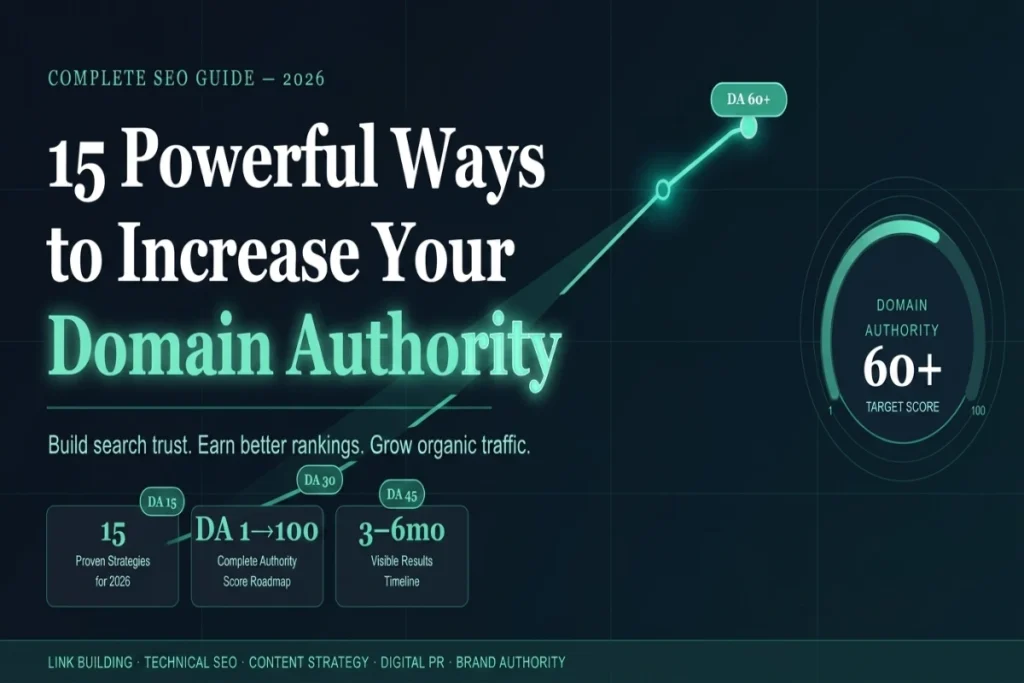
Domain Authority is a search engine ranking score developed by Moz that predicts how likely a website is to rank in search engine result pages (SERPs). Scores range from 1 to 100 — the higher the score, the greater the ranking potential. While Google doesn’t use DA as an official ranking factor, it is one of the most reliable indicators of a website’s overall SEO health and competitive standing.
Whether you’re running a blog, an e-commerce store, or a corporate website, understanding the ways to increase domain authority is essential to growing your organic traffic in 2026.
Domain Authority is only one component of a successful SEO campaign. If you’re building a complete ranking system, start with our Complete SEO Strategy 2026 guide, which covers keyword research, content optimization, technical SEO, and authority building in a single framework.
In this guide, we’ll walk you through 15 powerful, proven strategies that will help you build a stronger, more authoritative website.
What Is Domain Authority and Why Does It Matter?
Search visibility is changing rapidly as AI-powered search engines become more sophisticated. Understanding how authority signals are evaluated in modern search ecosystems is critical. Learn more in How AI Search Engines Work in 2026.
Before deploying tactical strategies, you must grasp exactly what this metric evaluates. Moz calculates this comparative score by analyzing a multitude of factors, focusing heavily on your total number of linking root domains, the exceptional quality of those inbound links, and the structural health of your overall backlink profile. Because it is a comparative metric, your score delivers the most value when stacked directly against your immediate niche competitors.
Understanding these benchmarks helps clarify your growth trajectory:
DA 20–30: Standard baseline for freshly launched websites.
DA 40–50: Average authority across most established online spaces.
DA 50–60: A solid, highly competitive position in most industries.
DA 60+: Excellent authority tier, showing dominant ranking power.
Industry giants like Wikipedia, Forbes, and the BBC consistently hit the 90s because of their massive, historic link profiles.
Why should you actively try to increase domain authority? The reason is simple: websites that successfully increase domain authority experience significantly less friction when trying to rank for highly competitive, high-volume keywords. By choosing to systematically increase domain authority, you effectively signal to search engines that your platform is a trusted, reputable source of information. This trust directly translates into sustainable organic traffic growth, faster indexing speeds, and a stronger competitive edge in search results. For a deeper look at how search architectures establish trust, you can read Google’s Search Quality Rater Guidelines regarding experience and authority.
Let’s dive straight into the actionable strategies.
1. Earn High-Authority Backlinks on a Consistent Basis
Inbound links remain the foundational pillar if you want to increase domain authority safely and effectively. However, the quality of your link profile matters far more than sheer volume. Securing a single, contextually relevant link from an industry-leading publication carries significantly more ranking power than acquiring hundreds of spammy links from low-quality web directories.
To successfully increase domain authority, you should center your digital outreach on earning high-editorial links from respected industry blogs, niche publications, and reputable media networks. You can secure these premium links by:
Pitching highly informative guest articles to authoritative websites.
Contributing data-driven expert insights to journalists through platforms like Connectively (formerly HARO).
Cultivating genuine, long-term professional relationships with influential content creators in your specific niche.
When aiming to increase domain authority, steady and methodical execution is everything. Search engine algorithms favor a natural, continuous link velocity over sudden, artificial spikes in link acquisition, making sustainable momentum your ultimate goal.
For a deeper breakdown of modern link acquisition methods, outreach systems, and editorial backlink strategies, see our upcoming Link Building Strategies for 2026 guide.
2. Produce Original, Link-Worthy Asset Pieces
Premium content remains the most reliable engine to attract editorial backlinks completely on autopilot. If your articles are superficial or generic, your site will struggle to earn organic referrals. Instead, you must aggressively invest your resources into developing assets that other publishers feel compelled to reference and share with their own audiences.
If your goal is to increase domain authority, you should focus on creating specific, high-value asset types that naturally command links:
Proprietary Research: Launch industry-specific surveys and compile the data into trend reports.
Definitive Guides: Publish comprehensive, long-form educational pillars that exhaustively cover a complex topic. A strong example is our Complete SEO Strategy 2026 pillar page, which demonstrates how comprehensive resources can naturally attract backlinks and authority signals over time.
Interactive Toolkits: Build free digital tools, templates, or customized calculators that solve immediate user problems.
Real-World Case Studies: Share transparent, data-backed success stories highlighting unique methodologies and metrics.
When you consistently put forward insights that are genuinely practical and difficult to source elsewhere, reporters, digital creators, and academic researchers will naturally cite your pages. This organic link acquisition allows you to increase domain authority passively, minimizing the need for exhausting cold outreach campaigns. For a closer look at creating comprehensive informational hubs that search engines trust, study the Search Engine Journal guide on Pillar Content to optimize your content framework.
3. Leverage the Skyscraper Technique for Premium Reach
Originally popularized by Backlinko, the Skyscraper Technique follows a proven three-step blueprint: identify a piece of content in your industry vertical that has already amassed a significant volume of inbound links, develop a dramatically superior version of that same asset, and run a targeted outreach campaign to every publisher who linked to the original file to present your superior resource.
This strategy remains incredibly effective because you are pitching exclusively to webmasters who have already proven they are willing to link to material on that specific topic. By providing them with a clearly superior resource, you vastly improve your conversion rates and successfully increase domain authority. In today’s digital ecosystem, making an asset “better” means ensuring it is thoroughly updated, includes proprietary data, features custom infographics, and offers clear, actionable takeaways.
4. Optimize and Strengthen Your Internal Link Infrastructure
Many digital marketers completely overlook the power of internal links when trying to increase domain authority, which is a massive strategic misstep. A masterfully planned internal linking matrix distributes valuable page authority (frequently called “link juice”) evenly across your entire domain, enabling search crawlers to discover, index, and contextualize your content with ease.
To ensure your layout helps increase domain authority, conduct an internal audit and enforce these structural rules:
The 3-Click Rule: Verify that every primary landing page or pillar piece sits no more than two or three clicks away from the homepage.
Contextual Anchor Text: Ditch generic “click here” text in favor of descriptive, keyword-rich phrases that clarify the destination page’s topic.
Equity Distribution: Purposely add links from your highest-traffic, top-performing pages to newer content blocks that require a ranking boost.
Shifting to a flat site architecture, where your most important resource pages live close to the root domain, significantly improves crawl efficiency and helps increase domain authority across your entire site.
5. Execute Regular Backlink Audits and Disavow Toxic Referrals
It is a common misconception that all incoming hyperlinks are beneficial. In reality, low-quality, spam-heavy, or entirely irrelevant incoming links from automated link farms, paid networks, or heavily penalized domains can actively destroy your search presence. If you do not actively manage these risks, keeping your profile clean makes it impossible to increase domain authority.
Utilize industry-standard platforms like Moz Link Explorer, Ahrefs, or Semrush to review your link profile at least once a quarter. Isolate suspicious, unnatural footprints, compile them into a text file, and submit them directly via the Google Search Console Disavow Tool to protect your site. Keeping your incoming links pristine is just as critical to your strategy as acquiring fresh, high-quality editorial placements.
6. Execute an Advanced On-Page SEO Blueprint
Page-level optimization is inextricably linked to your overall site metrics. When you optimize every page thoroughly, you send unmistakable signals to search crawlers that your platform is a credible, meticulously organized resource.
To ensure your on-page framework helps increase domain authority, you must implement these foundational practices across your entire site:
Meta Descriptions and Title Tags: Write completely unique, click-optimized titles and snippets for every post, including your target keywords near the beginning.
Semantic Heading Hierarchies: Use H1, H2, and H3 elements sequentially to map out a clear, readable content structure.
Natural Keyword Integration: Drop your focus keyword organically into the top 100 words of your body text and within at least one core subheader. If you’re struggling to identify high-value search terms, read How to Do Keyword Research With AI in 2026, where we explain how to uncover ranking opportunities using modern AI-assisted workflows. You can also explore our roundup of Top 10 Free Keyword Research Tools to find keyword opportunities, analyze search intent, and build content clusters more efficiently.
Media Optimization: Compress images to minimize load times, use readable URL slugs, and use descriptive alt text to ensure your visual assets are fully indexable.
7. Build a Flawless Technical SEO Architecture
A highly stable website commands immense trust from search engine crawlers, and this credibility directly impacts your ranking potential. Search engines penalize slow, poorly configured websites. Therefore, solidifying your technical health is one of the most effective structural ways to increase domain authority.
You can build a rock-solid technical framework by installing an SSL certificate to enforce secure HTTPS protocols, resolving duplicate content or cannibalization issues, and uploading an updated XML sitemap directly into Google Search Console. Additionally, using structured data, or schema markup, helps search engines interpret your content accurately. Think of technical SEO as the bedrock upon which your entire optimization strategy is built.
8. Maximize Your Core Web Vitals Performance
User experience signals continue to dictate search engine visibility. Core Web Vitals directly evaluate real-world user engagement through three primary metrics: Largest Contentful Paint (LCP), Cumulative Layout Shift (CLS), and Interaction to Next Paint (INP). Speeding up your site performance is an indirect yet powerful tactic to increase domain authority over time.
To maximize these performance metrics, implement a high-speed Content Delivery Network (CDN), eliminate render-blocking scripts, and use lazy loading for elements below the fold. You can use diagnostic tools like Google PageSpeed Insights to uncover exactly where your code needs optimization. Choosing a premium, high-performance hosting provider is equally vital for maintaining stable server response times during traffic spikes.
9. Diversify Your Referring Domain Profile
When looking at link metrics, the diversity of your inbound root domains matters far more than the raw number of hyperlinks pointing to your pages. Securing 500 individual links from just 10 domains offers very little ranking power compared to earning 500 links from 200 entirely unique, high-quality websites.
If you want to increase domain authority effectively, you must diversify your link acquisition avenues. You can build a varied backlink profile by:
Securing interviews and speaking slots on authoritative industry podcasts.
Actively participating in specialized, high-moderation professional forums.
Formulating strategic content collaborations with non-competing businesses in adjacent niches.
Getting listed in hand-curated, highly respected industry directories.
A varied backlink profile signals natural, earned authority, which makes your search rankings much more resilient against algorithm changes.
10. Deploy Digital PR to Secure Premium Media Placements
Digital PR remains a premier strategy to increase domain authority quickly and safely. By positioning your brand as a leading authority, you can earn editorial links from mainstream news outlets, global business publications, and top-tier trade blogs—the exact types of links that drastically move your visibility needle.
Digital PR, topical authority, and entity-based optimization are now core parts of the Best SEO Strategy for the AI Era, where search engines increasingly evaluate brand credibility beyond traditional ranking factors.
To run a successful digital PR campaign, you should launch data-driven research studies, pitch expert commentary on breaking industry news, distribute compelling press releases, and collaborate directly with investigative journalists. A single contextually relevant feature on a high-DA media outlet provides a level of search equity that hundreds of low-tier, run-of-the-mill blog links simply cannot replicate.
11. Cultivate a Dynamic Social Media Footprint
Although standard social media links utilize “nofollow” tags and do not directly distribute page equity, a vibrant social presence drastically broadens your content’s reach. This increased visibility introduces your brand to a much wider audience, which inherently boosts the likelihood that other webmasters will eventually link back to your resource pages.
To maximize this ripple effect, regularly distribute your premier asset pieces across the specific social channels where your target market actively congregates. Engage authentically with fellow content creators, actively participate in industry groups, and integrate prominent social sharing buttons directly into your blog layout. Over time, these social touchpoints accelerate your brand awareness, and a highly visible business profile naturally makes it much easier to increase domain authority through organic recognition.
12. Expand and Monitor Your Brand Mentions
Modern search algorithms have grown incredibly sophisticated at analyzing brand prominence, even in the complete absence of a traditional HTML hyperlink. These unlinked brand citations—instances where a publication references your exact business name without actively linking to your URL—are heavily factored into search engine trust calculations.
You can stimulate these valuable citations by consistently publishing cutting-edge thought leadership material, speaking at virtual industry summits, and building strong relationships with key figures in your vertical. Furthermore, you can proactively track these references using monitoring tools. Reaching out to editors who already mention your business and politely asking them to convert that text into a clickable link is a highly effective way to increase domain authority with minimal friction.
13. Systematically Refresh Outdated Content Assets
While launching fresh articles remains an important task, upgrading your legacy content is an equally potent strategy. Outdated resources naturally drop in search rankings and eventually stop attracting editorial references entirely. By systematically updating your older pages with fresh data points, modern structural formatting, and current insights, you instantly restore their organic performance.
Commit to a formal content audit twice a year to isolate pages experiencing a dip in impressions or organic positioning. Replace expired statistics, integrate comprehensive new subheadings, improve readability scores, and optimize the copy for emerging semantic search queries. Maintaining a fresh informational database builds immense trust with users and search crawlers alike, creating an optimal environment to increase domain authority naturally.
14. Optimize Core Page Velocity and Mobile Responsiveness
A fast, fully responsive mobile interface keeps users engaged longer, suppresses bounce rates, and sends strong usability signals to search systems. Because mobile devices drive the vast majority of global web traffic, maintaining an immaculate mobile configuration is mandatory under modern mobile-first indexing frameworks.
Regularly evaluate your site speed across varying network connections using performance diagnostics like GTmetrix. To ensure your performance levels help increase domain authority, configure comprehensive browser caching, compress your code script files, utilize modern image formats, and invest in high-performance cloud hosting. Shaving even a fraction of a second off your load speeds can drastically improve your user retention metrics and search visibility.
15. Maintain a Dedicated, Long-Term Strategic Mindset
The single most vital reality to accept regarding this metric is that it cannot be artificially forced upward overnight. It functions as a trailing indicator that rewards methodical, high-quality development over extended periods. Platforms that publish exceptional content predictably, acquire links responsibly, and maintain flawless technical health will consistently outpace competitors chasing short-lived algorithmic loopholes.
Establish realistic growth expectations from the start; visible shifts in your core metrics typically require three to six months of continuous optimization to materialize. Monitor your competitive landscape using platforms like Moz or Semrush, and channel your energy into mastering the essential inputs—impeccable content architecture, premium editorial link building, and clean code—rather than worrying about daily score fluctuations. Committing to this operational standard is the only definitive way to increase domain authority permanently.
Critical Pitfalls That Can Destroy Your Search Authority
When attempting to optimize your website, knowing which toxic practices to avoid is just as critical as executing the correct strategies. Many digital marketers unintentionally stall their progress by falling into common traps that suppress their search signals.
To ensure your growth strategy remains effective, avoid these critical optimization mistakes:
Purchasing Manipulative Link Packages: Buying inbound links directly violates foundational search engine quality guidelines. This practice can trigger severe manual penalties that completely wipe out your search visibility overnight. Avoid automated link farms and private blog networks (PBNs).
Prioritizing Volume Over Link Integrity: Chasing sheer link quantity while ignoring origin authority is a failing strategy. Securing ten contextually relevant links from trusted industry hubs will outperform thousands of low-tier, automated spam links every single time.
Overlooking Core Technical Vulnerabilities: Unresolved crawl errors, broken internal paths, sluggish page speeds, and unsecure HTTP protocols will quietly undermine your site’s credibility. Schedule routine automated technical health checks to catch these issues early.
Publishing Identical or Duplicate Copy Blocks: Allowing identical content to exist across multiple live URLs puzzles search crawlers and dilutes your ranking equity. Implement strict self-referential canonical tags and ensure every published page provides distinct value.
Abandoning Strategic Efforts Too Early: Building site authority is a long-distance endurance race rather than a quick sprint. Countless operators abandon their campaigns right before the compounding interest of their optimization efforts kicks in.
What is the General Timeline for Organic Authority Growth?
“How long will it take to see a noticeable shift in my metrics?” is a standard question throughout the digital marketing landscape. The realistic answer relies heavily on your baseline performance metrics, the competitive density of your industry vertical, and the steady velocity of your ongoing optimization campaigns.
For a freshly indexed web property, moving from a baseline score up to a DA 20 typically requires six to twelve months of aggressive, uninterrupted development. Scaling from that point up to a DA 40 can easily demand an additional twelve to eighteen months of careful link curation. Stepping into the elite DA 50+ tier generally requires a multi-year commitment characterized by widespread brand mentions, digital PR coverage, and a highly diversified link portfolio.
The encouraging reality is that your operational inputs are completely cumulative. Every premium link you earn, every page layout you refine, and every database error you resolve permanently stacks in your favor. Initiating your optimization campaigns early ensures your growth compounding curve begins sooner.
Actionable Strategy Summary
To give you a clear roadmap of how these different optimization disciplines intersect to help you increase domain authority, review the structural hierarchy below:
| Optimization Layer | Core Focus Area | Primary Tactical Output |
| Technical Bedrock | Core Web Vitals & Clean Code | Eliminates crawl friction; ensures fast indexing speeds. |
| On-Page Architecture | Semantic Structure & Keyword Flow | Clarifies contextual relevance for targeted search terms. |
| Off-Page Outreach | Digital PR & Editorial Link Velocity | Accumulates trust equity to successfully increase domain authority |
Final Thoughts
Successfully optimizing a digital property to increase domain authority cannot be achieved through a solitary standalone tactic. Instead, it is the natural byproduct of executing a symphony of high-quality web practices predictably over time. The structural methodologies outlined across this guide operate as an interconnected ecosystem: premium content organically commands references, those references build site trust, elevated trust drives search rankings, and top rankings yield high-intent traffic that continuously reinforces your market credibility.
Begin your optimization journey by focusing heavily on foundational elements. Run an exhaustive technical diagnostic check, purge your link profile of suspicious spam footprints, and invest your resources into developing genuinely authoritative, data-backed content. Once your baseline is stable, layer on targeted outreach campaigns, creative digital PR plays, and multi-channel social amplification.
True search authority belongs exclusively to platforms that seamlessly merge deep niche expertise, ironclad user trust, and impeccable code execution. Focus your daily operations on building those three pillars, and your metrics will naturally follow. For an official breakdown of how modern systems evaluate layout compliance and domain-level safety signals, consult the Google Webmaster Guidelines on Search Essentials to keep your optimization roadmap perfectly aligned with industry compliance standards.
related posts